
In India, there are more than 4,510 government schemes available for citizens. Government schemes of India are initiatives launched by the Central and State Governments to support citizens across different social, economic, and occupational groups. They are designed to address key areas such as healthcare, education, employment, housing, agriculture, financial inclusion, and social security, ensuring that essential support reaches those who need it most.
(Source: As per Data from 2025 reports from (https://www.myscheme.gov.in/)
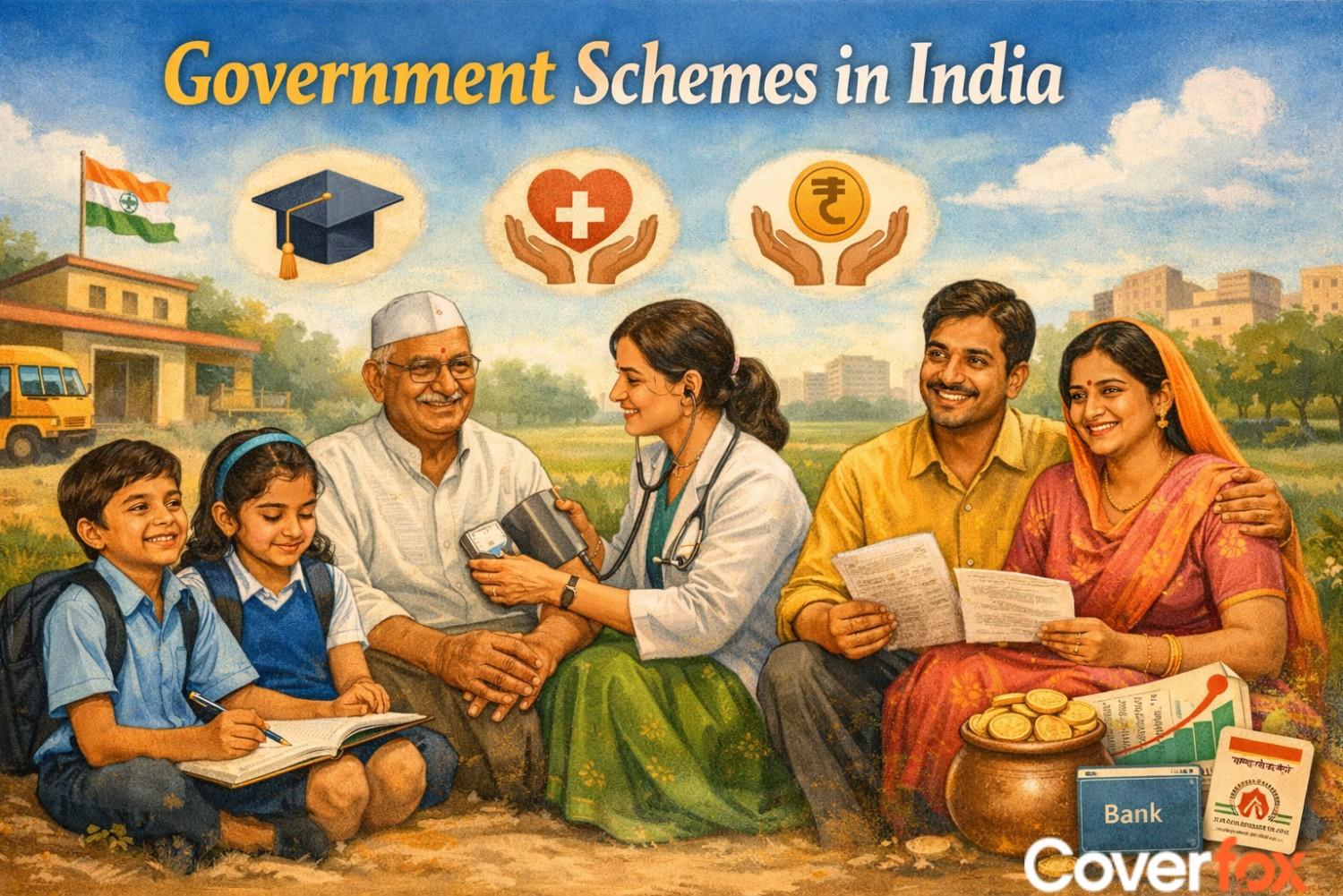
Government schemes are essential tools used by the government to improve the quality of life of citizens and ensure all-around growth. They provide structured support to individuals and communities who may otherwise lack access to basic services and financial security.
Schemes offer pensions, subsidies, and direct benefit transfers that help citizens manage daily expenses and cope with financial uncertainty.
Many schemes focus on healthcare, education, housing, and sanitation, making these services more affordable and accessible.
Targeted schemes help farmers, women, senior citizens, persons with disabilities, and low-income households meet their specific needs.
Government initiatives create job opportunities and provide skill training to enhance employability and income generation.
By addressing regional and socio-economic disparities, schemes promote balanced development across urban and rural areas.
Here is a list of government schemes in India:
| Scheme | Category | Ministry | Brief Description |
|---|---|---|---|
| Pradhan Mantri Gramin Awaas Yojana (PMAY-G) | Rural | Ministry of Rural Development | Provides financial assistance to eligible rural households for building permanent homes with basic amenities. |
| Pradhan Mantri Jeevan Jyoti Bima Yojana (PMJJBY) | Insurance | Ministry of Finance | Offers low-cost life insurance coverage to individuals in case of death due to any cause. |
| Pradhan Mantri Suraksha Bima Yojana (PMSBY) | Life / Insurance | Ministry of Finance | Provides affordable accident insurance covering death and permanent disability. |
| Pradhan Mantri Fasal Bima Yojana (PMFBY) | Crop | Ministry of Agriculture & Farmers Welfare | Protects farmers against financial loss due to crop failure caused by natural calamities. |
| Pradhan Mantri Matsya Sampada Yojana (PMMSY) | Rural | Ministry of Fisheries, Animal Husbandry & Dairying | Aims to strengthen the fisheries sector through infrastructure development and livelihood support. |
| Niramaya Health Insurance Scheme (NHIS) | Health | Ministry of Social Justice & Empowerment | Provides affordable health insurance coverage for persons with disabilities. |
| Mahatma Jyotirao Phule Jan Arogya Yojana (MJPJAY) | State/Health | Public Health & Family Welfare Dept. | Covers all Maharashtra state residents for secondary or tertiary healthcare. |
| Pradhan Mantri Mudra Yojana (PMMY) | Business / Loan | Ministry of Finance | Provides collateral-free loans up to ₹20 lakh to micro and small non-farm enterprises through banks, NBFCs, and MFIs to promote entrepreneurship and financial inclusion. |
| Mukhyamantri Ayushman Arogya Yojana (MAAY) | State / Health | Rajasthan State Health Assurance Agency (Government of Rajasthan) | Provides cashless health insurance coverage of up to ₹25 lakh per family for hospitalisation and treatment at empanelled government and private hospitals in Rajasthan, helping reduce out-of-pocket medical expenses. |
Government schemes in India are designed to address diverse needs across different sections of society and sectors of the economy. To make it easier for citizens to identify relevant benefits, these schemes are broadly grouped into categories based on their purpose, target beneficiaries, and implementing authority.
These schemes are introduced by the Union Government and are implemented across the country. They focus on nationwide priorities such as social welfare, financial inclusion, healthcare, infrastructure, and economic development, often with uniform guidelines for all states. There are currently 590+ central government schemes active in India.
State government schemes are introduced to address region-specific challenges and local development needs. These initiatives vary from state to state and are designed to support residents through state-funded welfare, subsidies, and development programmes. There are more than 3,920 state government schemes in India.
Social welfare schemes aim to support disadvantaged and vulnerable sections of society. They focus on providing financial assistance, social security, and basic living support to ensure dignity and well-being.
These schemes focus on improving access to healthcare services and reducing medical expenses for individuals and families. They often include coverage for hospitalisation, preventive care, and financial protection against health-related risks.
Education and skill development schemes are designed to promote learning, skill enhancement, and employability. They support students and working professionals through financial aid, training programmes, and capacity-building initiatives.
These schemes aim to provide safe and affordable housing while improving urban infrastructure. They focus on housing assistance, sanitation, basic amenities, and planned urban development.
Employment and income support schemes help create job opportunities and provide financial stability. They focus on livelihood generation, wage support, and economic self-reliance for individuals and families.
Agriculture-focused schemes are introduced to support farmers and improve agricultural productivity. They address issues such as income stability, crop security, access to resources, and rural development.
These schemes are aimed at improving the health, education, safety, and economic participation of women and children. They focus on empowerment, nutrition, and long-term social development.
Senior citizens' schemes provide financial security and social support to the elderly. They focus on regular income support, healthcare assistance, and improved quality of life during retirement.
Finding the right government scheme and applying for it has become easier with the availability of official digital platforms and scheme-specific portals.
How to Find Suitable Government Schemes
Visit the MyScheme portal at myscheme.gov.in.
Use the search or eligibility-based filters such as age, gender, state, occupation, income level, or category.
Review the list of schemes shown based on the details entered.
Click on a scheme to check its objective, benefits, eligibility criteria, and application mode.
Shortlist the schemes that match your profile and requirements.
Government schemes are initiatives launched by the Central or State Governments to provide financial, social, and developmental support to citizens in areas such as healthcare, education, employment, housing, and welfare.
You can find eligible schemes by using official platforms like MyScheme, where you can filter schemes based on age, income, occupation, state, and category to discover benefits you qualify for.
Not all schemes are universal. Most government schemes have specific eligibility criteria based on income, age, occupation, gender, location, or social category.
Central government schemes are applicable across India, while state government schemes are designed for residents of specific states and address region-specific needs..
Yes, you can apply for multiple schemes as long as you meet the eligibility criteria for each and the schemes do not explicitly restrict overlapping benefits.
Aadhaar is commonly required for identity verification and direct benefit transfers, but requirements vary by scheme. Some schemes may accept alternative identity documents.
Applications should always be submitted through the official website or authorised portal of the respective scheme to avoid fraud or rejection.
Processing time varies depending on the scheme, verification process, and government authority involved. Some benefits are released within weeks, while others may take longer.
Most schemes require basic documents such as identity proof, address proof, income certificate, bank details, and scheme-specific documents.
Application status can usually be tracked through the official scheme portal using an acknowledgement number, registered mobile number, or application ID

