
- Retail Insurance
- Business Insurance
- Resources
- Claims


a
A car is not only a means of transportation; it is a vital aspect of daily living. Long drives, family arrangements, and commuting. This is why car insurance is a top priority, not only due to legal requirements but also as a thoughtful financial decision.
A comprehensive car insurance plan provides coverage for own damage, as well as liabilities towards a third party, making sure that the car owner has full security from any risk that may be encountered while driving. Coverage under the policy protects the insured from accidents, theft, natural disasters, and man-made disasters. You can compare various insurers that provide comprehensive car insurance plans in one place at Coverfox.
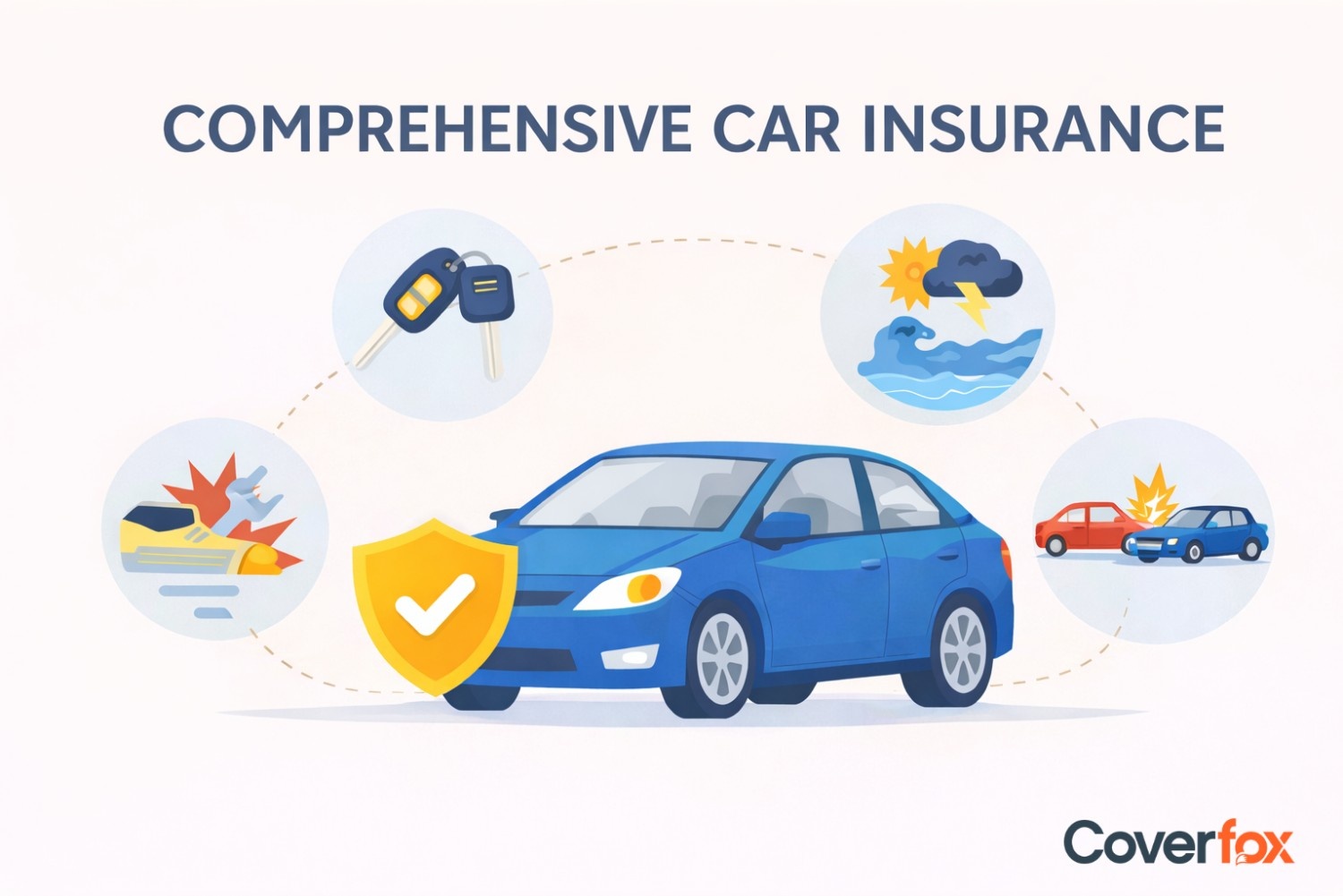
A comprehensive car insurance, as the name suggests, is a motor insurance policy designed to offer comprehensive protection for car owners against financial losses for their own vehicle as well as third-party liabilities. Insurance companies offer compensatory relief, such as vehicle repair or part replacement (depending on the total or partial damage of the vehicle).
Unlike a third-party insurance that covers only damages to others, or own-damage insurance that covers only your vehicle—comprehensive insurance stands out as covering both types of damages, protecting you against a wide range of unforeseen risks, including accidents, theft, fire, natural disasters, and vandalism.

Accidental Damage: Repairs or replacement costs arising from collisions or road accidents.
Fire-related Loss: Damage due to fire, explosions, or self-ignition incidents.
Vehicle Theft: Compensation if the insured car is stolen and not recovered.
Natural Calamities: Losses caused by floods, earthquakes, cyclones, or storms.
Third-party liabilities: legal responsibilities for bodily injury, wrongful death, or property damage caused to another person by you.
Manmade Risks: Damage caused by riots, strikes, or other violent acts.
Vandalism: Protecting against intentional damage to your vehicle.
Transit-related Damage: Protection while your car is being transported via road, rail or water.
Personal Accident Coverage: Compensation for injury or death to the owner/driver.
Intoxicated driving: Claims incurred as a result of a driver being under the influence.
Depreciation: The decrease in value for parts unless an add-on is provided.
Negligence: Damage caused by the insured through their own negligence.
Mechanical/Electrical Failure: There will be no covered breakdowns unless there is an accident involved.
Driving Without a Licence: Claims when the driver lacks a valid driving licence.
Wear and Tear: Damage that occurs from regular use.
Tyre or Tube Damage (Non-accidental): Standalone tyre issues without an accident.
War or Nuclear Events: Losses due to war, invasion, or nuclear hazards.
Consequential Losses: Indirect damages resulting from an initial incident.
Disclaimer: The information provided is meant for general information and should not be considered as a substitute for the actual policy terms. It is suggested to verify with the insurer before buying a policy.
Comprehensive car insurance can be customised to suit your specific needs through the use of add-ons. Common riders include the following:
Ensures that you receive your full claim without depreciating various parts of your car. This is particularly advantageous in the case of new cars because it saves money in case of repairs. This cover provides protection to various parts of your car, such as plastic, rubber, and metal parts.
Protects in case your tyres and tubes suffer damage due to cuts, bulges, or punctures. If your vehicle frequently traverses rough roads, this cover proves especially beneficial.
Ensures that you receive compensation for the original invoice price of your car, including registration charges and road tax, in case your vehicle is stolen or completely damaged.
The roadside assistance cover offers 24/7 support in case of breakdowns or accidents. The support includes towing, jump-starting, repairing flat tyres, fuel delivery, and locksmith services.
The consumables cover includes the cost of engine oil, lubricants, nuts, bolts, screws, and coolants used during repair. Generally, these costs are not covered in standard policies.
The engine protection cover provides protection for the engine in the event of damage due to water seepage, oil leakage, or hydrostatic lock. The cover is also beneficial for areas prone to flooding or high rainfall.
This cover provides the cost for replacing car keys or locks in the event of theft or loss. The cover may also include the cost for repairing or replacing the lock system.
Here is a look at the key benefits offered upon owning a Comprehensive Car Insurance:
In case there are damages sustained by your own car on account of accident, theft or other disaster, this policy offers protection against damage to your vehicle.
Damages caused to third parties by your insured car, be it injury, death or property damages, are effectively covered under this policy.
A natural calamity may strike at any time. This is why comprehensive car insurance offers protection against not just natural but also man—made calamities, including events such as floods, earthquakes, theft, riots, and vandalism.
A comprehensive insurance policy allows you to select multiple add-on covers that help enhance the value of your policy, impacting your coverage level, at the cost of slightly higher premiums.
Upon purchasing a comprehensive car insurance policy, you are provided with the No-Claim Bonus (NCB) benefit. Simply, this benefit allows you to get a discount on the premium during your policy renewal for every claim-free year.
At the time of claim settlement, this policy allows you to visit any authorised garage listed under your insurer's network of cashless garages and get your car repaired. The insurer will directly settle the amount with the garage, without you having to cover any expenses.
| Car Type | Typical Premium Impact | Reason for Variation |
|---|---|---|
| Hatchback | Lower premium | Lower Insured Declared Value (IDV) and repair costs |
| Sedan | Moderate premium | Higher value than hatchbacks with moderate repair costs |
| SUV | Higher premium | Higher IDV, larger engine capacity, and increased repair costs |
| Luxury Cars | Highest premium | Expensive parts, high repair and replacement costs |
| Fuel Type | Premium Impact | Reason for Variation |
|---|---|---|
| Petrol | Moderate premium | Standard repair and maintenance costs |
| Diesel | Slightly higher premium | Higher engine repair costs and vehicle value |
| CNG/LPG | Moderate to higher premium | Additional kit installation increases IDV |
| Electric Vehicles | Variable premium | Higher battery replacement cost, but lower mechanical risk |
Let us check out the key differences between the policies to see what each has to offer:
| Feature | Comprehensive Car Insurance | Third-Party Car Insurance |
|---|---|---|
| Coverage Scope | Own damage + third-party liability | Only third-party liability |
| Legal Requirement | Optional but recommended | Mandatory under the Motor Vehicles Act |
| Protection Level | Broad and inclusive | Limited |
| Add-ons Available | Yes | No |
| Premium Cost | Higher due to wider cover | Lower |
Although comprehensive coverage is relevant for older vehicles, there are a number of different factors involved:
As time passes and the car depreciates, its resale value becomes lower, thus making the IDV lower as well. Premiums for comprehensive coverage are mostly determined based on the IDV of a vehicle; hence, lower premiums are for older cars.
Most insurance providers offer zero depreciation and other add-on covers to cars up to 5 years old. Once the car surpasses this age limit, you may not be able to obtain some additional benefits.
High risk of flooding, theft, or traffic accidents leads to high premiums for older cars used regularly. Comprehensive insurance still offers valuable protection against accidents, theft, floods, and third-party liabilities, making it a sensible financial safeguard.
Premiums for comprehensive policies are determined using a combination of variables:
Insured Declared Value (IDV) of the vehicle
Vehicle make, model, and registration location
No Claim Bonus (NCB) history
Selected add-ons
Driver profile and claim record
Visit the Coverfox website.
Click on the “Insurance > Car Insurance” Tab.
Enter Vehicle number or click on “Bought a new car? Click Here”.
Enter your car details (such as Make, Model, RTO, etc.).
Compare different plans shown on the page and select the add-ons that will help you cover additional damages, and choose the best fit.
Upload the necessary documents.
Make the payment through the secure payment gateway.
Gain access to your police instantly.
Enter Car Details: Add details like the Car registration number and other basic details.
Compare & Select the Right Plan: Go through the shortlisted plans, compare their premiums and benefits. Then, go ahead and select the best plan.
Add Additional Covers: Enhance the protection of the policy by attaching add-ons like Zero Depreciation, Engine Protection, etc.
Make Online Payments: Pay premium online through a secure gateway from your credit/debit card, internet banking, wallet, etc
Need a comprehensive insurance plan that is worth your money? Coverfox is your ideal go-to online platform to select the best comprehensive car insurance plan that is tailor-made for you. In just a few simple clicks, you are provided with policy options from top insurers—allowing you access to instant quotes while evaluating key aspects like premiums, coverage, add-ons, and claim settlement ratios offered by each. What's more? You can also view a list of network garages offered by each insurer.
Now, all you have to do is sit back and compare the plans to select the best one suited for you, based on your needs and budget, while Coverfox takes care of the rest, allowing you instant coverage and hassle-free documentation.
Here’s why you should go ahead and consider Coverfox as your reliable Insurance platform:
In case your vehicle is involved in an accident or stolen/damaged, you will be required to file a claim with your insurer. The process for registering a claim is made even simpler with the help of Coverfox.


To file a successful car insurance claim, you will require the following documents:
Support: Get in touch with Coverfox for more guided assistance with a few contact details to help ease your queries.
Contact us here:
Phone number: 022 4897 1018
Email:help@coverfox.com
Comprehensive car insurance offers protection from all angles, including covering own damage, third-party liabilities and damage arising due to natural calamities. It also offers personal accident cover to safeguard the driver from injury, disability or death arising from an accident.
No, comprehensive insurance is not mandatory. However, it is highly recommended due to its extensive coverage benefits.
The premium for comprehensive car insurance is calculated based on factors such as the make and model of the car, geographical location and add-on covers incorporated.
Yes, add-on covers like zero depreciation can be added to your policy. This helps the insurer pay the full reimbursement during claims, without considering the depreciated value of the car.
In case policy renewal is delayed and policy lapses, the following occurs:
Yes, comprehensive car insurance is worth it, as it provides all-around protection against accidents, theft, natural disasters, and third-party liabilities, making it ideal for car owners in high-risk areas.
You can reduce premiums by:
Engine damage is covered only if you opt for an engine protection add-on; otherwise, it is excluded.
Yes, you can upgrade to a comprehensive policy at the time of renewal or by purchasing a new policy.
Yes, but availability depends on the insurer and vehicle age. Older cars may have limited coverage options.
Yes, you can buy or renew comprehensive car insurance online instantly by comparing plans, selecting add-ons, and making a payment digitally.