
Pradhan Mantri Matsya Sampada Yojana (PMMSY), launched in 2020 by the Ministry of Fisheries, Animal Husbandry, and Dairying, is a programme aimed at modernising and strengthening India’s fisheries sector. It focuses on boosting fish productivity, reducing post-harvest losses, and improving cold-chain and market infrastructure. The PMMSY Scheme aims to achieve the Blue Revolution in India.
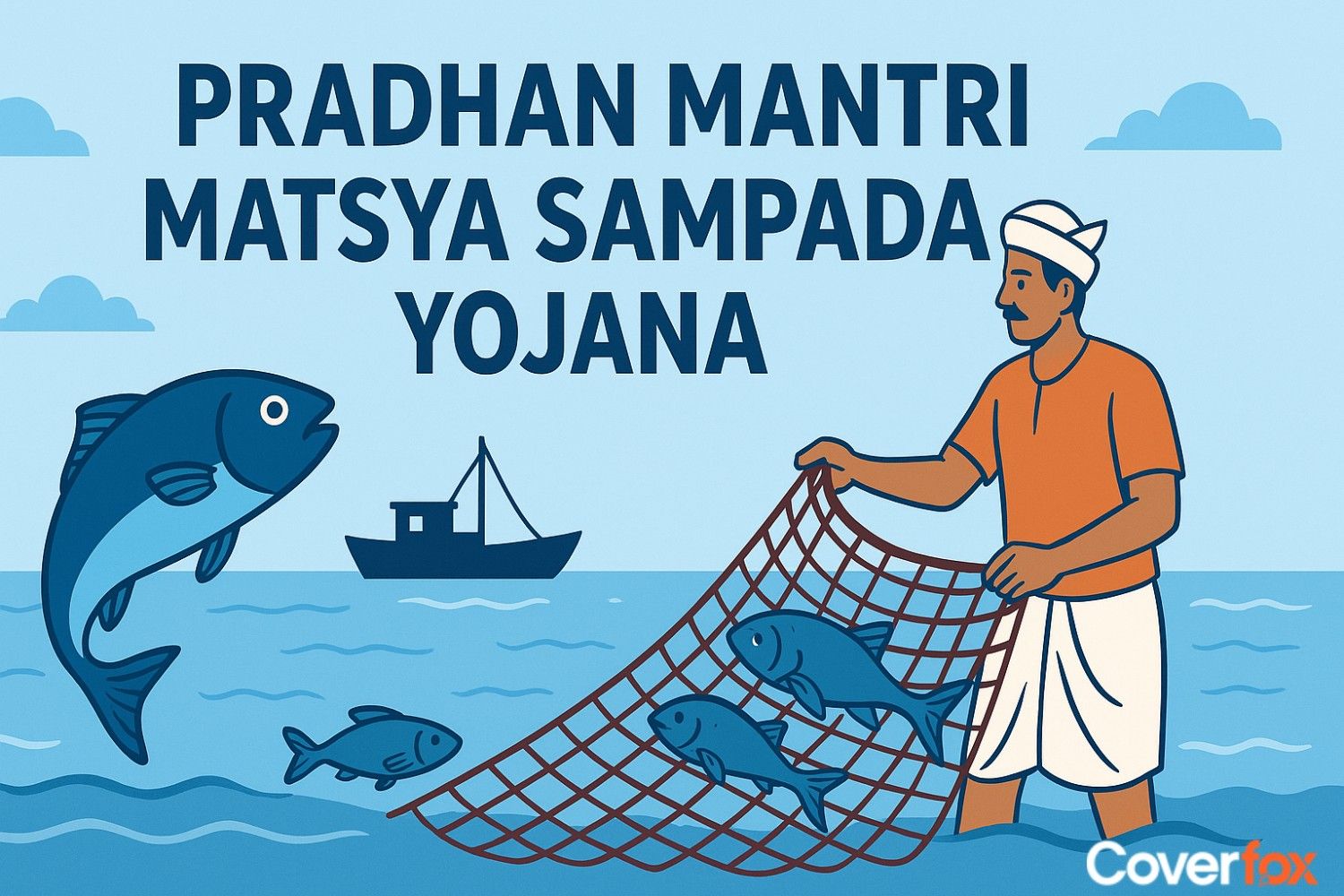
Pradhan Mantri Matsya Sampada Yojana (PMMSY) is a national programme launched in 2020 to give India’s fisheries sector a much-needed modern push. It works on fixing age-old problems in fish production, better farming practices, cold storage, or access to markets, so that the entire value chain works smoothly. At its core, the scheme is about helping fishers and fish farmers earn more, reduce losses, and build a more secure and sustainable livelihood.
To guide the fisheries sector toward long-term growth and resilience, the Pradhan Mantri Matsya Sampada Yojana lays out a clear set of goals that focus on both development and the well-being of fishing communities.
The Pradhan Mantri Matsya Sampada Yojana is designed to support a wide range of beneficiaries involved directly or indirectly in the fisheries value chain.
Fishers, fish farmers, fish workers, and fish vendors, including SCs, STs, women, and differently abled persons.
Fisheries-based groups and organisations such as SHGs, JLGs, cooperatives, federations, and Fish Farmer Producer Organisations/Companies (FFPOs/Cs).
Entrepreneurs, private firms, and fisheries development corporations engaged in aquaculture, processing, infrastructure, or allied activities.
State/UT Governments and their entities, including State Fisheries Development Boards (SFDB), as well as Central Government agencies involved in the fisheries sector development.
The programme outlines specific milestones aimed at strengthening fish production, improving economic outcomes, and uplifting the livelihoods of India’s fishing communities.
Scale up national fish production to 22 million metric tons by 2024–25, rising from 13.75 million metric tons in 2018–19.
Lift aquaculture productivity to 5 tons per hectare, compared to the present average of 3 tons.
Encourage higher domestic consumption by increasing per capita fish intake from 5 kg to 12 kg.
Raise the fisheries sector’s share in Agricultural GVA to around 9%, up from 7.28% in 2018–19.
Boost export revenues to ₹1,00,000 crore by 2024–25, nearly doubling the 2018–19 figure of ₹46,589 crore.
Promote greater private-sector participation and entrepreneurial activity across the fisheries value chain.
Cut post-harvest losses significantly—bringing them down from 20–25% to nearly 10%.
Create 55 lakh jobs, both direct and indirect, across fisheries and allied activities.
Work towards doubling the earnings of fishers and fish farmers.
During 2013-2014, India’s total fish production was 90 lakh tonnes, which called for the need for government help to increase this number, considering India’s ability (Source - Farmer’s Welfare). Here’s why the PMMSY scheme is needed:
India’s fisheries sector has enormous untapped potential, but inconsistent productivity and outdated practices were limiting growth.
Many fishers depended on traditional methods with low returns, making their livelihoods vulnerable and seasonal.
Market linkages were weak, with fishers unable to access better prices due to poor infrastructure and fragmented supply chains.
Aquaculture needed scientific, sustainable practices to prevent overfishing, protect ecosystems, and ensure long-term productivity.
India’s export capacity was strong but under-leveraged, requiring value addition, certification, and global-standard processing units.
A coordinated national framework was essential to unify policies, strengthen management, and bring accountability across the sector.
The success of Pradhan Mantri Matsya Sampada Yojana can be seen over the years since its establishment:
Between 2013-14 and 2024-25, India’s total fish production has more than doubled, rising from 96 lakh tonnes to 195 lakh tonnes
Within that period, inland fisheries and aquaculture surged by about 142%, showing major growth in non-marine fish production.
In FY 2022-23, India recorded a fish production of 175.45 lakh tonnes, making it one of the top fish-producing nations globally.
The fisheries sector now supports the livelihoods of over 28–30 million people, many from vulnerable and marginalised communities.
Seafood exports have grown significantly: by FY 2023-24, export values have more than doubled compared to a decade ago — reflecting the export potential of a well-managed fisheries value chain.
(Source - Ministry of Fisheries, Animal Husbandry & Dairying)
PMMSY is implemented through a mix of Central Sector (CS) and Centrally Sponsored Scheme (CSS) components, where CS activities are fully funded by the Government of India, while CSS activities are shared between the Centre and States. Under CSS, funding varies by region — with higher Central assistance for Northeastern and Himalayan states, and standard cost-sharing with other states and UTs.
The scheme is carried out through a coordinated system of national, state, and local institutions to ensure smooth implementation across the country.
Provides overall policy guidance, approves projects, and oversees national-level monitoring.
Offers technical expertise, facilitates projects, and implements select central-sector components.
Plan, execute, and supervise state-level and centrally sponsored activities.
Develop infrastructure, manage projects, and support sectoral growth within states.
Handle grassroots implementation, mobilise beneficiaries, and support community-based initiatives.
To apply for PMMSY, follow these steps:
Check whether you qualify (fisher, fish farmer, SHG, cooperative, entrepreneur, etc.) and identify the PMMSY component you want support for—such as pond construction, cage culture, hatcheries, equipment, or processing units.
Contact or visit your local Fisheries Office to understand guidelines, subsidy details, required documents, and to get the official application form or online portal link (varies by state).
Create a simple project report with details of your plan, cost estimates, expected production, and funding pattern (your contribution, loan amount if any, and PMMSY subsidy).
Collect ID proof, bank details, land/lease papers, quotations, photographs, and other documents requested by your State Fisheries Department.
Submit your form and project proposal either in person at the District Fisheries Office or through the state’s online fisheries application portal (if available).
Your application is reviewed by the department. For credit-linked projects, the bank will also evaluate the proposal before giving approval.
After approval, carry out the project as planned—constructing ponds, installing units, or purchasing equipment.
Once the project is verified and completed, the eligible subsidy is released directly to your bank account or through the bank for loan-linked projects.
Source - https://dof.gov.in/sites/default/files/2022-11/Farmer_FAQ.pdf
Beneficiaries must submit their Self-Contained Proposal or Detailed Project Report (DPR) to the District Fisheries Officer of their home district, or the district in the State/UT where they plan to carry out the fisheries activity. Applications are evaluated at the district and state level as per PMMSY operational guidelines.
Project proposals under the Central Sector component must be submitted directly to the Department of Fisheries, Government of India, at the official address provided in the PMMSY guidelines.
Address:
The Secretary
Department of Fisheries
Ministry of Fisheries, Animal Husbandry, and Dairying
Government of India
Room No-221, Krishi Bhawan
New Delhi - 110 001
email: secy-fisheries@gov.in
Here are the documents required for the PMMSY Application:
Aadhaar Card
PAN Card
Bank Account Details
Business Registration Certificate (if applicable)
Project Report/Detailed Proposal
Land-related Documents: Ownership papers, lease agreement, or NOC from the landowner (where land use is involved)
Partnership Deed or Memorandum of Association (MOA) for registered entities or groups
Note: The document requirements may differ depending on the project type and the scheme component. Applicants should confirm the exact list with their District Fisheries Office or refer to the official PMMSY guidelines before submitting their application.
PMMSY is a central scheme aimed at modernising India’s fisheries sector, improving productivity, strengthening infrastructure, and enhancing the livelihoods of fishers and fish farmers.
PMMSY is implemented for five years, from 2020–21 to 2024–25.
Yes, the scheme offers subsidies, credit-linked assistance, and infrastructure support based on beneficiary category and project type.
It provides better boats, gear, safety measures, training, subsidies, and improved market access—helping fishermen increase earnings and reduce risks.
EIAs include State/UT Fisheries Departments, District Fisheries Offices, Fisheries Cooperatives, FFPOs, SHGs, and other approved local bodies involved in project execution.
Fishers, fish farmers, fish vendors, cooperatives, fisheries enterprises, and allied businesses benefit through financial support, training, and infrastructure upgrades.
Eligible beneficiaries include fishers, fish farmers, fish workers, vendors, SHGs, JLGs, cooperatives, FFPOs, private firms, and State/UT bodies.
Yes. PMMSY integrates multiple fisheries development activities under both Central Sector and Centrally Sponsored components.
Applicants must submit a project proposal and documents to their District Fisheries Office or the state’s online fisheries portal. CS projects are submitted directly to the Department of Fisheries, GoI.
The scheme aims to build a sustainable, modern, and globally competitive fisheries sector that boosts production, strengthens value chains, and improves the socio-economic well-being of fishing communities.

