
A driver's licence is a legal document that authorises a person to drive a motor vehicle on Indian roads. Understanding the different types of driving licence will help applicants choose the appropriate permit based on the vehicle type, intended use, and their level of experience. The system of licensing in India is controlled by the Ministry of Road Transport and Highways (MoRTH) and assisted by the state Regional Transport Offices (RTOs).
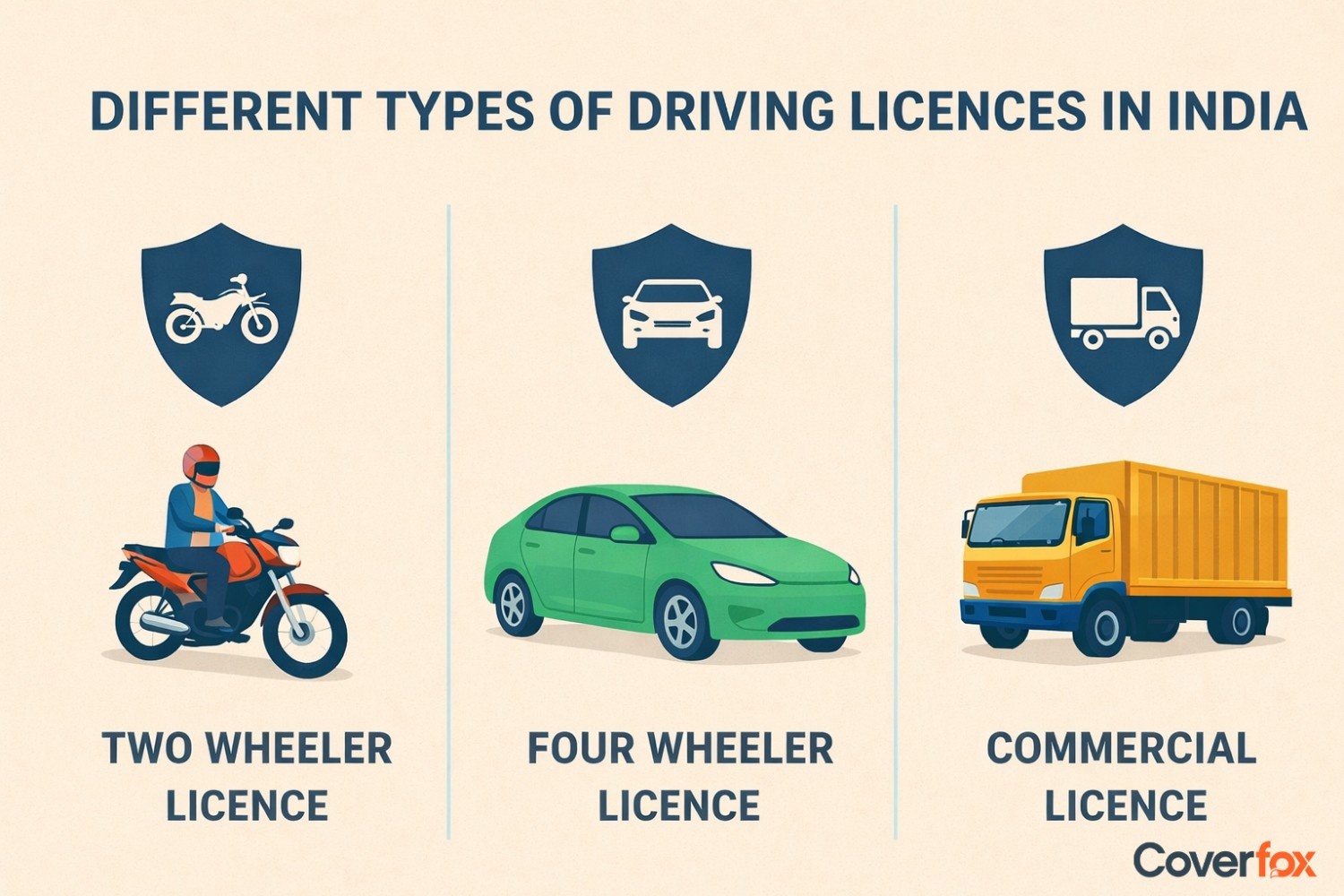
Driving licences in India are issued in various categories to suit learners, private drivers, commercial operators, and international travel needs. Each licence type comes with specific eligibility criteria, validity periods, and legal responsibilities.
In the driving licensing process in India, a Learner Licence is the first stage in accordance with the Motor Vehicles Act, 1988. It allows driving practice under supervision after successfully taking a written/oral test on the traffic regulations in the Regional Transport Office (RTO).
Age Limit: Motorcycles require the applicant to be 16 (up to 50cc with parental permission), and other vehicles require the applicant to be 18 years old and hold a Learner's (L) board.
Learning Licence Validity: 6 months, after which a candidate must undergo 30 hours of compulsory training in approved driving schools before applying for a permanent licence. Unaccompanied driving can result in a fine of up to ₹5,000 and the seizure of the vehicle.
A permanent driving licence permits independent driving after the practical driving test. It is issued to categories such as LMV (Light Motor Vehicles – cars/jeeps up to 7.5 tonnes), MCWOG (>50cc geared motorcycles), or MCWG (gearless), and must have a valid Learner's Licence for not less than 30 days.
Minimum age: 18 years; a certificate of medical fitness is required for those over 50 years.
Permanent Driving Licence Validity: 20 years or 50 years of age (whichever is less), renewable with re-testing of commercial vehicles. The invalid DL penalties are 3 months imprisonment and a ₹5,000 fine in the first instance.
For those who need to drive vehicles for professional purposes, a specialized licence category ensures drivers meet stricter standards. This is essential to maintain road safety when operating heavy or passenger-carrying vehicles.
A commercial driving licence allows the use of goods/passenger vehicles on hire (e.g., HMV >7.5 tonnes, MGV 3-7.5 tonnes, MPV >13 passengers). The requirements include passing the 8th standard, being at least 20 years old, having 1 year of LMV experience, and demonstrating medical fitness. Strict RTO driving test evaluates heavy vehicle handling. This type of driving licence is valid for 3 years and can be renewed with refresher training. The increased liability requires a PSV badge; offences such as overloading are fined ₹2,000-10,000, and the licence is suspended.
IDP translates an Indian DL into 10 languages and is valid for 1 year in 100+ countries. You must possess a valid Driver's Licence (DL) that has been in effect for at least one year, along with passport photos and a fee of ₹1,000, which can be obtained through authorised agents like the Parivahan portal. This type of driving licence in India is not independent; it must include the original driving licence and is required when renting vehicles in foreign countries; otherwise, you may face fines or vehicle confiscation.
Licences in India are categorised based on vehicle specifications:
MC 50cc: Gearless motorcycles 50cc and less (16+ years)
MCWG: Gearless motorcycles above 50cc (18 years and above)
MCWOG: Motorcycles with gears (18+ years)
LMV: cars/jeeps/LMV-trailers 7.5 tonnes GVW
HMV: Heavy motor vehicles over 7.5 tonnes (e.g., trucks)
MGV: 3-7.5 tonne Medium Goods Vehicles.
MPV: Passenger cars with over 13 seats.
They all require training hours (e.g., 18 hours LMV, 25 hours HMV) and exams. Misuse of classes attracts 5,000 fines.
The application can be done on the internet or at the RTO:
Register online on the Parivahan site or pay a visit to the RTO.
Post or submit your identity, address, and age documents.
Pay the amount for the relevant driving licence application fees for a driving licence as per the state laws.
Complete an online or offline Learner’s Licence test.
Once the learning period has ended, reserve the driving skills test.
Pass the exam to be given a Permanent Driving Licence.
Online services have simplified the processes of scheduling, submitting documents, and paying fees.
The eligibility regulations in different categories of licences differ:
16 years: Motorcycles less than 50cc (with parental permission)
18 years: LMV and non-commercial vehicles.
20 years and over: Business licences (with training certification)
In India, a licence is a legal necessity to drive a motor vehicle. It identifies the holder and confirms their competence in road rules and safe driving. The insurance claims can be denied in case the vehicle is driven without a valid licence. Therefore, a valid permit safeguards both legal and financial interests.
Failure to keep up with renewal dates: Most people fail to consider renewal dates, which impacts validity and insurance coverage.
Application in the wrong category: Choosing the wrong type of driving licence can slow down the process.
Missing practice: Driving tests should be properly prepared.
Poor documentation: Lapses in verification occur due to the absence of documents.
Failure to update address: A change of residence is to be reported to prevent administrative problems.
A systematic process will allow easy implementation and adherence to RTO standards.
Disclaimer: The data presented in this article is of general awareness. The categories of driving licences, eligibility, and application procedures are regulated by MoRTH and the respective State RTOs, and they may be modified without any notice. It is recommended that users verify the information presented by the official sources, like the Parivahan portal or the local RTO and then apply.
The principal ones are a learner's licence, a permanent licence, and an international driving permit.
A permanent driving licence requires renewal every 20 years. After reaching the age of 40, the licence can be renewed once for 10 years and then for every 5 years of the continuing period.
No, commercial cars need a Commercial Driving Licence.
An RTO is presented with a valid Indian licence, passport, visa, and photographs to submit an IDP application.
Operating a vehicle without the appropriate type of driving licence can result in fines, penalties, and insurance claim denials.

