
MoRTH has updated the Central Motor Vehicles Rules, 1989, to include E100 alongside E85 in the emission certification requirements for flex-fuel vehicles. This gives vehicle manufacturers a clear regulatory framework to develop and certify vehicles that can run on higher ethanol blends.
What Has MoRTH Changed in the Central Motor Vehicles Rules for E100 Flex-Fuel Cars?
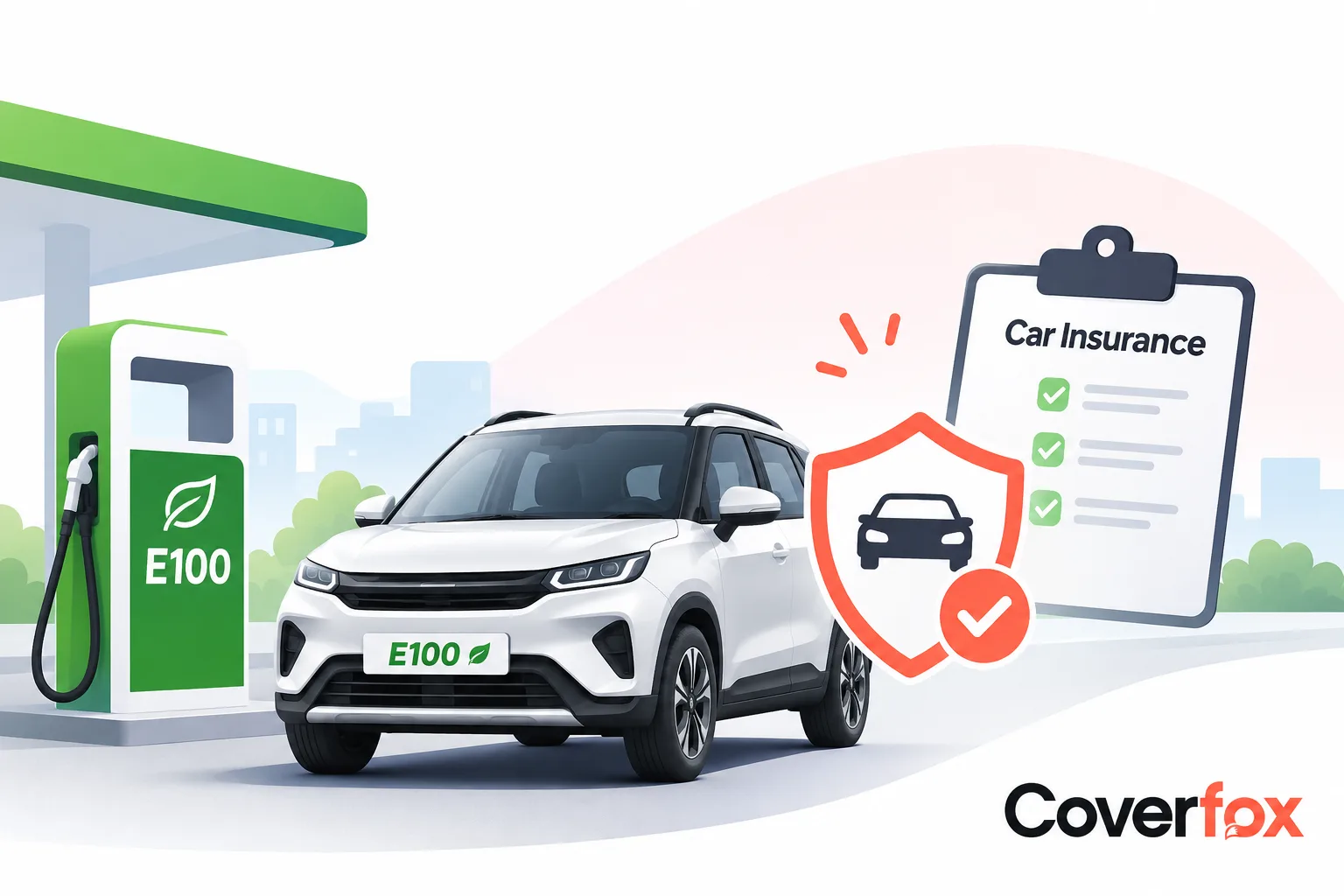
MoRTH amended the Central Motor Vehicles Rules, 1989, to include E100 alongside E85 in the emission-certification provisions for flex-fuel vehicles. The amendment was announced in a press release dated 26 October 2026. Only vehicles that manufacturers design and certify for these fuels are covered.
E100 is not mandatory.
Existing car owners do not have to convert or switch fuel.
A car approved for E10 or E20 is not cleared for E85 or E100.
The rule does not guarantee E100 at every fuel pump.
Will Car Insurance Premiums Go Up for E100-Compatible Cars in India?
The rule has no direct effect on premiums, because it deals with emission certification and not car insurance.
Own-damage premium depends on the car’s IDV, engine capacity, age, location and claim history.
Third-party car premium is set by the Centre by engine-capacity band, not by fuel type.
A higher-priced flex-fuel model may have a higher Insured Declared Value (IDV), which could also increase its own-damage premium.
Prices of E100-compatible models are not out yet, so there are no premium figures to quote.
Does Car Insurance Cover E100-Compatible Cars, and What Stays Excluded?
E100-compatible vehicles can be insured just like other eligible vehicles. However, the coverage you get for accidental damage, theft, fire, natural calamities or engine-related losses will depend on your policy's terms, conditions and exclusions.
Wear and tear
Gradual damage that builds up over time, such as corrosion in fuel lines
Mechanical or electrical breakdown
Engine damage that no insured event caused
Engine protection cover may cover damage caused by water entering the engine or oil leakage, depending on the policy terms. However, it may not cover all types of fuel-related damage.
How Are Car Insurance Claims Treated When Ethanol Fuel Is Involved?
Fuel type does not decide whether a claim is admissible. Using E20 fuel in a compatible vehicle does not mean your insurance claim will be rejected. The insurer will assess the claim based on what happened and the terms of your policy.
E100 is a separate matter. MoRTH says only certified vehicles should run on E85 or E100. If you use E100 fuel in a vehicle that isn't certified for it, any engine damage that follows could affect your insurance claim. The insurer will assess the claim based on the policy terms.
What Should Car Owners Check Before Using E85 or E100 Fuel?
Read the fuel compatibility sticker and the owner’s manual before you fill up.
Keep fuel bills, since they help establish the cause if damage is disputed.
If you install an aftermarket conversion kit, check with your RTO about the applicable requirements and inform your insurer in writing.
When buying a flex-fuel car, check that the fuel type is the same on the RC and the policy.
Read the engine protection add-on wording before you rely on it.
Frequently Asked Questions
Can I use E100 in my current petrol car?
Not unless the manufacturer has certified your model for E85 or E100.
Does using the wrong fuel cancel my car insurance policy?
Using the wrong fuel does not automatically cancel your policy. However, resulting engine damage may not be covered under a standard policy.
Will insurers charge extra for flex-fuel cars?
Insurers consider IDV, engine capacity and other standard factors. A costlier flex-fuel model may therefore have a higher premium.

