
- Retail Insurance
- Business Insurance
- Resources
- Claims


Electric two-wheelers are on the rise, and we can see that change in India's two-wheeler market as well. In 2025, more than 12.8 lakh electric two-wheelers were sold in the country, accounting for 56% of all EV sales across segments, making e-bikes and e-scooters the largest category in India's electric vehicle market (VynZ Research). As adoption continues to grow, protecting these technology-driven bikes with electric bike insurance has become an important part of owning an EV bike.
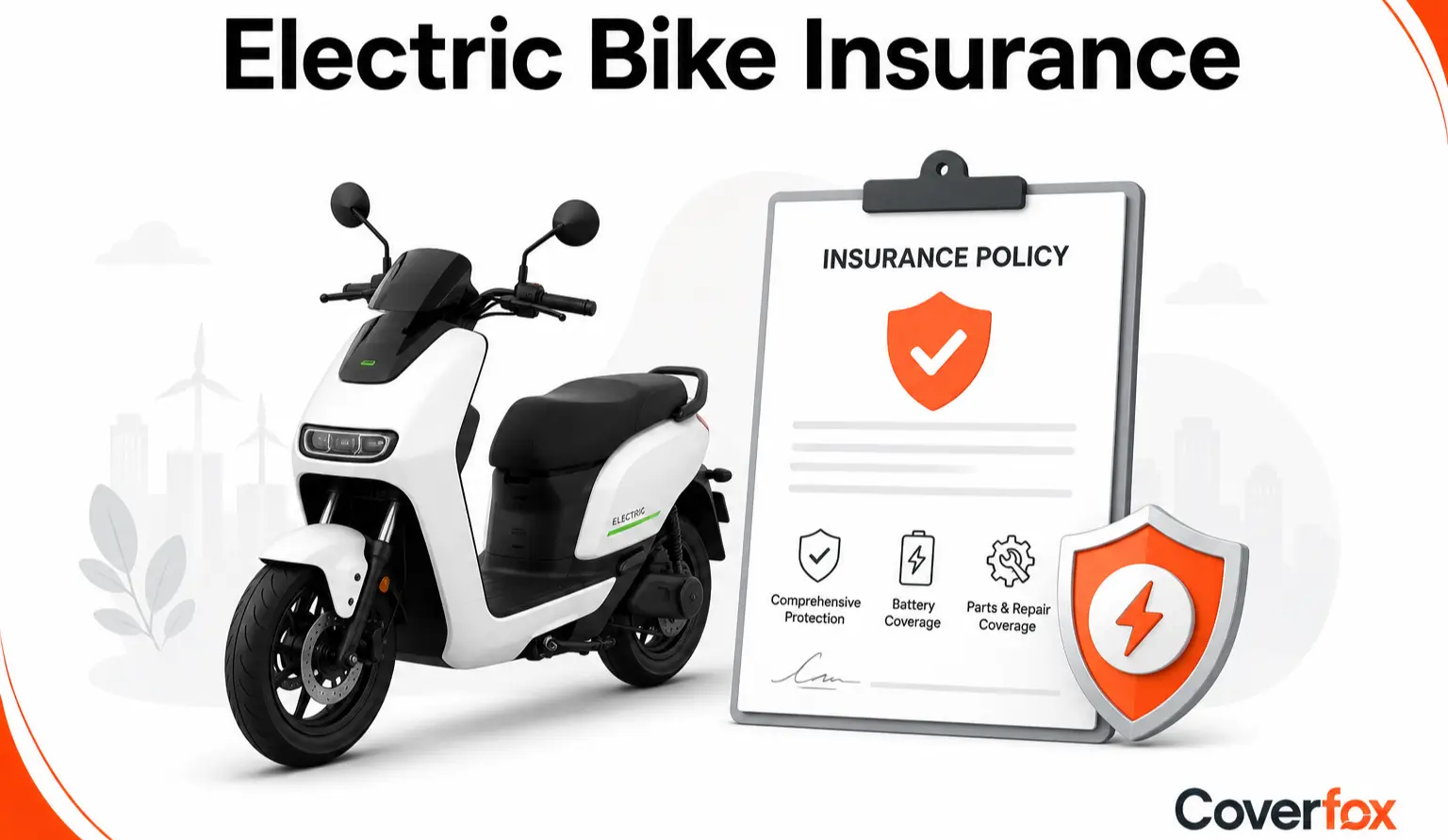
Electric bike insurance is a type of two-wheeler insurance that covers electric scooters and motorcycles against risks such as accidents, theft, fire, natural disasters, and third-party liabilities. It helps EV owners avoid large out-of-pocket expenses arising from unforeseen events.
Since electric bikes run on battery-powered technology instead of conventional engines, EV bike insurance takes into account the components and repair requirements associated with electric vehicles. Whether you own an electric scooter for daily commuting or a premium electric motorcycle, having an electric two-wheeler insurance policy can help you stay financially protected on the road.
Electric two-wheelers are changing the way India commutes, but they also come with unique ownership considerations that make insurance an important part of the riding experience.
Many electric scooters and motorcycles have a higher purchase price than comparable petrol-powered models. Insurance helps protect this investment against unforeseen events.
Components such as battery systems, motor controllers, display units, and onboard electronics can be costly to replace, making financial protection important for EV owners.
Electric scooters are increasingly used for daily commuting and last-mile mobility. Their growing popularity and high-value components make theft protection an important consideration for owners.
Most electric scooters are used extensively in cities, where frequent traffic, crowded parking areas, and daily road exposure can increase the likelihood of unexpected incidents.
Electric two-wheelers are commonly used throughout the year, including during monsoons. Heavy rainfall, waterlogged roads, and extreme weather conditions can create additional ownership risks.
Repairs following accidents, theft-related losses, or damage caused by natural calamities can lead to significant expenses that may disrupt an owner's budget.
Insurance allows riders to focus on enjoying the benefits of electric mobility without worrying about the financial impact of unforeseen events.
Yes, electric motorbike insurance is mandatory for all registered electric two-wheelers in India. If your electric scooter or motorcycle requires RTO registration and a driving licence, you must have at least a valid third-party insurance policy as per the Motor Vehicles Act, 1988.
However, low-speed electric scooters with a top speed of up to 25 km/hr and a motor power not exceeding 250W generally do not require registration and therefore do not fall under the mandatory two wheeler insurance requirement.
Electric bike owners can choose from different insurance plans depending on the level of protection they require for their vehicle.
Third party bike insurance is the minimum insurance required by law for registered electric two-wheelers. It covers legal and financial liabilities arising from injuries, death, or property damage caused to a third party by the insured electric bike.
A standalone own damage policy for Ebike covers damages to your electric bike caused by accidents, theft, fire, natural calamities, and other covered events. It can be purchased only if you already have a valid third-party insurance policy.
A comprehensive insurance policy for ebike combines third-party liability cover with own damage protection under a single plan. It offers broader coverage for the insured electric bike and is the most preferred option among EV owners.
The exact coverage may vary from one insurer to another, but most electric bike insurance policies generally include the following inclusions and exclusions.
| Inclusions of Electric Bike Insurance | Exclusions of Electric Bike Insurance |
| Damage to the insured electric bike due to accidents or collisions | Normal wear and tear of parts and components |
| Theft or total loss of the insured electric bike | Battery performance degradation or reduction in riding range over time |
| Losses arising from fire, self-ignition, lightning, or explosion | Mechanical, electrical, or electronic breakdown not caused by an insured event |
| Damage caused by floods, cyclones, earthquakes, landslides, and other natural calamities | Damage resulting from unauthorised modifications to the vehicle or battery system |
| Losses due to riots, strikes, vandalism, and other man-made disasters | Damage caused by using incompatible or non-approved charging equipment |
| Damage sustained while the electric bike is being transported by road, rail, air, or water | Riding under the influence of alcohol, drugs, or other prohibited substances |
| Third-party injury, death, or property damage liabilities | Riding without a valid driving licence, where applicable |
| Personal Accident Cover for the owner-driver, if opted for or applicable | Consequential losses arising from continued use of a damaged vehicle |
| EV-specific add-on benefits such as battery protection or charger cover, if purchased | Any loss occurring outside the policy terms, conditions, and exclusions |
Note: The coverage available under an electric bike insurance policy depends on the insurer, policy type, and add-ons selected. Always refer to the policy wording for complete details of inclusions and exclusions.
While a standard policy covers common risks, EV-specific add-ons can provide additional protection for components and systems that are unique to electric two-wheelers.
| Add-On Cover | Description |
| EV Battery Protection Cover | The battery is one of the most valuable components of an electric bike. This add-on provides coverage for insured damages to the battery caused by incidents such as accidents, water ingress, short circuits, or fire, subject to policy terms. |
| EV Shield Cover | Offered by select insurers, EV Shield Cover provides enhanced protection for key electric vehicle components, including the battery, motor, controller, and charging system, against specified risks. |
| EV Electric Motor Protection Cover | This add-on helps cover repair or replacement expenses for the electric motor if it is damaged due to an insured event covered under the policy. |
| EV Charger and Charging Equipment Cover | Provides protection for charging cables, portable chargers, connectors, and charging equipment associated with the insured electric bike against covered damages. |
| Electric Surge Protection Cover | Covers losses arising from sudden voltage fluctuations, power surges, or electrical short circuits affecting covered EV components, as per policy conditions. |
| Roadside Assistance Cover | Provides emergency support services such as towing assistance, on-road repairs, breakdown assistance, and transportation support in the event of an unexpected breakdown. |
| Zero Depreciation Cover | Reduces depreciation deductions on eligible parts during claim settlement, helping policyholders receive a higher claim amount after an insured loss. |
| Return to Invoice Cover | In case of theft or total loss, this add-on helps bridge the gap between the claim settlement amount and the original invoice value of the electric bike, subject to policy conditions. |
| Battery Depreciation Allowance | Available with select insurers, this add-on reduces or eliminates depreciation deductions applicable to the battery during claim settlement, resulting in better compensation for covered losses. |
The electric bike insurance cost is determined by a combination of vehicle-specific and policy-related factors. Since electric two-wheelers vary significantly in battery capacity, technology, and replacement costs, premiums can differ from one model to another. An online premium calculator can help you estimate the premium by entering details such as the vehicle model, registration year, location, and coverage requirements.
Third-party insurance premiums for registered electric two-wheelers are regulated by IRDAI and are based on the vehicle's power output. These rates remain uniform across insurers, although the premium for a comprehensive policy may vary depending on the vehicle and coverage selected.
| Motor Power | 1-Year Third-Party Premium (₹) | 5-Year Third-Party Premium for New Vehicles (₹) |
| Not exceeding 3 kW | ₹457 | ₹2,466 |
| Above 3 kW and up to 7 kW | ₹607 | ₹3,273 |
| Above 7 kW and up to 16 kW | ₹1,161 | ₹6,260 |
| Above 16 kW | ₹2,383 | ₹12,849 |
Note: These are IRDAI-prescribed third-party premium rates. The final premium for comprehensive electric bike insurance may vary depending on the insurer, IDV, add-ons, and other rating factors.
At Coverfox, we partner with trusted electric bike insurance companies to help you protect your EV with comprehensive coverage at competitive premiums. With electric bike insurance plans starting at just ₹457*, access to a wide network of cashless garages, and insurers known for their high claim settlement ratios (CSR), finding the right coverage for your electric two-wheeler is simple and hassle-free. Below is the list of insurers that offer electric bike insurance through Coverfox in 2026 (in no particular order).
| Private Bike Insurance Company | Cashless Garages |
|---|---|
| Acko General Insurance Ltd. | 4,000+ |
| Bajaj General Insurance Ltd. | 7,200+ |
| Cholamandalam MS General Insurance Co. Ltd. | 16800+ |
| Generali Central Insurance Co. Ltd. | 6500+ |
| Go Digit General Insurance Ltd. | 9,000+ |
| HDFC ERGO General Insurance Co. Ltd. | 12200+ |
| ICICI Lombard General Insurance Co. Ltd. | 6900+ |
| IFFCO–Tokio General Insurance Co. Ltd. | 11800+ |
| Zurich Kotak General Insurance Co. Ltd. | 4600+ |
| Liberty General Insurance Ltd. | 6000+ |
| Magma General Insurance Ltd. | 4000+ |
| Navi General Insurance Ltd. | 900+ |
| Raheja QBE General Insurance Co. Ltd. | 1300+ |
| IndusInd General Insurance Company Limited | 11000+ |
| Royal Sundaram General Insurance Co. Ltd. | 7,600+ |
| SBI General Insurance Co. Ltd. | 9277+ |
| Shriram General Insurance Co. Ltd. | 2000+ |
| Tata AIG General Insurance | 10000+ |
| Universal Sompo General Insurance Co. Ltd. | 13500+ |
| Zuno General Insurance Ltd. | 3300+ |
| Public Sector Bike Insurance Company | Cashless Garages |
|---|---|
| National Insurance Co. Ltd. | 3100+ |
| The New India Assurance Co. Ltd. | 3000+ |
| The Oriental Insurance Co. Ltd. | 7926+ |
| United India Insurance Co. Ltd. | 500+ |
Disclaimer: *Price for TP bike insurance for EV (Under 3kW) for 1 year. The bike insurance companies displayed above are in alphabetical order, and Coverfox does not endorse or favour any one company over the other. For an accurate list of bike insurers in India, you can refer to the IRDAI (Insurance Regulatory and Development Authority of India) website www.irdai.gov.in
Several factors influence the premium of an electric bike insurance policy. Unlike conventional two-wheelers, insurers also consider EV-specific aspects such as battery value and electric drivetrain components.
Higher-capacity batteries and more powerful electric motors generally increase the vehicle's value and replacement costs, which can influence the premium.
Premium electric scooters and motorcycles equipped with advanced connectivity features, larger battery packs, or higher performance specifications may attract higher insurance premiums.
The IDV reflects the current market value of the electric bike. A higher IDV typically results in a higher premium, as the insurer's potential claim liability increases.
Comprehensive electric bike insurance generally costs more than third-party insurance because it provides broader protection for the insured vehicle.
Optional covers such as battery protection, EV Shield Cover, charger protection, and roadside assistance increase coverage and may impact the premium amount.
Electric bikes registered in metro cities and densely populated urban areas may attract different premiums due to variations in traffic density, theft exposure, and claim trends.
A claim-free policy year can earn the policyholder a No Claim Bonus, helping reduce the renewal premium.
As an electric bike ages, its market value generally decreases. This may reduce the IDV and consequently affect the premium payable during renewal.
The cost and availability of replacement batteries, controllers, display units, and other EV-specific parts can also influence how insurers assess risk and price the policy.
Whether you're purchasing a policy for a new electric scooter or renewing an existing one, Coverfox allows riders to purchase electric bike insurance online and compare plans from multiple insurers:
Provide details such as the registration number, make, model, variant, registration year, and city of registration of your electric scooter or motorcycle.
Choose whether you want to buy a new electric bike insurance policy or renew an existing one. For renewals, you may be asked to provide your current insurer and policy expiry date.
Review electric bike insurance plans from multiple insurers based on coverage, premium, add-ons, claim support, and policy benefits.
Select the policy type and add any relevant EV-specific covers such as battery protection, charger protection, EV Shield Cover, or roadside assistance, if available.
Check the premium amount, coverage details, IDV, deductibles, and selected add-ons before proceeding to payment.
Complete the payment using your preferred online payment method.
Once the payment is successful, the policy document is generated and shared digitally on your registered email address.
With multiple insurers offering coverage for electric scooters and motorcycles, it is important to compare more than just the premium before making a decision.
A comprehensive policy offers broader protection than a third-party plan by covering both third-party liabilities and damages to the insured electric two-wheeler.
Look for add-ons such as battery protection, charger cover, EV Shield Cover, motor protection, and roadside assistance, especially if they are relevant to your vehicle and usage.
Review the insurer's claim process, network garage availability, and customer support services to ensure a smoother claims experience.
Selecting an appropriate IDV helps ensure adequate financial protection in the event of theft or total loss of the electric bike.
A lower premium may come with reduced coverage or fewer benefits. Compare policy features, exclusions, deductibles, and add-ons before making a decision.
Understanding what is not covered can help avoid claim-related surprises later and ensure the policy matches your requirements.
Coverfox makes it easy for electric two-wheeler owners to compare, customise, and purchase insurance policies from multiple insurers on a single platform.
Review and compare policies, premiums, coverage options, and add-ons from leading insurance companies in one place.
Complete the purchase or renewal process for e-bike insurance digitally without paperwork or lengthy procedures.
Choose the policy type and add-ons that best suit your electric scooter or motorcycle.
Once the payment is completed, the policy document is generated and shared digitally.
Get assistance with policy selection, renewals, and insurance-related queries throughout your ownership journey.
Electric two-wheelers have unique components and operating requirements. Following the manufacturer's recommendations and maintaining accurate policy coverage can help prevent claim-related complications.
Since the battery is one of the most expensive parts of an electric bike, review your policy and add-ons periodically to ensure it has appropriate coverage, wherever available.
Using uncertified chargers, connectors, or charging accessories may increase the risk of electrical damage and could create difficulties during claim assessment if the damage is linked to unauthorised equipment.
If you replace the battery with a higher-capacity unit or make significant electrical modifications, update your insurer to ensure the vehicle details in the policy remain accurate.
Modifications to the controller, wiring harness, motor, or battery management system that are not approved by the manufacturer may affect claim eligibility.
Maintaining records of authorised servicing, battery inspections, and software updates can help establish proper upkeep of the vehicle if required during claim evaluation.
As your usage pattern changes, reassess add-ons such as battery protection, charger cover, or roadside assistance to ensure the policy continues to match your electric bike's requirements.
Disclaimer: *Premiums starting from ₹457 are indicative for third-party bike insurance for select models and may vary based on vehicle specifications, location, and insurer.
Low-speed electric scooters with a top speed of up to 25 km/hr and a motor output not exceeding 250W generally do not require registration or mandatory insurance. However, owners may still choose to purchase insurance for financial protection.
The electric bike insurance price depends on factors such as the vehicle model, battery capacity, IDV, location, policy type, and add-ons selected. Third-party premiums are regulated by IRDAI, while comprehensive policy premiums vary across insurers.
Battery replacement is typically covered only when the damage results from an insured event and the policy terms permit such coverage. Some insurers may also offer dedicated battery protection add-ons.
Yes. Used electric scooters and motorcycles can be insured just like new vehicles, provided the necessary ownership and registration documents are available.
The core policy structure remains similar, but electric bike insurance takes into account EV-specific components, motor power classifications, battery-related risks, and electric vehicle add-ons that are not relevant to conventional motorcycles.
Battery Protection Cover, EV Shield Cover, Charger Protection Cover, Roadside Assistance Cover, and Zero Depreciation Cover are among the most popular add-ons for electric two-wheelers.
Coverage for charging equipment depends on the insurer and policy selected. Some insurers offer charger and charging equipment protection as an optional add-on.
Yes. You can purchase electric bike insurance online through platforms such as Coverfox by comparing plans, selecting coverage, making payment, and receiving the policy digitally.
High-speed electric scooters and motorcycles require registration and a valid driving licence. Low-speed electric scooters that meet prescribed limits are generally exempt from these requirements.
Yes. Most insurers allow policy renewal after expiry, although an inspection may be required in certain cases depending on the duration of the lapse and insurer guidelines.
Battery damage may be covered if it results from an insured event such as an accident, fire, or natural calamity. Coverage depends on the policy terms and any battery-related add-ons purchased.
EV Shield Cover is an add-on offered by select insurers that provides enhanced protection for key electric vehicle components such as the battery, motor, controller, and charging system.
Yes. The No Claim Bonus belongs to the policyholder and can generally be transferred to a new vehicle, subject to insurer rules and applicable conditions.
Factors such as battery capacity, motor power, vehicle value, registration location, policy type, add-ons selected, claim history, and No Claim Bonus can influence the premium.
Coverage depends on the cause of the fire and the policy terms. If the incident falls within covered perils under the policy, the resulting damage may be covered subject to the insurer's assessment.
There is no single best policy for every rider. The ideal policy depends on factors such as the vehicle model, usage pattern, coverage requirements, claim support, and availability of EV-specific add-ons.
Third-party insurance fulfils the legal requirement for registered electric two-wheelers, but it does not cover damage to your own vehicle. Many EV owners prefer comprehensive coverage for broader financial protection.
Many comprehensive policies cover theft of the insured electric bike. However, coverage for standalone battery theft depends on policy terms and insurer conditions.
Yes, as per the Motor Vehicles Act, 1988, it is mandatory to purchase third party insurance for electronic bikes. However, you can also choose to buy comprehensive insurance cover as it offers coverage against own damages as well as third parties.
E-bikes having less than 25 kmph speed do not require a driving license.
While riding an e-bike, you have to carry documents such as registration certificate, insurance copy, driving license, etc.
No, electric bikes do not require a Pollution Under Control certificate and hence you do not need to carry the same while riding the bike.

