
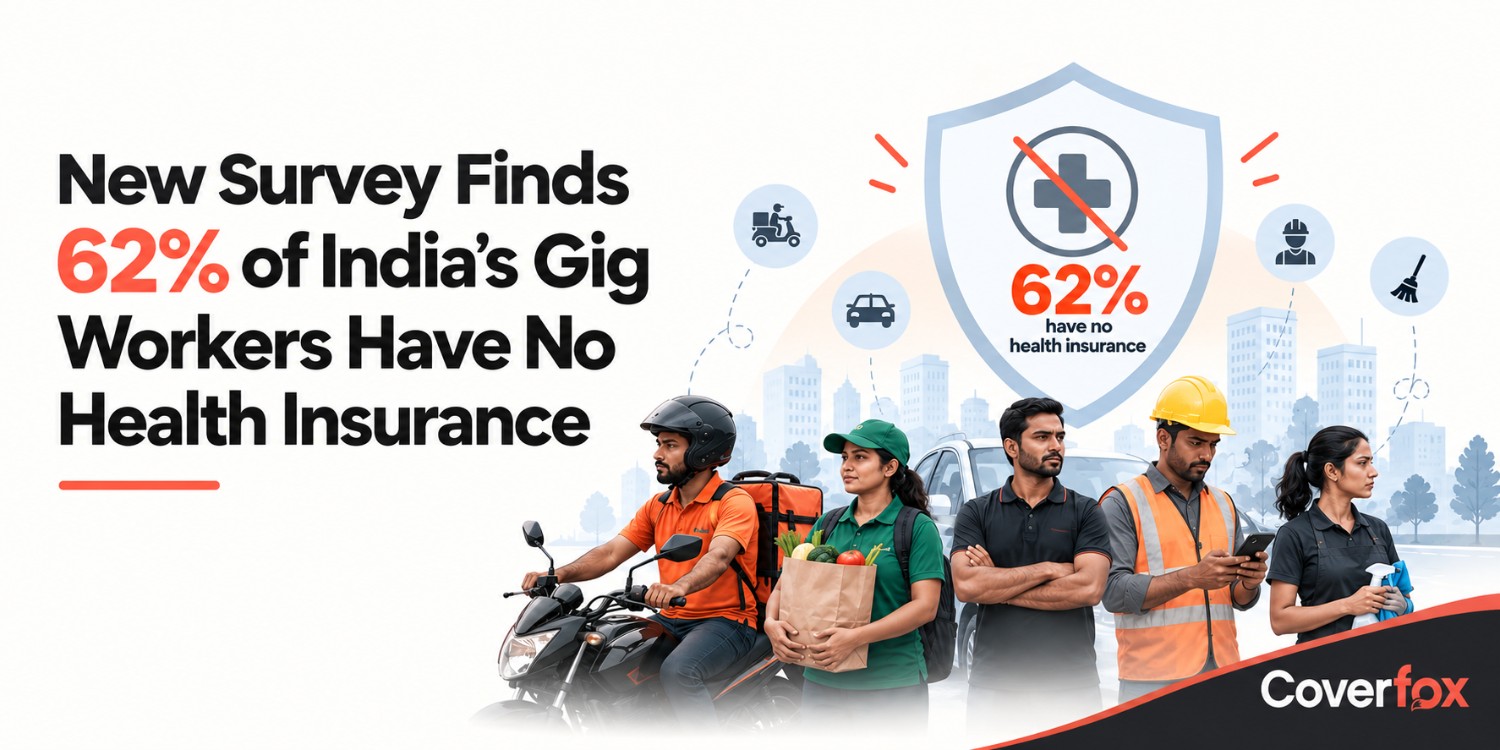
India’s gig economy is putting more people on the road, but insurance protection has not kept pace. A new survey found that 62.2% of gig workers have no health insurance and 44.2% have no accident cover, bringing the financial risks of platform work into focus.
What are the Findings From the Survey
Janpahal and the Gig Workers Association (GigWA) surveyed 1,000 gig workers across 10 Indian cities. The report, titled "Occupational Safety and Health of Platform-based Gig Workers in India," was released on 3 September 2026 in Delhi. The findings are:
| Risk / Coverage Area | Finding |
|---|---|
| Workers without health insurance | 62.2% |
| Workers without accident insurance | 44.2% |
| Workers affected by extreme heat | 96.57% |
| Workers who found accident claims difficult | 80%+ |
| Workers reporting a vehicle near-miss | 62.2% |
| Workers reporting a traffic accident | 27.5% |
The findings show that the issue is not limited to whether workers have insurance. The nature of gig work itself exposes them to risks that can directly affect both their health and earnings.
Why the Insurance Gap Is Wider Than It Looks
India’s gig workforce is getting bigger. It is projected to grow from around 1 crore workers in 2024-25 to 2.35 crore by 2029-30, which would account for about 6.7% of the non-agricultural workforce, according to NITI Aayog.
But insurance access has not kept pace with the sector’s growth. By June 2026, around 12 lakh gig and platform workers had registered on e-Shram, up from more than 5 lakh in December 2025, according to IMPRI. Against a workforce already running into crores, the numbers point to a sizeable gap between the growth of gig work and the reach of formal protection.
Why Gig Workers Need a Different Insurance Approach
Traditional insurance products may not always fit the way gig workers earn and work. A gig worker can move between platforms, work variable hours and have income that changes from week to week. Insurance products for this segment therefore need to consider:
Affordability: Premiums need to work for workers with variable incomes.
Portability: Protection should ideally not become irrelevant when a worker changes platforms.
Relevant risks: Accident, hospitalisation, disability and other risks need to reflect the realities of gig work.
Simple claims: The process should be easy to understand and accessible without extensive paperwork.
Flexible distribution: Digital platforms, employers, aggregators and other worker touchpoints can help improve access.
Government Schemes Can Help, But Awareness and Access Matter
The government has introduced measures to extend social-security protection to gig and platform workers. The Code on Social Security, 2020 formally recognises this workforce and provides for benefits covering areas such as health, accident, life and disability. The e-Shram portal also brings gig and platform workers into the registration system and helps eligible workers access relevant government schemes.
The challenge now is making these provisions accessible in practice:
Awareness: Workers need to know which schemes they can access and what benefits they provide.
Registration: Being part of the formal registration system is an important step towards accessing eligible benefits.
Accessibility: Workers need simple processes to enrol, understand their benefits and use them when required.
Claims and benefits: Protection has real value only when workers can successfully access the benefit when an illness, accident or other covered event occurs.
Closing the Protection Gap
India’s gig workforce is growing rapidly, but access to financial protection has not expanded at the same pace. As more workers depend on platform-based income, closing this gap will require protection that reflects the risks and financial realities of gig work.
For the insurance industry, the opportunity lies in making health and accident protection easier to access, afford and use for this growing workforce.
Source - Occupational Safety and Health of Platform-based Gig Workers in India
Frequently Asked Questions
What is the current insurance coverage among gig workers in India?
A 2026 survey of 1,000 platform workers across 10 Indian cities found that 62.2% did not have health insurance, while 44.2% did not have accident insurance.
Do gig workers in India get health insurance?
Gig workers may access health protection through government schemes or private insurance, depending on their eligibility and enrolment. However, the 2026 Janpahal and GigWA survey found that 62.2% of respondents did not have health insurance, indicating that coverage remains limited among the surveyed workforce.
Do gig workers need accident insurance?
Accident insurance can provide specified financial benefits following covered accidental injury, disability or death. It can be particularly relevant for gig workers whose jobs involve significant road exposure, with the survey reporting traffic accidents and vehicle-related near-misses among respondents.
What are the biggest risks faced by gig workers?
The survey identified several risks, including road accidents, extreme heat, fatigue, injuries and other work-related health concerns. Among the 778 workers who reported working in extreme weather, 96.57% said heat affected their ability to work.

