

To the Chairperson and Members of the Insurance Regulatory and Development Authority of India (Authority or IRDAI)
The Authority's consultation paper sets out goals every responsible participant in this industry shares: insurance that costs the customer less, remuneration that is visible, and a market that reaches every Indian by 2047. I support those goals without reservation.
I am writing publicly because the Consultation Paper’s consequences are already public. Within a day of release, household investors, lenders, employees and distribution partners were asking questions that deserve open answers. The consultation remains open until 25 October 2026. This letter sets out those questions, and some constructive answers, in the hope that the Authority, government of India, ministry of finance take responsible steps to build the industry which has been painfully built over the last 50 years, rather than dismantling it.
1. Insurance is a business of trust. So is Regulation.
In Insurance we pay money upfront for a service honoured at a later date. This is possible because trust is the only important element in the transaction. I believe the proposed changes raise legitimate questions about regulatory predictability and investor confidence.
When the rules can change this sharply, and within weeks of the Authority licensing new insurers and granting intermediaries perpetual registration, the cost is borne well beyond the companies directly affected. It impacts-
listed businesses
household investors who priced them on the framework then in force
on the foreign investors whom Parliament has just allowed to own insurers outright;
and ultimately on confidence in the regulatory framework itself.
Mixed signals from a regulator are themselves a source of risk. Consider the sequence of the last few months:
29 June 2026: Turtlemint, an IRDAI-licensed broker's parent, listed on the exchanges after an ₹882.67 crore IPO priced at ₹152 a share, raised from public investors on the regulatory framework then in force.
SEBI approved the IPO, based on a business model, which IRDAI had approved before the DRHP filing. Did IRDAI not have knowledge that they would write a Consultation paper, which would change the very premise of the business model of Turtlemint.
July 2026: the Authority granted its fourth new insurer licence of the year, and replaced periodic renewal of intermediary licences with perpetual registration. The sector now permits 100% foreign ownership under the Sabka Bima Sabki Raksha Act.
23 September 2026: the consultation paper is published.
24 September 2026: Turtlemint's shares hit the 20% lower circuit at ₹109.10. PB Fintech suffered the steepest single-day fall since its 2021 listing and has since lost more than ₹34,000 crore in market value.
Our questions:
Did the Authority have the knowledge of the Consultation Paper at the time of granting approval for the IPO? If it had knowledge, then why did it allow the IPO to happen and break the Trust of small investors who invested in Turtlemint?
How should investors, domestic and foreign, read a framework that can be rewritten weeks after the Authority has licensed new entrants and investors have priced public offerings on it?
We also want to understand if the new license that has been given will fall under the new EOM guidelines as prescribed in the consultation paper?
It could also imply that the perpetual Intermediary license may become a monthly renewal requirement by the Regulator in future?
2. What do the numbers actually show?
The paper's case rests on distribution costs having grown faster than premium. Its own data tell a more complex story.
Private insurers: Part 1 of the consultation paper shows private life insurers' total expense ratio rising from 16.5% in FY21 to 20.2% in FY26, and private general insurers' from about 25% in FY19 to 32.1% in FY26.
All insurers: the annexures to Part 2 show the life industry's total expense ratio at 17% in FY23 and 16% in FY26.
Reclassification: Part 1 attributes the fall in operating expense ratios after 2023 to insurers reclassifying distribution payouts into commission. Part of the "commission surge" is money moving into the correct line, which is what the 2023 reforms asked for.
- Tax and accounting: FY26 costs coincide with the loss of input tax credit after individual life and health premiums became GST-exempt in September 2025, and with changed recognition of long-term health premiums.
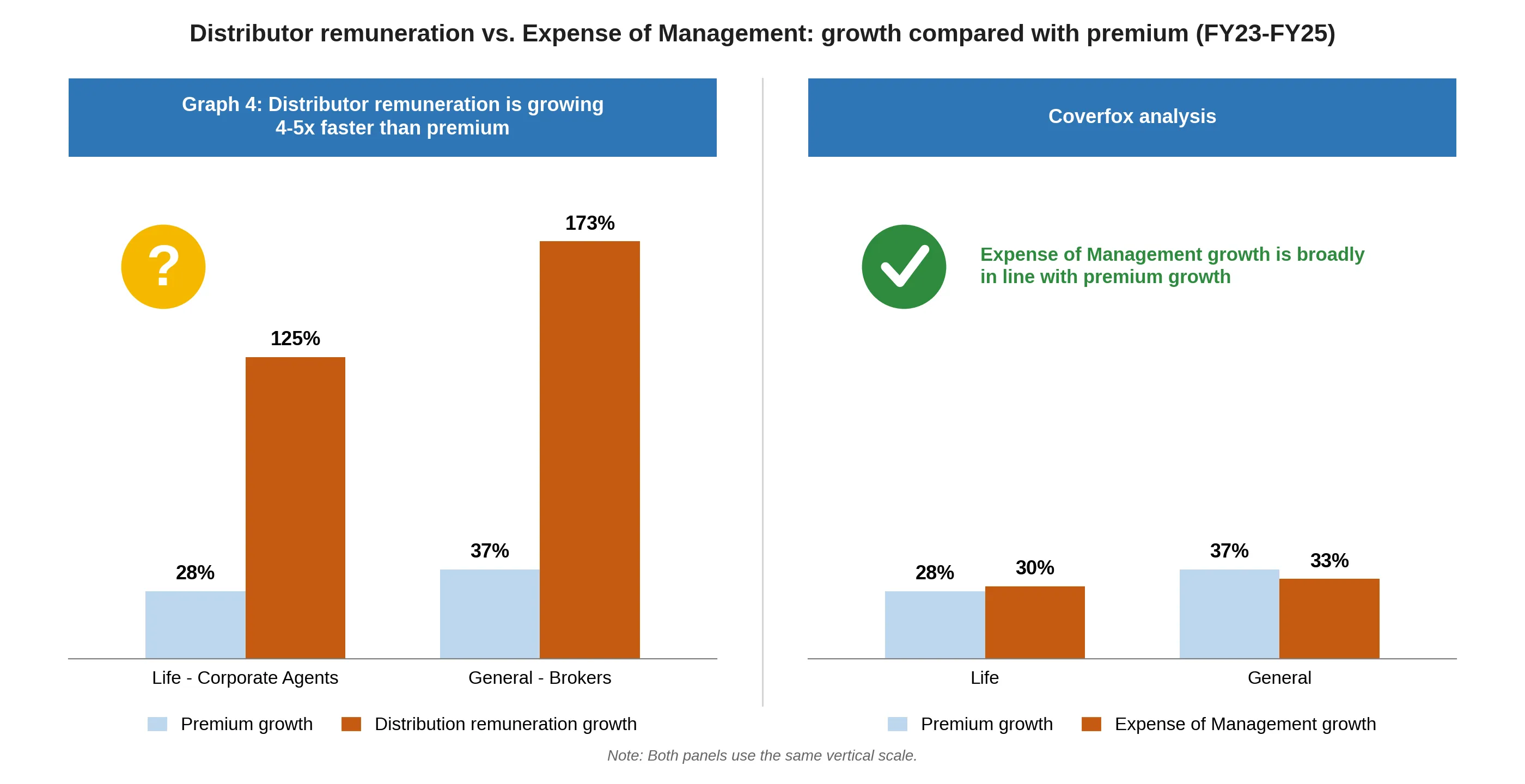
*Expenses of management includes- Distribution remuneration and operating expenses related to insurance business which together comprises expenses of management as per IRDAI.
*Coverfox Analysis- This analysis is based on data available with Govt of India, SEBI, IRDAI, NSE, BSE.
Our questions:
Sir, why have you published misleading data in the Consultation Paper?
How much of the rise in total expenses is genuine additional cost, and how much reflects reclassification, the loss of input tax credit and accounting changes?
3. Consultation is necessary. Impact assessment is essential.
Publishing a public consultation paper is the right step, and we welcome it. But public consultation on proposals which have a direct consequence on the business model of the vast majority of companies alone then such a consultation should be an inclusive discussion.
IRDAI has itself shown what a better process looks like. When it moved on expenses of management and commission, it released an exposure draft of the Expenses of Management, including Commission, of Insurers Regulations, with the actual regulation text, invited comments over a defined window, and notified final regulations under its statutory powers. Stakeholders knew what instrument was proposed, what it said, and what authority it rested on.
The current paper does not meet that standard. It contains no regulation text, and does not say whether its proposals will become regulations or circulars. It arrived about three months after draft amendments to the intermediaries regulations that proposed a different structure.
The paper also contains no estimate of how many policyholders may lose cover, how many livelihoods in distribution are affected (including roughly 27 lakh registered point-of-sale persons, nearly 15 lakh of them engaged through brokers), or how much capital may leave the sector. A regulator that can quantify EoM limits and commission caps for insurers can quantify the impact of its own proposals.
We urge IRDAI to publish draft regulation text, a statement of objectives and an impact analysis, a general response to the comments received, and to consult afresh if the final rules differ substantially from the draft.
Our question:
Why did the Regulator not follow the protocol it followed when it issued the Expenses of Management Framework in 2023?
4. The last mile, and the borrower who cannot buy online
Sir, you have proposed a low commission of 2% for all loan-linked protection. Loan-linked protection is not a recent invention. The Life Insurance Corporation of India has offered group cover to rural and loan-linked borrowers for decades, from the Landless Agricultural Labourers Group Insurance of 1987 and its group scheme for Integrated Rural Development Programme borrowers of 1988 to its present-day group credit life plans. It exists because it does two jobs no other product does as well:
It protects the family. In most low-income households the borrower is the principal earner. If He/she dies, the loan does not die with him/her; the obligation passes to a family that never took it. Group credit life settles the loan and pays any balance to the nominee.
It protects the lender, and through it, the borrowers who come next. Lenders fund their books with borrowed money at double-digit rates. Unprotected losses weaken the balance sheets that finance the next borrower.
Beyond those two jobs, loan-linked cover does a third thing: it reaches households that no other channel reaches. For a low-income rural family, the loan is often the first and only formal financial relationship, which makes it the natural point at which protection can be offered. The numbers show the gap. NABARD's rural financial inclusion survey (NAFIS 2021-22) finds that 52% of rural households carry debt, while only 24% hold life cover. The Authority's own rural obligation regulations count group lives towards insurers' rural targets, so this channel is also how insurers meet the obligations the Authority sets. A 2% commission asks that same channel to work harder at lower pay. How does the Authority expect it to keep reaching these households?
When the Regulator brought the EOM framework in 2023, it actually gave a structure to Group Credit life and it also gave the lenders to work with a IRDAI Regulated Intermediary to structure the loan linked product in line with the extant RBI regulation. To implement that many companies actually made a capex in technology, such that the GCL can travel faster and achieve its core objective of protecting the lives of the poor vulnerable sections of the society.
Sir, it is therefore extremely important that you understand how the Group credit life is sold. This is sold only by the lender. India has taken more than 40 years to strengthen its priority Sector lending and entire lending operates by constantly rewriting the credit quality and enabling creating a huge infrastructure, so that credit can reach faster. These loans are more expensive than the Bank loans and it is so, because banks cannot actually reach where NBFC’s can reach. Credit life is sold at an average commission of 30% across the board for the last 3 decades because the distribution cost by the lenders to make the product available to the household is expensive. Moreso, these lenders have over the 3 decades incurred billions of dollars to create the rail through which the Insurance products can travel easily to the last mile.
The paper suggests that remuneration here has risen too far: it finds commission on group credit life rising from about 5% to 28% between FY23 and FY25. However, prior to even 2023 these levels of 28% to 35% existed. Only that the Insurers paid this amount as Marketing and Advertising expenses to the lenders distributors and not called it commission. The average commission always was around 30%. But the proposed limit is 2% making lenders to do charity on the cost incurred on the credit infrastructure built over the last 30 years.
Our questions:
Sir, given that you are promoting Bima Sugam and PSU insurers through your reforms and you want to pay ONLY 2% for selling loan linked products. Sir, are we to expect that Bima Sugam and LIC will open branches near all loan distribution points and branches of the lenders?
Who will enrol and service a rural borrower for ₹20, and at what quality?
If lenders stop offering cover, how will those borrowers be insured instead, given that they rarely buy online or separately?
Has the Authority estimated how many lives now insured through group credit covers would lose protection under the proposed limits?
5. Who owns the outcome?
Sir, when a business restructures or makes a Pivot the entrepreneur, its leadership owns the consequences for customers, employees and shareholders and sees through the changes. We all know 7/10 pivots actually fail. Sir, what you are proposing is a Pivot and chances of it failing is 70%. So Sir, what you call a reform of this scale will shape Indian insurance for the next decade or more. Its outcomes should be owned just as clearly.
Our questions:
What outcomes will the Authority commit to (lives covered, claims paid, coverage by district, distributor livelihoods), and will it publish a review against them within 24 months, with a commitment to correct course if they are not met?
Given that the proposed changes would have consequences extending well beyond the Authority’s current regulatory cycle, what mechanisms will be put in place to ensure continuity, monitoring and course correction irrespective of changes in leadership?
6. Insurance is sold, not bought
Few people go looking for protection against death, illness or loss. Demand is created by someone who explains, persuades and stands by the family at claim time. The Authority's own data confirm it: online direct business, the lowest-cost channel available, accounts for about 2% of premium for private life and general insurers (Part 1, Graph 10- IRDAI Consultation Paper).
India has about 31 lakh individual agents and about 27 lakh registered point-of-sale persons. A former Chairman of the Authority has said the industry needs close to one crore agents to reach Insurance for All by 2047. And most of what is paid for selling reaches the field: one listed platform's offer document shows about ₹77 of every ₹100 of commission passed on to its point-of-sale partners, 80% of whom work outside India's 30 largest cities.
Our questions:
Sir, the country needs to roughly triple its distribution force, yet the proposals sharply reduce the remuneration for selling. How can both happen together? Lower commission does not turn a push product into a pull product; it means fewer people are reached at all. How do you intend to meet this gap?
Sir, we beg to understand from you, based on your Consultation Paper, you propose to reduce the commission payouts to the POSP’s. This will force them to stop selling Insurance as they will not be able to feed their own families at such a low remuneration. Sir, how do you intend to address the job loss?
7. Regional Presence of IRDAI and PSU in Tier 3 cities and below.
Sir, all other regulators in India have a very deep regional presence. Why doesn’t IRDAI have a regional presence? In addition, Sir, why doesn't your consultation paper mandate PSU Insurers to open offices in all cities and towns below Tier 3 cities.
8. Is the Regulator even-handed? Penalties for insurers, punishment for intermediaries
Everyone has read the headlines: two insurers, Acko and Niva Bupa together breached the Expenses of Management (EoM) limits by ~₹584 crore. This is the very framework the Authority designed and notified in 2023.
The consequence was minor. The consequence was a warning and a six-month restriction on opening new places of business, with no monetary penalty reported.
The intermediaries did not breach anything. Brokers and distributors have complied with the EoM guidelines. Yet the consultation paper proposes deep cuts to their remuneration, so the compliant party bears the burden and the defaulting party gets a modest fine.
Our question: Sir, why do you have a step child treatment towards the Intermediaries, whereas conversely with your Consultation Paper proposes to give significant benefit to the Insurers. Does the proposed framework do favors to insurers while punishing intermediaries? Is the authority against the concept of brokerage
9. Reform without disruption: Five point suggestions
Questions alone are not enough. These proposals would achieve the paper's aims while protecting what works.
- Create Priority Sector Insurance. RBI's priority sector lending framework directs credit to underserved segments without distorting the rest of the market. A Priority Sector Insurance framework would define underserved customers by geography, income and product, and give insurers and distributors who serve them differentiated, audited treatment. It could link to the existing rural obligation regulations, so that distributors who help insurers meet those obligations share in the rewards the regulations already contemplate.
- Under this framework please create a composite micro manufacturing category with lower capital requirements.
- Force large Life insurers to sell low cost and yet wide coverage products to Rural India, through Microfinance Institutions, Small Finance Banks. Why doesn't LIC sell loan linked life insurance through priority sector lenders?
- Open a path from distribution to manufacturing. The Authority has licensed four new insurers this year. Established distributors like Policy Bazaar, Coverfox, Turtlemint with long track records and deep customer relationships could offer similar value as underwriting agencies or insurers, subject to stringent fit-and-proper, capital and conduct criteria.
- Use the existing digital rails to let Insurance travel to the last mile. Humans are not the only seller in the current world. Introduce concepts like Corporate POSP; Create framework around public Digital Infrastructure. This country doesn't need many manufacturers; but needs many, many highly capitalised and technology advanced digital distributors.
- Regulate total cost, not one line. Anchor the framework on the total expense ceiling, with every payment to a distributor, Insurers Opex; Investments made by Insurers in other business from treasury be disclosed and audited. A total-expense limit cannot be avoided by moving costs between heads; a commission limit can.
- Follow RBI's regulation-making framework. Publish an impact assessment, respond to comments, and form a standing advisory group with industry, consumer and academic members to review the framework periodically.
In closing
We respectfully urge the Authority to answer these questions publicly. I am also open for an In-person debate with the drafters of the Consultation Paper, including the Chairman at the venue you decide.
Yours sincerely,
Sanjib Jha Founder and Managing Director, Coverfox Insurance Broking Private Limited
About the author
I am Sanjib Jha and have spent more than twenty five years building financial services for Indians the formal system has found hard to reach. I was part of the founding team of the Intellecap–Aavishkar group and the founding CEO of IntelleGrow, India's first lender dedicated to start-ups, where we raised about $200 million and lent and invested to more than 100 enterprises. I worked with the World Bank, SIDBI, Department of Financial Services, to help execute the Government of India's $500 million MSME funding programme through SIDBI, and led the $1.5 billion Fund of Funds for Start-ups, for the Government of India. Today I lead Coverfox, an IRDAI-licensed insurance broker that has served Indian customers for thirteen years, and whose customers today are overwhelmingly beyond India's large cities.
I write and speak about insurance distribution, financial inclusion, embedded insurance, regulation, AI-led automation, MSME finance and building capital-efficient financial-services businesses. I practice Insurance, lending, and helped craft a national level policy framework that matters to the public at large, investors and entrepreneurs who are solving vast protection and credit gaps.
In the interest of transparency: Coverfox distributes, among other products, protection linked to loans made by regulated lenders, a subject this letter addresses. The questions below apply to the whole industry. None of this is an argument against reform. It is an argument on Accountability and Trust that we have on a Regulator.
Sources:
IRDAI, Recalibrating Economics of Insurance Distribution, Parts 1 and 2 (September 2026): Box 1, Box 3, Graph 10, paras 35–36, Part 2 Annexure 1

