
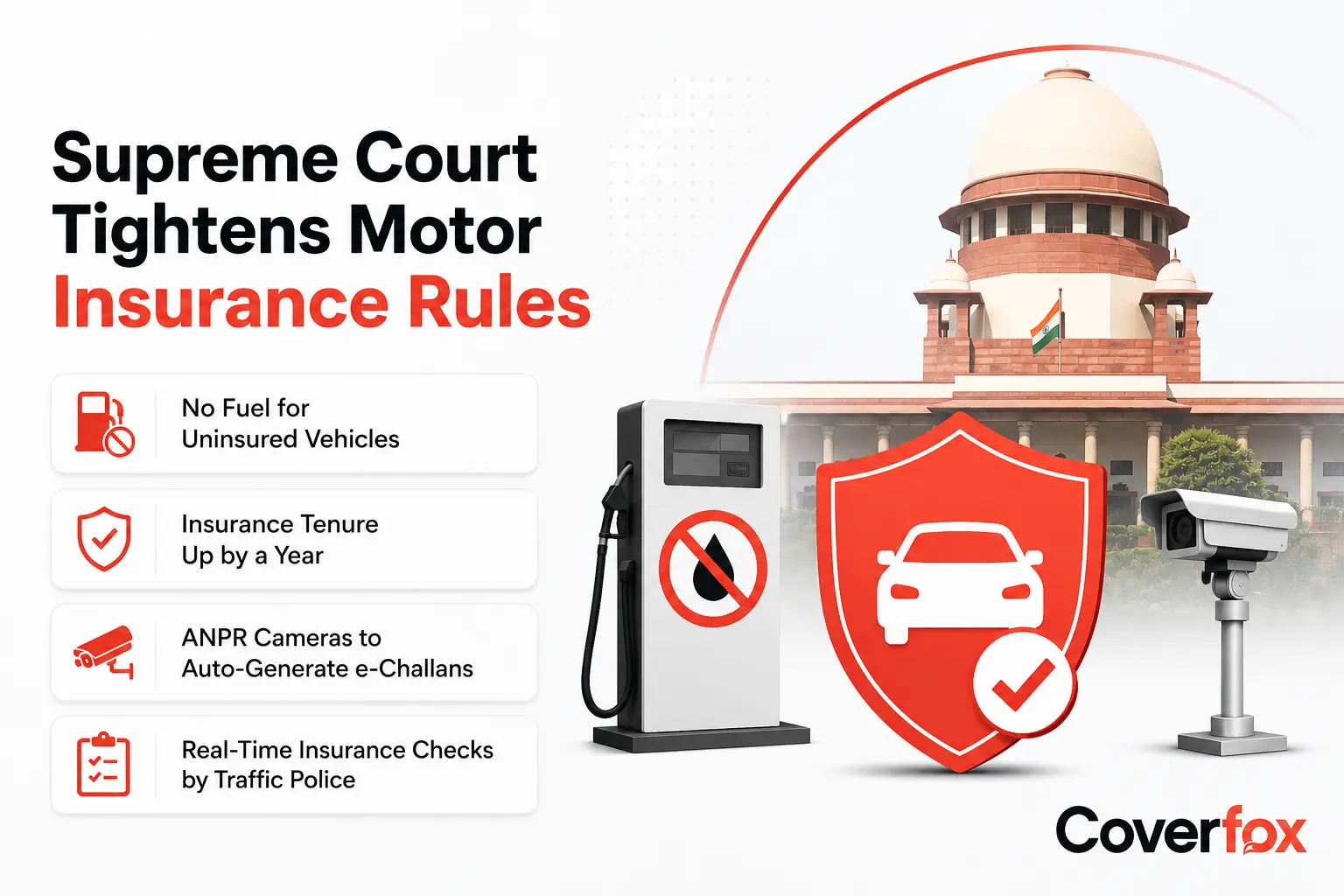
- The Supreme Court has directed IRDAI and the Ministry of Road Transport and Highways to design a pilot project that denies fuel at petrol pumps to vehicles without valid insurance, until the cover is renewed.
- Mandatory third-party insurance tenure for new vehicles has been extended by one year: from three to four years for cars, and from five to six years for two-wheelers.
- ANPR cameras on highways will be linked to the Insurance Information Bureau and VAHAN databases to auto-generate e-challans, and traffic police will get handheld devices to check insurance status on the spot.
A Supreme Court bench of Justices Sanjay Karol and Prashant Kumar Mishra passed a set of directions on August 4, 2026, aimed at closing the gap between India's mandatory motor insurance law and how poorly it's enforced on the ground. The order came in National Insurance Co. Ltd. v. Smt. Thungala Dhana Laxmi & Ors. (2026 INSC 793), a case that started as a routine accident compensation dispute and expanded into a nationwide review of motor insurance compliance.
What the Supreme Court Actually Ordered
The bench had earlier impleaded 22 insurance companies, the IRDAI, and MoRTH as parties, given how far the issue reached beyond the original appeal. After hearing submissions from the IRDAI, the General Insurance Council, and MoRTH, the Court issued eleven distinct directions covering enforcement, insurance structure, and claims processing.
Important context: these are Supreme Court directions requiring IRDAI and MoRTH to design and implement mechanisms, not rules that are already in force. Several changes, particularly the fuel-linkage pilot, still need to be built and rolled out by the two authorities.
Fuel Denial for Uninsured Vehicles: How the Pilot Would Work
This is the most attention-grabbing part of the order. The Court recorded that "the IRDAI, in consultation with the MoRTH, is to deliberate and evolve a pilot-project whereby fuel for vehicles to be linked with valid insurance status." In practice, a vehicle without valid insurance would be refused fuel at the pump until the owner renews the policy.
Detection method: ANPR (Automatic Number Plate Recognition) cameras already installed on highways and city roads would flag uninsured vehicles.
Cross-checked against: The Insurance Information Bureau database, maintained under IRDAI, and the VAHAN portal.
Oil ministry's position: The Court noted the Ministry of Petroleum and Natural Gas has "in principle, no objection" to the proposal.
Stated purpose: identifying uninsured vehicles on one hand, and pushing owners to keep their cover active on the other.
No date has been set for when this pilot will actually launch. IRDAI and MoRTH have been asked to develop the mechanism, not implement it immediately.
Third-Party Insurance Period Gets Longer
Back in 2018, in S. Rajaseekaran v. Union of India, the Court had made it mandatory to buy third-party insurance for three years on new cars and five years on new two-wheelers at the time of registration. Eight years on, the bench found compliance had barely moved, so it extended the mandatory tenure further.
| Vehicle Type | Previous Mandatory Tenure | New Mandatory Tenure |
|---|---|---|
| New cars | 3 years | 4 years |
| New two-wheelers | 5 years | 6 years |
IRDAI has been directed to issue the necessary implementation guidelines without delay.
A New Four-Layer Insurance Structure for Private Vehicles
Rather than leaving buyers to decode dense policy wording, the Court accepted IRDAI's proposal for a standard four-layer structure, to be presented through a mandatory "customer option form" at the point of purchase.
| Layer | Cover | Who Sets the Price |
|---|---|---|
| Third-Party Only (mandatory) | Base cover required under Section 146 of the Motor Vehicles Act | Fixed jointly by IRDAI and the Central Government |
| Occupant/pillion legal liability (optional) | Covers occupants or pillion riders other than the owner, driver, or their family | Set by individual insurers |
| Personal accident cover (optional) | Death or permanent disability of the owner, driver, or occupants/pillion riders | Set by individual insurers |
| Own damage cover (optional) | Loss or damage to the insured vehicle itself | Set by individual insurers, market-driven |
Every buyer will now see this broken down on a form with checkboxes and premium amounts against each layer, rather than a single bundled figure.
ANPR Cameras, E-Challans and Real-Time Checks
Enforcement was the Court's central concern, since the law mandating third-party insurance under Section 146 has existed for decades with little to show for it on the roads.
ANPR integration: Cameras already used to catch speeding and red-light violations will now also be linked to insurance databases to flag uninsured vehicles automatically.
Handheld verification for traffic police: Officers will get devices or apps connected to the Insurance Information Bureau and VAHAN data to check a vehicle's insurance status on the spot and issue challans.
Current fine structure: Rs. 2,000 for a first offence and Rs. 4,000 for repeat offences under Section 196 of the Motor Vehicles Act, which the Court noted is "not having the desired effect."
Proposed fine increase: A pending amendment to Section 196, not yet notified, would raise penalties to three times the vehicle's basic premium or Rs. 5,000 (whichever is higher) for a first offence, and five times the premium or Rs. 10,000 for repeat offences.
Public verification tool: A separate pilot would let citizens check whether a vehicle they're travelling in, or sending goods through, actually carries valid insurance, and whether it's third-party only or comprehensive.
Why the Court Stepped In: The Numbers Behind the Order
The bench leaned heavily on official data to justify the intervention.
56% of vehicles uninsured: Citing the Parliamentary Standing Committee on Finance's December 2024 report, the Court noted 16.54 crore of India's 30.48 crore vehicles carry no valid insurance.
Road accidents rising: Per a Rajya Sabha reply dated December 10, 2025, road accidents stood at 4,61,312 in 2022, 4,80,583 in 2023, and 4,87,705 in 2024.
Highway fatalities disproportionate: National highways make up roughly 2% of India's total road length but account for close to 30% of road deaths, a figure the Court cited from a separate ongoing matter on highway safety.
Claims stuck in limbo: The Court referenced its own recent observation that more than half of pending motor accident claim cases have dragged on for over four years.
Faster Accident Claims: The Other Half of the Order
Beyond insurance enforcement, the bench also revived older, frequently ignored directions on how quickly accident claims should move through the system.
Police must file a Detailed Accident Report before the Motor Accident Claims Tribunal within 30 days of an accident.
Police must ensure timely service and production of drivers, owners, or witnesses before the Tribunal.
Insurance companies must compute compensation within 30 days of receiving the accident report.
If an offer is accepted, payment must follow within 30 days; if rejected or found unfair, the Tribunal must pass an award within 30 days.
These directions apply specifically to accidents that occurred before March 31, 2022, since the 2022 amendment to the Central Motor Vehicles Rules already built similar timelines in for cases after that date.
National Insurance Co. Ltd. v. Smt. Thungala Dhana Laxmi & Ors.: Case Background
Underneath all the policy directions sits a 1996 road accident. The deceased, T. Ramu, was killed when a truck struck his car near Singarayakonda. His family's compensation claim was initially rejected by the Tribunal in 2009 on a technicality: that no extra premium had been paid to cover the owner's own risk while riding as a passenger. The Telangana High Court reversed that in 2024, awarding compensation based on an IRDA circular from 2009 that makes insurers liable to compensate any occupant under a comprehensive policy. The Supreme Court upheld that reasoning and dismissed the insurer's appeal on this point, before moving on to the wider systemic directions.
Is Any of This in Effect Yet?
Not immediately, and this is worth being clear about. The judgment directs IRDAI and MoRTH to build and roll out these mechanisms; it isn't a notification that takes effect on its own. All stakeholders have been asked to file compliance affidavits by August 14, 2026, with the matter next listed before the Court on August 18, 2026 to review progress. Vehicle owners should watch for actual IRDAI or MoRTH notifications rather than assuming the fuel-denial pilot or the extended insurance tenure is already operational.
Key Takeaways
The Supreme Court has pushed motor insurance enforcement in India toward technology-driven, real-time checks, ANPR cameras tied to insurance databases, a fuel-denial pilot, and mandatory four-layer policy disclosure, while also stretching out how long a third-party policy has to last before renewal comes up again. None of it changes what's required to drive a vehicle today (valid third-party insurance under Section 146 remains the baseline), but it signals that enforcement gaps insurers and regulators have tolerated for years are now squarely under judicial pressure to close.
Source -
https://www.verdictum.in/pdf_upload/2026/08/05/882720258150172912judgement04-aug-2026watermark-1782018.pdf
Frequently Asked Questions
Has fuel actually started being denied to uninsured vehicles?
No. The Supreme Court has only directed IRDAI and MoRTH to design a pilot project for this; it has not been implemented yet.
Is third-party insurance now mandatory for 4 years on all cars?
The Court has directed this extension, from three to four years for new cars and five to six years for new two-wheelers, but IRDAI still needs to issue formal implementation guidelines.
What happens if I don't have valid insurance right now?
You remain liable to a fine of Rs. 2,000 for a first offence and Rs. 4,000 for repeat offences under Section 196 of the Motor Vehicles Act, and your vehicle can be seized under Section 207, regardless of the pending amendment.
Which case led to this order?
National Insurance Co. Ltd. v. Smt. Thungala Dhana Laxmi & Ors., Civil Appeal No. 14369 of 2025, decided by the Supreme Court on August 4, 2026 (2026 INSC 793).
What is the four-layer insurance structure?
A mandatory third-party base policy, plus three optional add-ons: occupant/pillion legal liability cover, personal accident cover, and own damage cover, each to be disclosed and priced separately on a customer option form.

