
Written by Mansi Jaiswal, based on insights from Sanjib Jha
A Number That Should Keep Us Awake
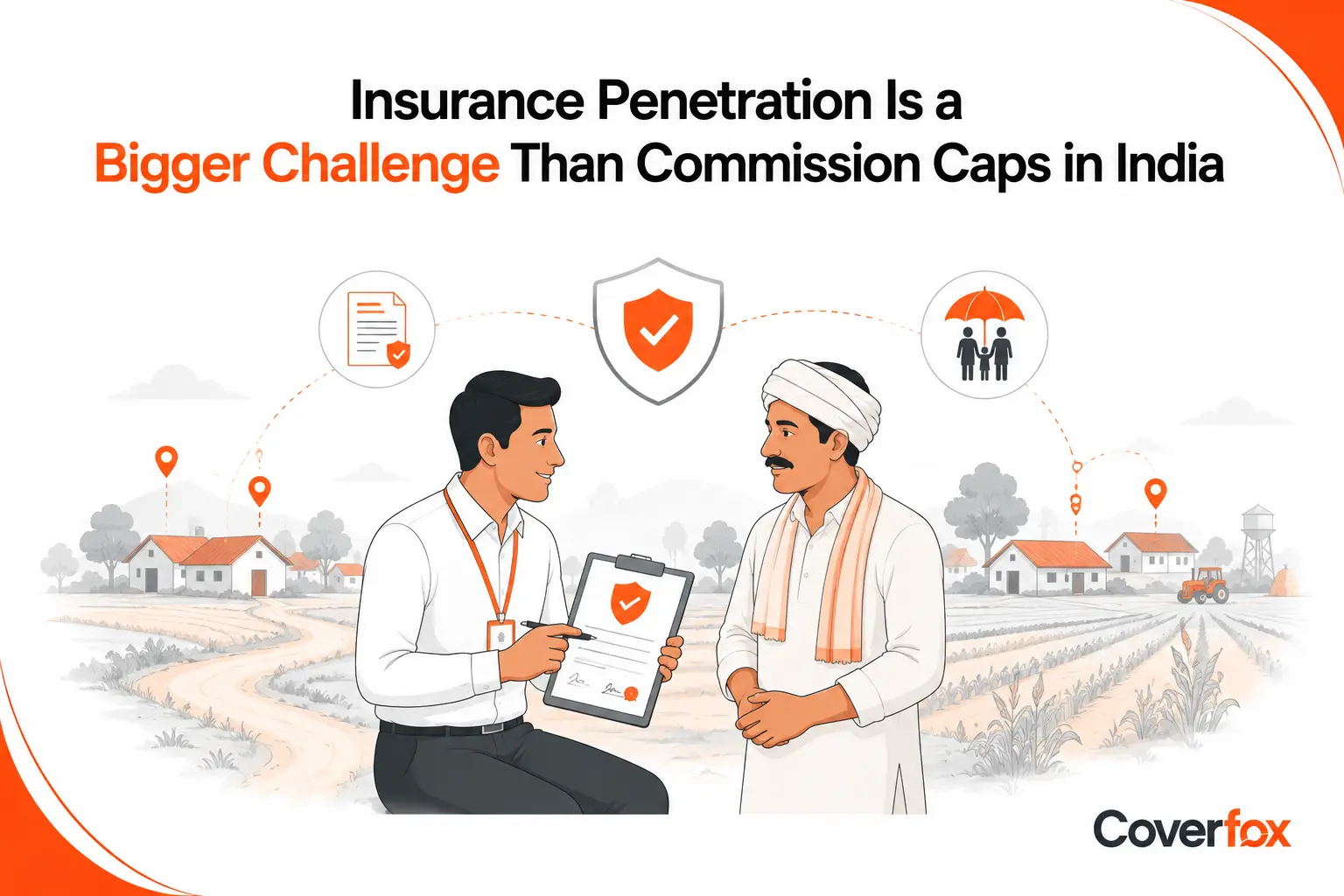
Somewhere in Marathwada tonight, a farmer is weighing the cost of his daughter's wedding against the premium on a crop insurance policy he isn't sure covers what he loses. In a small town in Uttar Pradesh, a daily-wage worker is hoping he does not fall sick this month - because if he does, there is no policy, no safety net, only debt. These are not hypothetical people. They are 900 million of our fellow citizens, and we have built an insurance industry that has simply never found them.
India's insurance penetration stood at 3.7% of GDP in FY25 - the third consecutive year of decline from the pandemic-era peak - against a global average of 7.3% and developed-market benchmarks of 10–11%. Insurance density stands at $97 per person against a global average of $943, and rural insurance literacy is below 15%. These are not statistics to file. They are the lived reality of a country still waiting to be protected.
It is in this context that renewed speculation around reintroducing direct commission caps on insurance intermediaries must be evaluated. The intent - reining in distribution costs, protecting policyholders, improving penetration - is not wrong. But the question that should occupy all of us is not whether IRDAI can act, but how - and whether a blunt, uniform cap is the right instrument for a country that does not suffer from too much distribution cost, but from too little insurance, reaching too few people.
What We Got Right in 2023 - And Why It Mattered
The Expenses of Management (EOM) framework introduced in 2023 fixed a distortion everyone in this industry recognised: under earlier rigid, product-level commission caps, distributor attention flowed toward whatever paid the most, while products that mattered most - micro-insurance, crop insurance, group loan protection - were left to wither. EOM set an overall expense ceiling for insurers but gave them freedom to decide distribution economics within it.
Something quietly remarkable followed. An insurtech embedding loan protection at the moment of an NBFC disbursement could build economics that made sense. A Bima Vahak - a woman trained to sell and service policies in her own village - could be compensated in a way that made her work in Vidarbha commercially practical, even on a policy worth just ₹400 a year. For the first time, the platforms trying to reach gig workers, borrowers, and informal-sector households had room to build something that could survive.
This was not a technical adjustment. It was the first real opening for India's last mile in years.
The Anatomy of the Uninsured - And Why the Map Tells the Story
There are roughly 900 million Indians without meaningful insurance coverage: the borrower whose family loses their home if he dies before the loan is repaid, the gig worker with no employer standing between him and his next hospital bill, the farmer whose crop premium doesn't come close to covering what a failed monsoon actually costs. These people are not uninsured because commissions made premiums too expensive. They are uninsured because no one has yet reached them - and for many models attempting to do exactly that, commercial viability is already a thin margin.
| City Tier | Share of Population | % of Life Premium | % of Non-Life Premium |
|---|---|---|---|
| Tier 1 (8 Metros) | ~35% | ~60–65% | ~55–60% |
| Tier 2 (Next 50 cities) | ~18% | ~25–30% | ~25–30% |
| Tier 3 + Rural (~47% of India) | ~47% | ~10–15% | ~12–18% |
Source: IRDAI Annual Report FY2024-25 | IBEF Insurance Sector Report 2025 | Policybazaar 5-Year Analysis
Tier 3 cities and rural India - half of this country's 1.46 billion people - generate just 10–15% of life insurance premiums and 12–18% of non-life premiums, while eight metro cities account for an estimated 60–65% of life premium income. This is not a market finding its natural shape; it is the shadow of decades of an industry building only where it was easiest to build.
Half of India barely registers on our balance sheets. That is the real penetration crisis - not the commission line item.
Watching the Retreat Happen, in Real Time
If you want to know what happens when distribution economics tighten even slightly, you do not need to imagine it. In a single year, HDFC Life's rural policy share fell from 30.4% to 23.6% - not because rural India needed insurance any less, but because urban India, riding a buoyant equity market, offered better economics for ULIPs. The one insurer that moved the other way - LIC - did so on the back of a 1.4-million-strong agent network built over generations, under a public mandate that gave agents a reason to keep showing up where the economics were thin.
| Insurer | Rural Share FY24 | Rural Share FY23 | Change |
|---|---|---|---|
| LIC | 47.72% | 22.25% | +25.47 pp |
| SBI Life | 30.78% | 31.87% | −1.09 pp |
| HDFC Life | 23.61% | 30.44% | −6.83 pp |
| ICICI Pru Life | 20.90% | 22.63% | −1.73 pp |
| Max Life | 23.90% | 21.13% | +2.77 pp |
Source: Company Annual Reports FY2024; Business Standard - 'Pvt insurers ceded ground in rural areas in FY24' (Aug 2024)
The Hidden Cost of Treating Mumbai and Marathwada the Same
The deepest flaw in a uniform commission cap is one of empathy as much as economics: it assumes that selling insurance is the same act, everywhere, to everyone. Selling a term policy to a salaried professional in Bengaluru through a slick app costs a fraction of what it takes to sit with a farmer in Marathwada, in his language, more than once, earning trust that no push notification can replace. One of these journeys can be automated. The other cannot - not yet, maybe not for a generation. And it is precisely the second journey that Insurance for All by 2047 depends on.
78% of rural India has no formal insurance cover at all - not because commissions made premiums too expensive, but because nothing has ever been offered to them.
84% of rural respondents say they cannot buy a policy on their own; they do not need a discount, they need a person - patient, trusted, paid enough to keep coming back.
Bima Vahaks - IRDAI's own vision for village-level insurance agents - depend entirely on commissions that work at ₹400–800 annual premiums.
A uniform cap calibrated for the high-volume corridors of urban bancassurance would land on these women's earnings just as hard as on a bank.
The difference is that the bank has a hundred other revenue lines to absorb the shock. The Bima Vahak has only this one.
The Last Mile, Counted
If the human stories do not move the needle, the numbers will. Each row below is not an abstraction - it is millions of families standing on the wrong side of a line that, right now, only gets harder to cross.
| Metric | Data Point | What It Tells Us |
|---|---|---|
| Insurance penetration (FY25) | 3.7% of GDP | Flat for 3rd consecutive year; global avg 7.3% |
| Insurance density | $97 per capita | vs $943 global avg; $4,000+ USA; $800+ China |
| Rural population insured | Only 22% | 78% of rural India has no formal cover |
| Villages with insurance access | <20% of 6 lakh villages | Despite housing ~65% of India's population |
| Insurance agents – urban concentration | ~70%+ in Tier 1 & Tier 2 | Of 3.12 million agents; rural markets starved |
| SAHI offices in Tier 1 | ~80% | Standalone health insurer offices - 4 in 5 in metros |
| Rural insurance literacy | <15% | vs 23% nationally; awareness gap is structural |
| Rural independent policy purchase | Only 16% | 84% cannot buy without hand-holding - agents needed |
| Out-of-pocket health expenditure | 58.7% of health spend | Catastrophic risk exposure - the cost of no insurance |
| Private insurer rural share (avg FY24) | ~24% of policies | And falling - HDFC Life down 6.8 pp in one year |
Sources: IRDAI Annual Report FY2024-25 | Bajaj Capital Suraksha Kavach Report 2025 | GFTN Insurance Ecosystem Report Aug 2025 | Business Standard | National Health Accounts India
Lessons From a Sector That Has Already Walked This Road
There is a useful mirror for this debate sitting right next to us in the financial system. Forty years ago, formal credit in India was as distant from the last mile as insurance is today. The journey from there to a country where an NBFC can profitably lend to a borrower 30 kilometres from the nearest bank branch took decades - and it happened for reasons directly instructive for where insurance stands today.
| Milestone | Data Point | Why It Matters |
|---|---|---|
| NBFC AUM growth | ₹2T → ₹30+ trillion (FY23) | ~15x growth over two decades, most in underserved geographies |
| Microfinance portfolio (FY24) | ₹6,889 billion, +26% YoY | Tier 3, rural, informal-sector lending growing fastest |
| NBFC rural loan growth (2022) | +70% YoY (vs +65% urban) | First time rural lending growth outpaced urban |
| NBFC sector ROA (FY24) | ~2.9% | Proof last-mile lending can be commercially viable at scale |
| Time taken | ~40 years | From branch licensing (1970s) to NBFC/MFI/fintech last-mile (2020s) |
Sources: CRISIL MI&A / Northern Arc Investor Report 2025 | Sa-Dhan Quarterly Report June 2024 | Statista/BCG India
The most important number in that table is the ROA: 2.9%. Sa-Dhan, the RBI-recognised self-regulator for microfinance, considers an ROA of 3–4% "appropriate" for institutions whose entire business model is lending small amounts to people most of the financial system had given up on. Read that again: the sector that took on India's hardest lending - informal incomes, no credit history, geographies where the next branch is an hour away - runs on a return of 1.5% to 3% on assets. That is not a sector drowning in margin. That is a sector that made the economics of reach work, at scale, on razor-thin returns - because technology, policy design, and a mindful distribution ecosystem did the heavy lifting that margin alone never could.
The credit sector's transformation was never primarily a cost story. It was a structural story: priority-sector lending norms that gave banks a reason to look beyond metros; an NBFC regulatory framework that let differentiated business models survive on thin margins because volume and technology made unit economics work; and the JAM trinity that cut the cost of acquiring and servicing a customer in a way no commission cap ever could.
Insurance has the equivalent building blocks on the table right now - Bima Sugam, Bima Vistar, Bima Vahaks - but they are early-stage, under-scaled, and at risk of being undermined before they have had the chance credit's equivalents were given.
Credit did not get to the last mile by becoming cheaper to distribute. It got there by becoming structurally rewarding to distribute - for those willing to go where others wouldn't.
Target Behaviour, Not Capacity: A Smarter Path Forward
The honest question is not whether distribution costs should be watched - of course they should. The honest question is whether a uniform cap is the right tool, or whether it punishes an entire ecosystem for the sins of a few high-volume, low-effort channels. The wiser path is to match the commission to the difficulty of the journey, the way credit policy eventually learned to match capital and incentives to the difficulty of the borrower:
Higher remuneration
For policies sold in Tier 2 and Tier 3 districts, to first-time buyers, or through last-mile models like Bima Vahaks and NBFC-embedded platforms.
Tighter oversight
For high-volume urban and bancassurance channels, where the cost of reaching a customer is demonstrably and measurably lower.
Structural recognition
In solvency norms, capital treatment, or rural-obligation scoring - for insurers who can show, with data, that they are moving the 10–15% number, not just managing it.
None of this is radical. It is how credit eventually learned to think about its hardest-to-reach borrowers - and it took 40 years to learn it. Insurance does not have another 40 years to relearn the same lesson the hard way.
What We Owe the Next 41 Crore Policies
India issued more than 41 crore insurance policies in FY25 and collected ₹11.93 lakh crore in premiums. By any conventional measure, that is an industry firing on all cylinders. And yet penetration didn't move - not by a single basis point, for the third-year running. That gap, between the volume we celebrate in our annual reports and the protection that reaches people's lives, is a story about distribution, about reach, about whether anyone shows up. It is not a story about commissions being too generous.
The EOM framework of 2023 was genuinely bold, evidence-led policymaking. The Bima Trinity - Bima Sugam, Bima Vistar, and Bima Vahaks - is exactly the kind of structural thinking that can move the needle on penetration, if we let it breathe the way priority-sector lending and NBFC reform were allowed to breathe for decades before anyone asked whether they cost too much. Parliament's decision to give IRDAI greater discretion over commission structures is an opportunity to build on that foundation. It would be a tragedy to use it instead to dismantle what we have only just started building.
This new discretion is a scalpel. It should not be wielded like an axe. The answer to India's insurance challenge has never been fewer incentives - it is better incentives: incentives that follow the customer who is hardest to reach, not the one who was always going to buy anyway. Rewards tied to persistence, not just the moment of sale. Outcome metrics like geographic reach and first-time-buyer share as the gateway to higher commission eligibility - exactly as priority-sector targets did for credit.
Before this debate moves any further, I would ask every policymaker to sit, just for a moment, with that farmer in Marathwada - and with the question that should be keeping all of us awake: not 'are commissions too high?', but 'why, after everything we've built, are 78% of rural Indians still waiting - and are we about to make them wait another 40 years?' That is the number worth fixing first.
Views expressed are personal.
Data Sources: IRDAI Annual Report FY2024-25 | Swiss Re Sigma 2024 | IBEF Insurance Sector Report 2025 | GFTN Insurance Ecosystem Report Aug 2025 | Business Standard | Bajaj Capital Suraksha Kavach Report 2025 | CRISIL MI&A / Northern Arc Investor Report 2025 | Sa-Dhan Quarterly Report June 2024 | Company Annual Reports FY2023-24 & FY2024-25 | National Health Accounts India

