
- Retail Insurance
- Business Insurance
- Resources
- Claims
Gold holds deep cultural and religious significance in India, symbolising wealth, luck, and prosperity across generations. It’s not just an ornament but a trusted investment and a mark of social status. To ensure authenticity and purity, the BIS hallmarking system certifies gold jewellery, giving buyers confidence in their purchase. These certifications include KDM, Gold Hallmark, 916 Gold, and much more, each having its own meaning and status that you can learn about through this page.
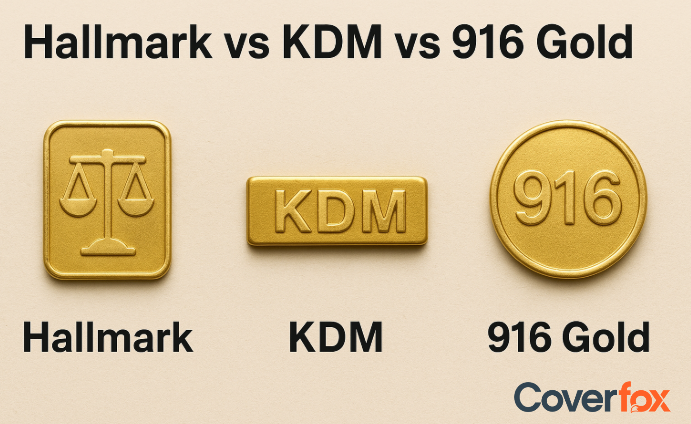
Hallmark gold refers to jewellery certified by the Bureau of Indian Standards (BIS) hallmark, ensuring its purity and authenticity. This hallmark on gold includes details like the BIS logo, purity level (such as 916 gold for 22 karat), and the jeweller’s identification mark. Checking for a genuine BIS hallmark while buying gold jewellery in India helps ensure you’re purchasing authentic and high-quality gold.
KDM gold refers to gold jewellery made using cadmium solder instead of the traditional gold-silver alloy. Although once popular for its strong joints and smooth finish, KDM gold is now restricted due to cadmium’s health hazards. Today, jewellers in India prefer BIS hallmark gold or 916 gold for safer and purer gold jewellery options.
916 gold, also known as 22 karat gold, contains 91.6% pure gold mixed with other metals for added strength. It’s the most common choice for making gold jewellery in India due to its ideal balance of purity and durability. Always look for the BIS hallmark on 916 gold to ensure authenticity, purity, and the correct 916 hallmark gold price.
When purchasing gold jewellery in India, it’s essential to understand the key differences between Hallmarked Gold, KDM Gold, and 916 Gold — each representing distinct aspects of purity, certification, and craftsmanship.
| Factor | Hallmarked Gold | KDM Gold | 916 Gold (22K) |
|---|---|---|---|
| Meaning | Gold jewellery certified by BIS for purity and authenticity | Gold alloyed with cadmium solder during jewellery making | Gold with 91.6% purity (22 parts gold out of 24) |
| Purity | Can vary – 22K, 18K, or 14K | Around 92% (similar to 22K) | Exactly 91.6% pure gold |
| Certification | BIS hallmark indicating purity and testing centre | Not officially certified | Can be BIS hallmarked |
| Usage | Standard for buying and selling gold jewellery in India | Mostly used in traditional handmade ornaments | Commonly used for wedding and daily wear jewellery |
| Health & Safety | Safe and government-approved | Cadmium use poses health risks to artisans | Safe and widely accepted |
| Key Highlight | Assures purity and authenticity | Outdated and being phased out | Ideal mix of purity and durability |
Identifying genuine Hallmarked Gold Jewellery is simple if you know what to look for.
Look for the BIS logo – it confirms government certification.
Check the purity mark, such as 22K916, 18K750, or 14K585.
Verify the Assaying and Hallmarking Centre’s identification mark.
Find the Jeweller’s unique identification number stamped on the item.
Use the BIS Care App to authenticate the hallmark digitally before purchasing.
Gold comes in various types and purities, each suited for specific jewellery styles and investment purposes.
24K Gold (99.9% pure): Highest purity; soft and ideal for coins, bars, and gold bullion.
22K Gold / 916 Gold (91.6% pure): Common in traditional Indian gold jewellery; strong yet retains shine.
18K Gold (75% pure): Durable with a rich hue; preferred for diamond or gemstone-studded jewellery.
14K Gold (58.5% pure): Affordable and hardy; used in daily wear gold ornaments.
White Gold: Alloyed with palladium or nickel; modern alternative to platinum for rings and accessories.
Rose Gold: Contains copper for a pinkish tone; trendy in contemporary and bridal jewellery.
Green Gold: Mixed with silver and zinc; rare and used in designer gold jewellery.
KDM Gold: Uses cadmium solder for purity maintenance; now replaced by hallmark-compliant gold.
Black Hills Gold: Distinct tri-colour (green, pink, yellow) style, originated from South Dakota.
Gold Bullion: Investment-grade 24K gold bars and coins certified for purity.
Gold ETFs (Exchange Traded Funds): Digital investment in gold value without physical ownership.
Gold hallmarking offers assurance of purity, transparency, and trust when purchasing gold jewellery in India.
Confirms that the gold’s actual fineness matches the stated karat, such as 916 for 22K gold.
Protects buyers from counterfeit or impure gold jewellery often sold at high prices.
Hallmarked gold is easier to sell or exchange since it’s verified for authenticity.
Ensures uniform gold purity standards across all jewellers under BIS hallmarking.
Builds trust and peace of mind while buying or investing in gold ornaments.
The gold hallmarking process ensures that every gold ornament or item meets BIS-certified purity and quality standards.
Jeweller submits gold jewellery or items to a BIS-approved Assaying and Hallmarking Centre.
Samples are tested using methods like X-ray fluorescence (XRF) or fire assay to determine purity.
Once purity is verified, BIS stamps the gold with the official hallmark symbols.
The item is recorded and certified for karat, jeweller’s code, and hallmarking centre ID.
The hallmarked gold jewellery is returned, ready for sale with verified purity.
Hallmark gold commands a higher resale value because its purity and authenticity are certified by BIS, ensuring complete buyer confidence. Jewellers readily accept hallmarked gold since the karat value is verified and transparent. This eliminates disputes during resale, offering better returns and a smoother exchange process compared to non-hallmarked gold.
Ans: Hallmarked gold is certified by BIS for purity and authenticity, assuring buyers that the jewellery meets Indian standards and protects them from fraud.
Ans: It means the gold is 99.9% pure, representing the highest possible purity level for investment-grade gold.
Ans: Hallmark gold prices may vary due to making charges, hallmarking costs, and purity verification, even though the base gold rate remains similar.
Ans: You can verify the BIS hallmark and jeweller details through the BIS Care app available on Android and iOS.
Ans: KDM gold was banned because cadmium used in soldering posed severe health risks to workers during the jewellery-making process.
Ans: Look for the BIS logo, purity mark (like 916 for 22K), jeweller’s identification code, and hallmarking centre number on the ornament.
Ans: 24K gold is too soft and malleable, making it unsuitable for intricate designs or daily wear jewellery.
Ans: Gold is typically hallmarked in purities like 24K, 22K (916), 18K, and 14K, each verified by BIS for quality and fineness.

