
- Retail Insurance
- Business Insurance
- Resources
- Claims
In India, taxes play a crucial role in building infrastructure such as roads, railways, airports, and digital networks, while also supporting essential public services like healthcare, education, defence, and law enforcement. Tax revenue further enables welfare schemes, including food security programmes, rural employment initiatives, subsidies, and social security benefits, thereby promoting inclusive economic growth and stability.
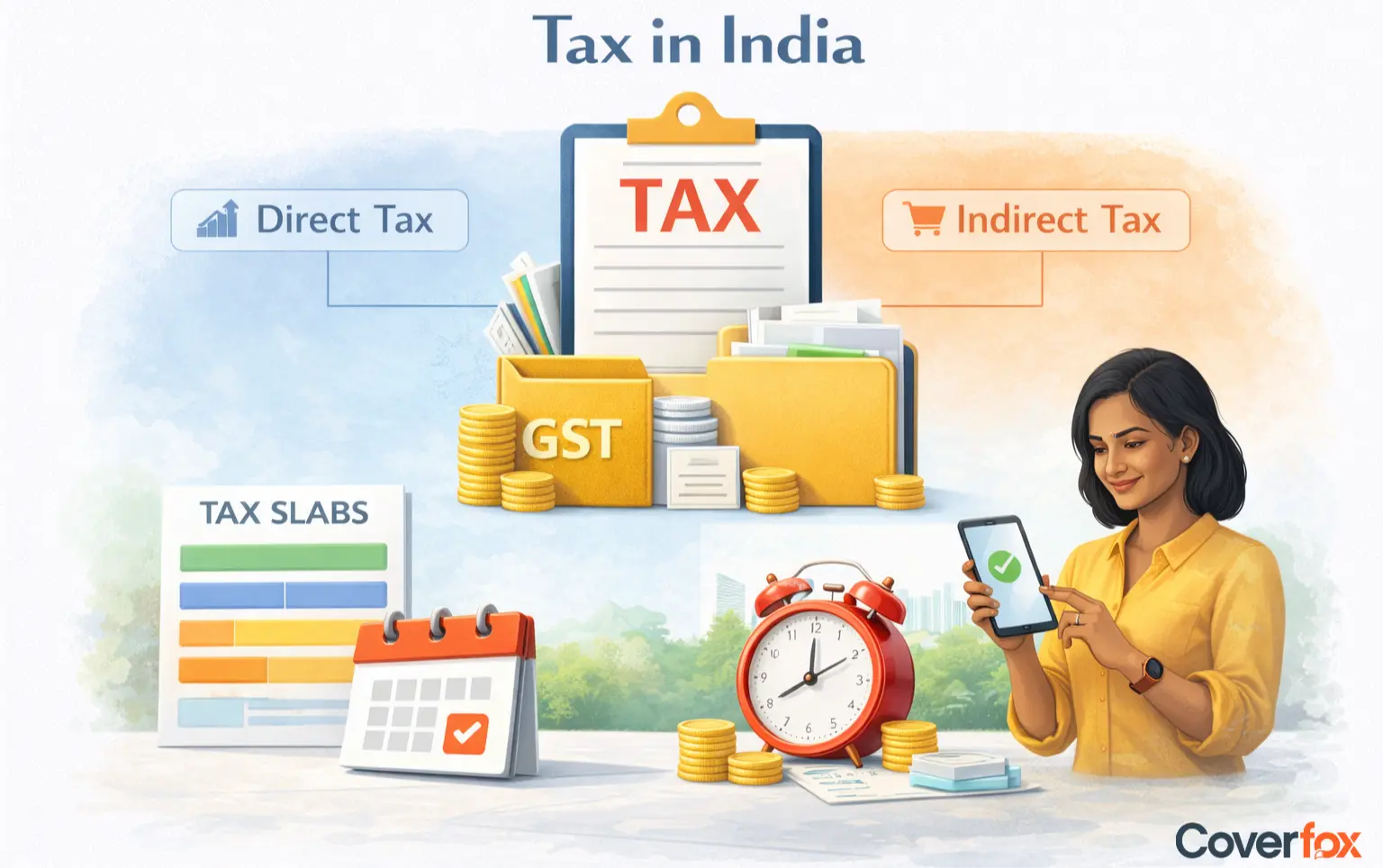
A tax is a compulsory financial levy imposed by the government on individuals, businesses, and other entities to generate public revenue. This revenue is used to run the country’s administration, provide public services, develop infrastructure, support welfare programmes, and maintain economic stability by regulating income distribution and controlling inflation.
In India, taxation powers are divided between the Centre and States under the Constitution through the Seventh Schedule, with separate legislative lists for Central and State taxes.
The Seventh Schedule of the Indian Constitution lists which taxes the Centre and States can levy and collect, ensuring a clear allocation of taxation authority.
The Income Tax Act, 1961, governs direct taxes on income for individuals, companies and other entities in India, and is regularly updated through annual Finance Acts. Official link: Income Tax Act, 1961 – Official (Income Tax Dept)
The Central Board of Direct Taxes (CBDT) administers and enforces direct tax laws like the Income Tax Act, formulates direct tax policies and supervises tax collection.
The Goods and Services Tax (GST) is governed by GST laws and administered jointly by the Centre and States via CGST/SGST/IGST posts under the GST Council structure. Official link: GST Rules – Goods and Services Tax Council (CGST Rules)
The Central Board of Indirect Taxes and Customs (CBIC) oversees GST and customs duties, and plays a key role in indirect tax enforcement and policy advice. Official link: CBIC – Official Website (Central Board of Indirect Taxes & Customs)
India’s tax system is broadly classified into Direct Taxes and Indirect Taxes — direct taxes are paid directly by taxpayers to the government, while indirect taxes are levied on goods and services and ultimately borne by consumers.
Direct taxes are levied directly on individuals, businesses, and entities based on income, profits, or gains, and the liability cannot be shifted to others. They are generally progressive, meaning higher earners pay a higher tax rate, helping reduce income inequality and redistribute resources.
Income tax on individual income as per specified tax slabs for FY 2025–26 (AY 2026–27).
Tax on profits earned by companies and businesses.
Tax on profits from sale of assets (Short-Term & Long-Term Capital Gains).
Tax on purchase/sale of securities like shares.
Tax on receipt of monetary or valuable gifts above a threshold.
Abolished in India (earlier replaced by surcharge mechanisms on high incomes and other indirect ways of taxing wealth).
Indirect taxes are levied on goods and services and collected by intermediaries (like businesses) from the final consumer; the burden is passed on through the supply chain.
A unified tax on supply of goods and services comprising CGST, SGST/UTGST (for intra-state) and IGST (for inter-state) transactions.
Tax on imported (and some exported) goods.
Applies on production/sale of certain goods (now limited mainly to alcohol & petroleum outside GST).
Earlier state-level tax on goods (now subsumed largely by GST, but may exist in special cases).
Historical indirect taxes prior to GST implementation (now covered under GST).
Under the Income Tax Act, taxpayers in India are classified based on their legal status and source of income.
Includes resident and non-resident individuals earning income in India.
A separate taxable entity recognised under Indian tax laws.
Includes domestic and foreign companies operating in India.
Partnership firms and Limited Liability Partnerships are taxed separately.
Group of persons earning income collectively.
Taxed as per specific provisions under the Act.
The latest income tax slabs effective for Financial Year 2026–27 (Assessment Year 2027–28) were reaffirmed in the Union Budget 2026, and the Government kept the existing slab structure unchanged while introducing a new Income Tax Act to take effect from 1 April 2026.
| Taxable Income (₹) | New Tax Regime Rate |
|---|---|
| Up to 4,00,000 | Nil |
| 4,00,001 – 8,00,000 | 5% |
| 8,00,001 – 12,00,000 | 10% |
| 12,00,001 – 16,00,000 | 15% |
| 16,00,001 – 20,00,000 | 20% |
| 20,00,001 – 24,00,000 | 25% |
| Above 24,00,000 | 30% |
These rates apply under the new tax regime for individual taxpayers.
Old tax regime slabs continue with higher basic exemption limits and standard deductions, but without the structured multi-slab progression of the new regime; taxpayers can still opt for it while filing their returns.
Under the new regime, individuals earning up to ₹12 lakh can effectively pay zero tax after rebate and deduction adjustments, making it attractive for many salaried taxpayers.
Source - PRID=2221458"https://www.pib.gov.in/PressReleasePage.aspx?PRID=2221458
Here’s how the new tax regime differs from the old one:
Offers lower tax rates with fewer deductions and exemptions, simpler compliance, and minimal paperwork, making it suitable for taxpayers who do not claim many benefits.
Has higher tax rates but allows multiple deductions and exemptions such as HRA, 80C, and 80D, making it beneficial for those who invest in tax-saving schemes and claim exemptions.
The new tax regime is available to all individual taxpayers, including salaried employees, self-employed persons, and professionals.
It can be opted for by HUFs (Hindu Undivided Families) as well.
Salaried individuals can choose the regime every financial year while filing their income tax return.
Self-employed persons can switch back to the old regime only once after opting out of the new regime.
Taxpayers must select their preferred regime while filing returns or submitting Form 10-IEA (where applicable).
To choose the right tax regime, taxpayers should carefully compare their income level, eligible deductions and exemptions (such as 80C, 80D, HRA, and home loan benefits), and long-term financial goals. If you have limited investments and prefer simple compliance, the new regime may be suitable. However, if you actively invest in tax-saving instruments and claim multiple benefits, the old regime may help you reduce your overall tax liability. Evaluating both options before filing returns ensures better financial planning and maximum tax savings.
| Section | Purpose of Deduction | Maximum Deduction (Approx) |
|---|---|---|
| 80C | Investments & expenses like EPF, PPF, NSC, ELSS, life insurance premiums, tuition fees | ₹1,50,000 |
| 80CCD(1B) | Additional deduction for NPS contributions | ₹50,000 |
| 80CCD(2) | Employer’s contribution to NPS | Up to 10–14% of salary |
| 80D | Medical/health insurance premiums | ₹25,000 (₹50,000 senior citizen) |
| 80E | Interest on education loan | No upper limit |
| 80G | Donations to approved charities | Depends on institution |
| 80TTA / 80TTB | Savings account interest income | Up to ₹10,000 / higher for seniors |
| Section 24(b) | Home loan interest deduction | Up to ₹2,00,000 |
Notes: These deductions are primarily available under the old tax regime; many are not available (or are limited) if opting for the new tax regime unless specifically allowed and the aggregate cap for Section 80C, 80CCC, and 80CCD(1) is ₹1,50,000.
Under the simplified new tax regime, most traditional deductions and exemptions are available only to institutions/funds; a limited set of deductions is still permissible to provide basic relief to taxpayers while keeping the regime simple and low-compliance.
Salaried individuals and pensioners can claim a standard deduction (currently ₹75,000 per year) from their salary/pension income.
Employer contributions to the National Pension System (up to 10–14% of salary) remain deductible.
A deduction on family pension income (lower of one-third of actual pension or ₹25,000) is allowed.
Specific contributions to Agniveer Corpus Fund are allowed under the regime.
A rebate under Section 87A (up to ₹60,000) reduces tax liability for individuals with taxable income up to ₹12 lakh.
Most traditional deductions, such as 80C (investments like PPF/ELSS/LIC), 80D (health insurance), HRA, LTA, home loan interest, etc. are not available under the new tax regime.
Direct and indirect taxes have different impacts on taxpayers and the economy, with direct taxes promoting fairness through income-based charging and indirect taxes ensuring easy collection through consumption.
| Type of Tax | Advantages | Disadvantages |
|---|---|---|
| Direct Taxes | Progressive in nature, promotes income equality, and increases government control | Higher compliance burden, risk of tax evasion, affects savings and investment |
| Indirect Taxes | Easy to collect, wide coverage, ensures steady revenue | Regressive in nature, increases the cost of living, burdens low-income groups |
Filing an Income Tax Return (ITR) is the process by which a taxpayer reports income earned, deductions claimed and taxes paid to the Income Tax Department for a financial year. It can be filed online through the official e-Filing portal.
Go to the Income Tax e-Filing Portal
Use your PAN as User ID, password and captcha to log in. Ensure your PAN is linked with Aadhaar.
Download your pre-filled information (income, TDS, deductions) by entering PAN and Assessment Year.
From the dashboard, go to e-File > Income Tax Returns > File Income Tax Return.
Select the correct assessment year and appropriate ITR form (e.g., ITR-1 for salaried individuals).
Fill in all applicable income heads like salary, house property, capital gains, etc.
Enter deductions under Chapter VIA (under old regime) and verify totals.
Verify the tax liability, check calculations, and preview your return.
Submit the completed ITR form on the portal.
Verify your return electronically using Aadhaar OTP, net banking, bank account EVC or Demat EVC.
Depending on your income sources, you should have:
PAN & Aadhaar cards (linked).
Form 16 (salary income & TDS).
Form 26AS & Annual Information Statement (AIS).
Bank statements/passbook (interest income).
Investment proofs for deductions under the old regime (80C, 80D, etc.).
Rent receipts/house property details (if applicable).
Business or profession records, if income is non-salary.
Income tax compliance requires taxpayers to adhere to prescribed due dates for filing returns and paying taxes.
ITR Filing (Non-audit cases) - 31 July of the assessment year.
ITR Filing (Audit cases) - 31 October of the assessment year.
Advance Tax Due Dates
15 June – 15%
15 September – 45%
15 December – 75%
15 March – 100%
TDS Return Filing
Q1 (Apr–Jun): 31 July
Q2 (Jul–Sep): 31 October
Q3 (Oct–Dec): 31 January
Q4 (Jan–Mar): 31 May
Official Source: Income Tax Department - Due Dates
Failure to file returns or pay taxes within the prescribed time may attract penalties, interest, or legal consequences under the Income Tax Act.
Up to ₹5,000 depending on delay and income level.
Charged for delay in filing, advance tax shortfall, or non-payment.
50% to 200% of tax payable in certain cases.
In serious cases of tax evasion.
Official Source: Income Tax Act, 1961 – Penalty & Interest Provisions
Paying taxes is not just a legal obligation but a contribution towards nation-building and economic stability.
Funds the construction of roads, highways, railways, airports, digital networks, and smart cities.
Supports essential services such as healthcare, education, defence, police, and judiciary.
Finances government programmes like food security, rural employment schemes, pensions, and subsidies.
Enables public investment, boosts employment, and supports overall economic development.
Direct taxes help reduce income inequality through progressive taxation.
Strengthens defence forces and disaster management systems.
Higher tax compliance strengthens India’s fiscal position and global economic standing.
Paying taxes ensures active participation in the country’s growth and governance.
Disclaimer:
* Tax benefits under Section 80D are subject to applicable tax laws and individual eligibility—please consult a tax advisor for guidance.
* The 0% GST benefit is as per the new GST 2.0 reforms, subject to change as per GST updates.
* All savings and online discounts are provided by insurers as per IRDAI approved insurance plans.
* ₹250/month is the cheapest premium price for an 18-year-old male living in Mumbai.
* STANDARD TERMS AND CONDITIONS APPLY. For more details on risk factors, terms and conditions, please read the policy document carefully.
No, only individuals and entities whose income exceeds the basic exemption limit prescribed under the Income Tax Act are required to pay income tax.
India follows a dual system with two options: the old tax regime (with deductions and exemptions) and the new tax regime (with lower rates and limited deductions).
Direct taxes are paid directly by taxpayers on income or profits, while indirect taxes are levied on goods and services and passed on to consumers.
Goods and Services Tax (GST) and corporate income tax together form the largest share of India’s total tax revenue.
Tax rates are proposed by the Central Government in the Union Budget and approved by Parliament.
No, India’s personal income tax rates are moderate compared to many developed countries, and the new tax regime has made taxation more competitive.
You should compare your total tax under both regimes after considering your income, deductions, and investments, and choose the option with lower tax liability.
You may face late fees, interest, loss of refund claims, difficulty in loans/visas, and possible legal action in serious cases.
Yes, premiums for life and health insurance are deductible under Sections 80C and 80D in the old tax regime.
Salaried individuals can switch every year, while self-employed taxpayers can switch only once.
FY is the year in which income is earned, while AY is the following year in which tax is assessed and paid.
Individuals earning income above the exemption limit, companies, firms, and certain specified persons must file ITR.
No, the new tax regime is the default option, but taxpayers can still choose the old regime while filing returns.
Standard deduction, employer’s NPS contribution (80CCD(2)), family pension deduction, Agniveer Corpus Fund deduction, and Section 87A rebate are allowed.
You can file a belated return with a late fee and interest, but certain benefits and loss carry-forwards may be restricted.
Yes, a late filing fee of up to ₹5,000 under Section 234F and interest under Sections 234A/B/C may apply.
Yes, life insurance premiums qualify under Section 80C and health insurance premiums under Section 80D under the old regime.


