
- Retail Insurance
- Business Insurance
- Resources
- Claims


The TVS Orbiter is an electric scooter built for everyday urban commuting. It is available in two variants: the Orbiter V1 with a 1.8 kWh battery and the Orbiter V2 with a 3.1 kWh battery. The V1 has an IDC range of 86 km, while the V2 can travel up to 158 km on a single charge. Both variants use a 2.5 kW peak-power BLDC hub motor and have a top speed of 68 km/hr.
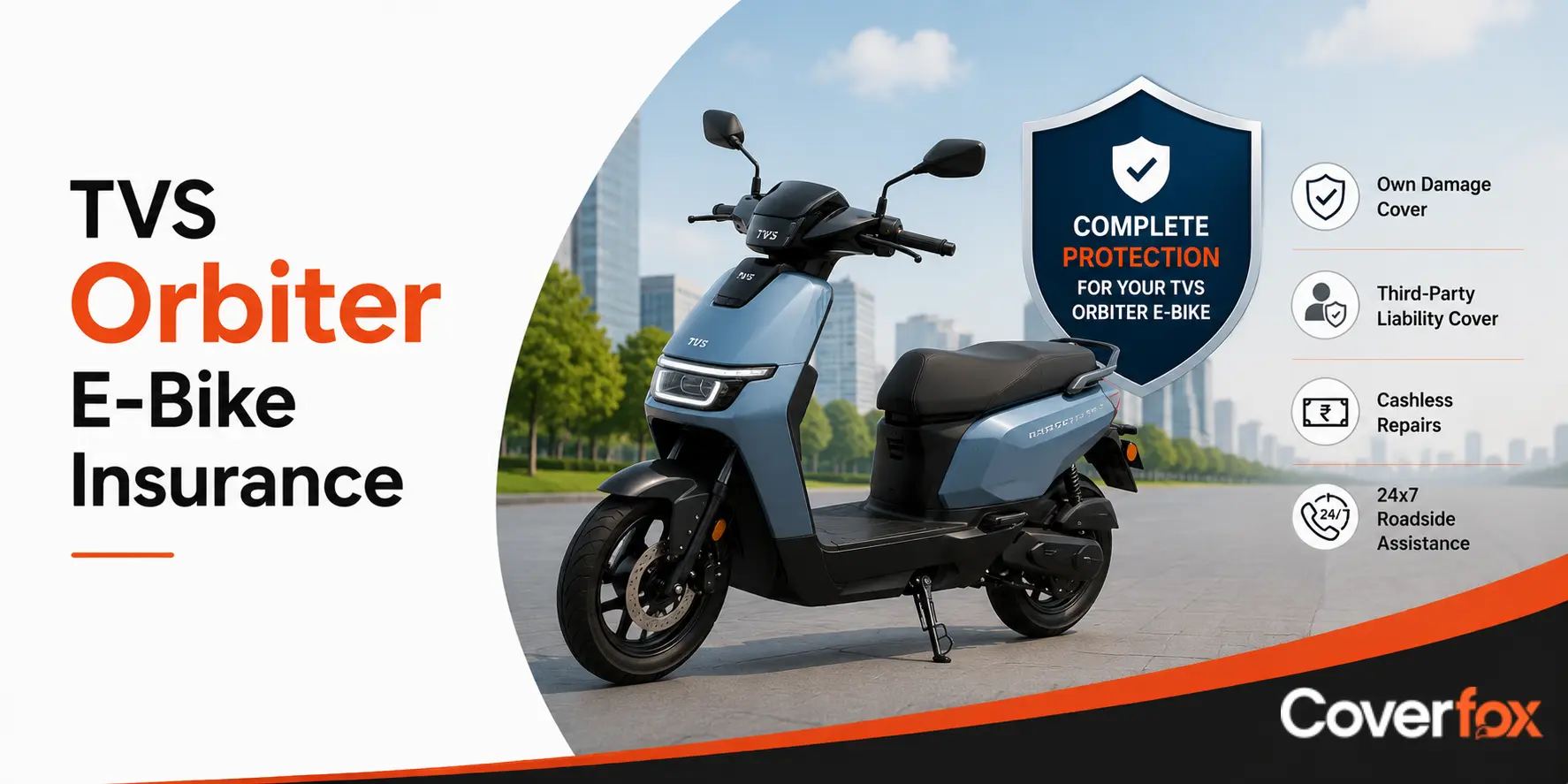
A valid third-party bike insurance policy is mandatory for the TVS Orbiter when it is used on public roads in India. This cover protects against specified liabilities towards third parties. Owners who also want protection for the scooter can opt for comprehensive two wheeler insurance, which combines third-party liability cover with own-damage protection.
| Specification | TVS Orbiter |
|---|---|
| Variants | Orbiter V1 and Orbiter V2 |
| Battery Capacity | 1.8 kWh / 3.1 kWh |
| IDC Range | 86 km / 158 km |
| Motor | BLDC hub motor |
| Peak Motor Power | 2.5 kW |
| Top Speed | 68 km/hr |
| Charging Time | 2 hours 20 minutes / 4 hours 10 minutes for 0–80% |
| Charger | 650 W portable charger |
| Seat Length | 845 mm |
| Boot Space | 34 litres |
| Battery Type | Lithium-ion NMC |
| Braking | Front disc / rear drum |
| Battery Rating | IP67 for key components |
| Riding Licence | Required for both variants |
The electric bike insurance cost for this model depends on the variant, IDV, registration city, policy type and insurer. The manufacturer's current price breakdown gives a useful reference for the Orbiter V1.
| Bike Model | Zero Depreciation | IDV [1st Year] | Net Premium [5 Years] |
|---|---|---|---|
| TVS Orbiter V1 | ₹284.13 | ₹56,826 | ₹4,382 |
| TVS Orbiter V2 | ₹300 | ₹85,763 | ₹4,660 |
* Prices are indicative and may change as per insurer, location and time.
Accidental damage to the TVS Orbiter caused by a covered road accident.
Theft of the TVS Orbiter, with the claim settled according to the policy's IDV and applicable conditions.
Damage caused by fire, explosion or other insured fire-related events.
Damage from floods, cyclones, storms, earthquakes and other covered natural calamities.
Damage caused by riots, strikes, malicious acts and other specified man-made events.
Third-party injury, death or property damage arising from an accident involving the Orbiter.
Damage to the scooter's body and eligible electrical components when caused by an insured event.
Total loss of the Orbiter where the repair cost crosses the applicable threshold under the policy.
Before purchasing bike insurance for this electric two wheeler, it is equally important to understand the situations and damages that may not be covered under the policy.
Gradual loss of battery capacity from normal use is not an accident-related insurance claim.
Deterioration of tyres, brakes and other components through regular use is not covered.
A component failure that is not caused by an insured event is outside standard own-damage cover.
Damage linked to modifications or accessories not declared to the insurer may be excluded.
Claims arising while the Orbiter is being ridden by someone without the required licence may be rejected.
Damage caused while riding under the influence of alcohol or drugs is excluded.
Indirect financial losses resulting from an accident are not covered under standard motor insurance.
Manufacturing defects or other issues covered by the TVS battery warranty should be dealt with under the applicable warranty rather than treated as an insurance claim.
Claims can be affected if the scooter is used for purposes or in circumstances not covered by the policy.
Battery protection depends on the policy purchased and the insurer's terms. A comprehensive policy should not be treated as automatic protection against every form of battery-related loss.
May be covered when the damage results from an insured event and falls within the policy terms.
Normal reduction in battery capacity is different from accidental damage and is not automatically an insurance claim.
Whether this is covered depends on the policy wording and the cause of the damage.
TVS separately provides warranty protection for the battery, motor, controller and charger. Its current FAQ states that the standard warranty covers these components for three years, subject to the warranty terms.
If an insurer provides a specific EV or battery protection add-on, check exactly which components and risks it covers before selecting it.
Insurance and warranty should therefore be considered separately. The manufacturer's warranty deals with eligible product-related issues, while insurance responds to covered insured events.
The add-ons worth considering for an electric scooter are those that address repair costs, roadside emergencies and EV-specific risks.
Reduces depreciation deductions on eligible parts during an admissible claim, subject to the insurer's terms. It can be useful for a new Orbiter where repair costs could otherwise include depreciation deductions.
Helps with services such as towing and breakdown assistance when the scooter cannot be ridden. TVS itself includes roadside assistance for the first year with the Orbiter purchase.
Can cover the difference between the vehicle's IDV and its invoice value in eligible theft or total-loss situations, subject to the add-on conditions.
Some insurers provide EV-specific protection for components such as the battery, motor or charger. The scope differs between policies, so the exclusions and covered events should be checked before purchase.
You do not need to add every available cover. The right combination depends on the Orbiter's age, usage, location and the protection already included in the base policy.
You can purchase TVS Orbiter insurance online by entering the vehicle details, comparing available policies and selecting the required coverage.
Provide the registration number and required details of the Orbiter.
Choose the correct Orbiter V1 or V2 variant.
Select third-party, standalone own-damage or comprehensive insurance.
Review the IDV quoted for your scooter.
Compare the insurance quote along with coverage, deductible and exclusions.
Add Zero Depreciation, Roadside Assistance or EV-specific protection where relevant.
Enter owner, vehicle and previous policy details.
Complete the premium payment online.
Keep the policy document accessible for future renewals and claims.
Renewing a TVS Orbiter insurance policy involves reviewing the existing cover and obtaining a renewal quote before the expiry date.
Start the renewal process before the current policy ends.
Check whether the quoted IDV reflects the scooter's current value.
Confirm that your eligible No Claim Bonus has been carried forward.
Retain only the covers that remain relevant.
Check the premium along with coverage and deductibles.
Pay the renewal premium and download the renewed policy.
The claim process depends on the type of claim and whether the scooter is repaired at a network garage.
Inform the insurer after the accident or insured event.
Arrange towing if the Orbiter cannot be ridden safely.
Take the scooter to an insurer-authorised network garage.
Provide the policy and vehicle documents requested by the insurer.
The insurer assesses the damage before approving repairs.
The garage carries out the approved repairs.
The insurer pays the admissible amount to the network garage after applicable deductions. You pay the deductible and other non-covered expenses.
Register the claim and follow the insurer's instructions.
Complete the required assessment before repairs where applicable.
Settle the repair bill as required under the reimbursement process.
Keep the original bills, receipts and repair records.
Send the required documents to the insurer.
The insurer verifies the damage, policy coverage and bills.
The approved amount is paid after applicable deductions.
Confirms the insurance cover.
Establishes the insured vehicle.
Confirms that the rider was authorised to ride the Orbiter.
Records the details of the incident.
Provides the expected repair cost.
Required for reimbursement claims.
May be requested to assess the damage.
May be required for major accidents or specific circumstances.
Confirms the active insurance cover.
Establishes vehicle ownership.
Required to report the theft to the police.
May be requested during theft claim assessment.
May be required for transfer or settlement formalities.
Contains details of the theft.
May be required before settlement, depending on the claim and applicable procedure.
The insurer can request additional documents depending on the circumstances of the claim.
Yes. Third-party motor insurance is mandatory for the TVS Orbiter when it is used on public roads in India. Comprehensive insurance is optional and adds protection for damage to the scooter.
The TVS Orbiter insurance premium can depend on the variant, IDV, registration location, policy type, vehicle age, previous claims, deductible and selected add-ons. Own-damage premiums are set by individual insurers, while third-party premiums are regulated.
IDV, or Insured Declared Value, represents the insured value of the scooter for own-damage claims. It is linked to the vehicle's current market value after applicable depreciation. A higher IDV can increase the own-damage premium, while a lower IDV can reduce the premium but also lower the amount available for a total-loss claim.
Third-party insurance is enough to meet the mandatory motor insurance requirement, but it does not cover damage to your own TVS Orbiter. A comprehensive policy adds own-damage protection for events such as accidents, theft, fire and covered natural calamities.
A comprehensive TVS Orbiter insurance policy can cover third-party liabilities and own damage caused by insured events such as accidents, theft, fire, natural calamities and specified man-made events. The exact coverage depends on the policy wording.
Common exclusions can include normal wear and tear, mechanical or electrical breakdowns not caused by an insured event, consequential losses, riding without a valid licence and damage caused while using the vehicle in violation of the policy conditions. Battery degradation is also different from accidental battery damage and should not be assumed to be covered.
You cannot simply transfer an existing policy from another vehicle to a new TVS Orbiter. Motor insurance is linked to the insured vehicle. If you sell your existing vehicle, the NCB belongs to the policyholder rather than the vehicle and can be used for a new vehicle subject to the applicable rules.
You can reduce the premium by comparing quotes, choosing an appropriate IDV and selecting only the add-ons you need. Maintaining a claim-free record can also help you earn an NCB on the own-damage premium. Avoid choosing a lower IDV simply to reduce the premium, as this can reduce the amount available in a total-loss claim.

