
- Retail Insurance
- Business Insurance
- Resources
- Claims


The TVS Sport mileage is up to 80 kmpl, making it one of the fuel-efficient commuter motorcycles in the 110cc segment. The bike uses a 109.7cc fuel-injected engine, weighs 112 kg in its electric-start version and has a 10-litre fuel tank. In everyday riding, mileage can be lower than the claimed figure depending on traffic, riding style, road conditions, tyre pressure and maintenance.
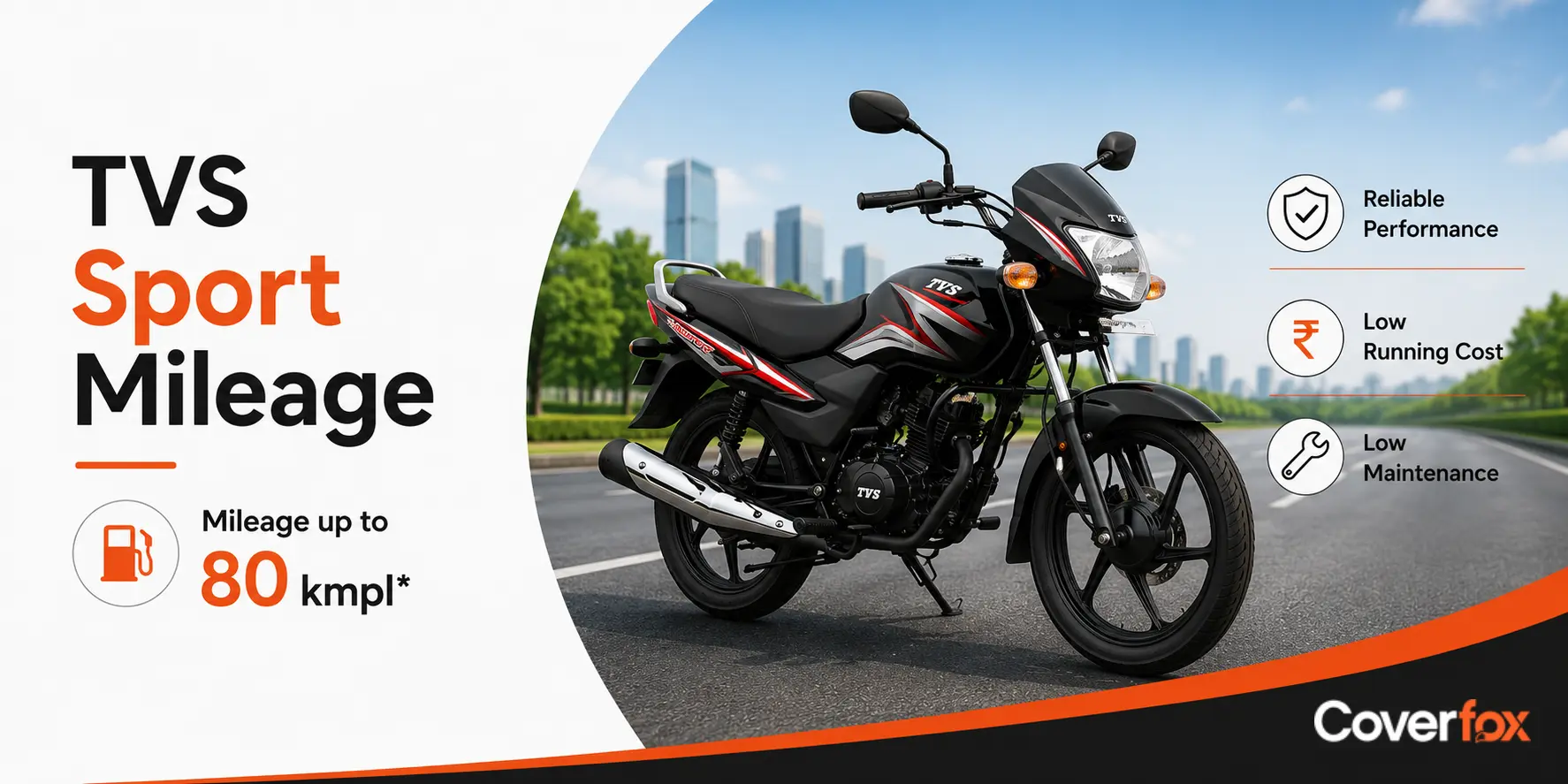
For daily commuters, mileage has a direct impact on fuel expenses. The TVS Sport's combination of a small-capacity engine, low weight and fuel-injection technology is aimed at keeping running costs low.
| Specification | Details |
| Engine | 109.7cc, single-cylinder, 4-stroke, air-cooled |
| Fuel system | ETFi fuel injection |
| Fuel type | Petrol |
| Mileage | Up to 80 kmpl |
| Real-world mileage | Around 70 kmpl |
| Fuel tank capacity | 10 litres |
| Transmission | 4-speed constant mesh |
| Kerb weight | 112 kg |
| Maximum power | 6.03 kW @ 7,350 rpm |
| Maximum torque | 8.7 Nm @ 4,500 rpm |
The 80 kmpl figure is the mileage achieved under specified test conditions. On the road, factors such as traffic, speed, acceleration, braking and load affect fuel consumption.
For practical riding, the TVS Sport can return around 70 kmpl, although individual results can vary.
The TVS Sport is available in two current electric-start variants. Both use the same 109.7cc engine and have the same mileage figure.
| Variant | Engine | Mileage | Ex-showroom Price |
| TVS Sport Self Start - ES | 109.7cc | Up to 80 kmpl | ₹58,750 |
| TVS Sport Self Start - ES+ | 109.7cc | Up to 80 kmpl | ₹59,950 |
Prices can vary with location and may change over time. On-road prices also include registration, road tax, bike insurance and other applicable charges.
Mileage difference: Both variants use the same engine and fuel-injection system, so there is no separate mileage advantage associated with either variant.
The TVS Sport mileage per litre is up to 80 km under the stated mileage conditions.
| Mileage | Distance covered with 1 litre |
| 65 kmpl | 65 km |
| 70 kmpl | 70 km |
| 75 kmpl | 75 km |
| 80 kmpl | 80 km |
The actual distance covered on one litre depends on how the motorcycle is ridden. Heavy traffic, frequent acceleration and braking can bring fuel economy down, while smooth riding on open roads can improve it.
The TVS Sport does not have a single mileage figure that applies to every road condition.
| Riding condition | Expected mileage |
| Heavy city traffic | Around 60-65 kmpl |
| Regular city riding | Around 65-70 kmpl |
| Open roads | Around 70-75 kmpl |
| Maximum claimed figure | Up to 80 kmpl |
These are practical mileage ranges rather than separate certified city and highway figures.
City riding: Frequent stops, idling, acceleration and braking increase fuel consumption.
Highway riding: A steady pace with fewer stops can improve fuel economy compared with congested city traffic.
Your riding speed still matters. Sustained high-speed riding can reduce mileage even on an open road.
The TVS Sport 110 cc mileage comes from its 109.7cc single-cylinder engine. It uses ETFi fuel injection, which manages fuel delivery electronically and is tuned for a balance between fuel economy and everyday performance.
109.7cc
ETFi fuel injection
Up to 80 kmpl
4-speed
10 litres
112 kg
The relatively low weight also helps reduce the effort required to move the motorcycle, which supports its commuter-focused fuel economy.
The TVS Sport BS6 mileage is up to 80 kmpl. The BS6 version uses the 109.7cc fuel-injected engine with ETFi technology and a 10-litre fuel tank.
TVS states that ETFi technology delivers 15% more mileage compared with the BS-IV version, based on its internal testing. The actual TVS Sport BS6 mileage per litre will depend on riding conditions and maintenance.
Several everyday factors can change the mileage you get from the motorcycle.
Sudden throttle inputs increase fuel consumption.
Frequent hard braking means the bike repeatedly uses fuel to regain speed.
Under-inflated tyres create greater rolling resistance.
Stop-and-go traffic uses more fuel than a steady ride.
Riding at high speeds increases engine load and fuel consumption.
Carrying extra weight requires more effort from the engine.
Poor engine and drivetrain condition can reduce fuel efficiency.
Rough roads, slopes and frequent gradients can increase fuel consumption.
Use smooth throttle inputs instead of sudden acceleration.
Check tyre pressure regularly and keep it at the recommended level.
Switch off the engine during longer stops when it is safe to do so.
Avoid keeping the engine at unnecessarily high rpm.
Follow the recommended service schedule.
Carry only what is needed.
Consistent riding helps reduce unnecessary fuel consumption.
Keep the drive chain clean, lubricated and correctly adjusted.
The TVS Sport uses a 109.7cc single-cylinder, air-cooled, fuel-injected engine. It produces 6.03 kW of maximum power at 7,350 rpm and 8.7 Nm of peak torque at 4,500 rpm. A 4-speed constant-mesh gearbox sends power to the rear wheel.
Its fuel-efficiency focus comes from three main areas:
Controls fuel delivery for efficient combustion.
The electric-start version weighs 112 kg.
Helps the rider identify economical riding conditions.
The 10-litre fuel tank also gives the bike a useful range between refuelling stops.
The TVS Sport sits among commuter motorcycles where fuel economy is one of the main buying considerations.
| Bike Model | Engine Capacity | Claimed Mileage |
| TVS Sport | 109.7cc | Up to 80 kmpl |
| Hero Splendor Plus | 97.2cc | 70 kmpl |
| Hero Splendor Plus XTEC 2.0 | 97.2cc | 73 kmpl |
The TVS Sport has a 10-litre fuel tank.
Its theoretical range at different mileage levels is:
| Mileage | 10-litre range |
| 65 kmpl | 650 km |
| 70 kmpl | 700 km |
| 75 kmpl | 750 km |
| 80 kmpl | 800 km |
These figures are mathematical estimates. Actual riding range will depend on traffic, riding style, road conditions and the amount of fuel available before refuelling.
TVS StaR Sport is a different motorcycle from the current TVS Sport. The name refers to an older TVS commuter model, so TVS Star Sport mileage should not be treated as a variant or alternate name for the current TVS Sport.
For current 109.7cc TVS Sport mileage, refer to the figures above.
The TVS Sport has a claimed mileage of up to 80 kmpl. Real-world mileage can be around 70 kmpl, depending on traffic, riding style, road conditions and maintenance.
The TVS Sport's ARAI mileage is 80 kmpl.
The TVS Sport can deliver around 70 kmpl in real-world riding. Actual fuel economy varies with traffic, speed, acceleration, braking, load and maintenance.
At 80 kmpl, the TVS Sport can cover up to 80 km on one litre of petrol. At 70 kmpl, it covers around 70 km per litre.
The TVS Sport's 109.7cc engine delivers a claimed mileage of up to 80 kmpl.
The TVS Sport BS6 mileage is up to 80 kmpl. Its 109.7cc fuel-injected engine uses ETFi technology to improve fuel efficiency.
The TVS Sport can return around 60-70 kmpl in city riding, depending on traffic density and riding style. Heavy stop-and-go traffic can reduce mileage further.
Ride smoothly, maintain the correct tyre pressure, avoid unnecessary idling, use the right gear, keep the motorcycle serviced and avoid carrying unnecessary weight.
Regular servicing helps keep the engine, tyres and drivetrain in good working condition. This can help maintain fuel efficiency, although servicing alone cannot guarantee a specific mileage figure.
The TVS Sport has a claimed mileage of 80 kmpl, while the Hero Splendor Plus is rated at 70 kmpl. The two motorcycles have different engine capacities and specifications, so mileage should be compared alongside performance and running costs.
With its 10-litre fuel tank, the TVS Sport has a theoretical range of 800 km at 80 kmpl. At 70 kmpl, the theoretical range is around 700 km. Actual range will vary with riding conditions.

