
- Retail Insurance
- Business Insurance
- Resources
- Claims


The Nissan Magnite mileage ranges from 17.9 km/l to 19.9 km/l, depending on the engine and transmission. The Nissan Magnite with the 1.0-litre petrol engine and manual gearbox has a claimed mileage of 19.4 km/l, while the 1.0-litre turbo-petrol version with CVT has a claimed mileage of 17.9 km/l.
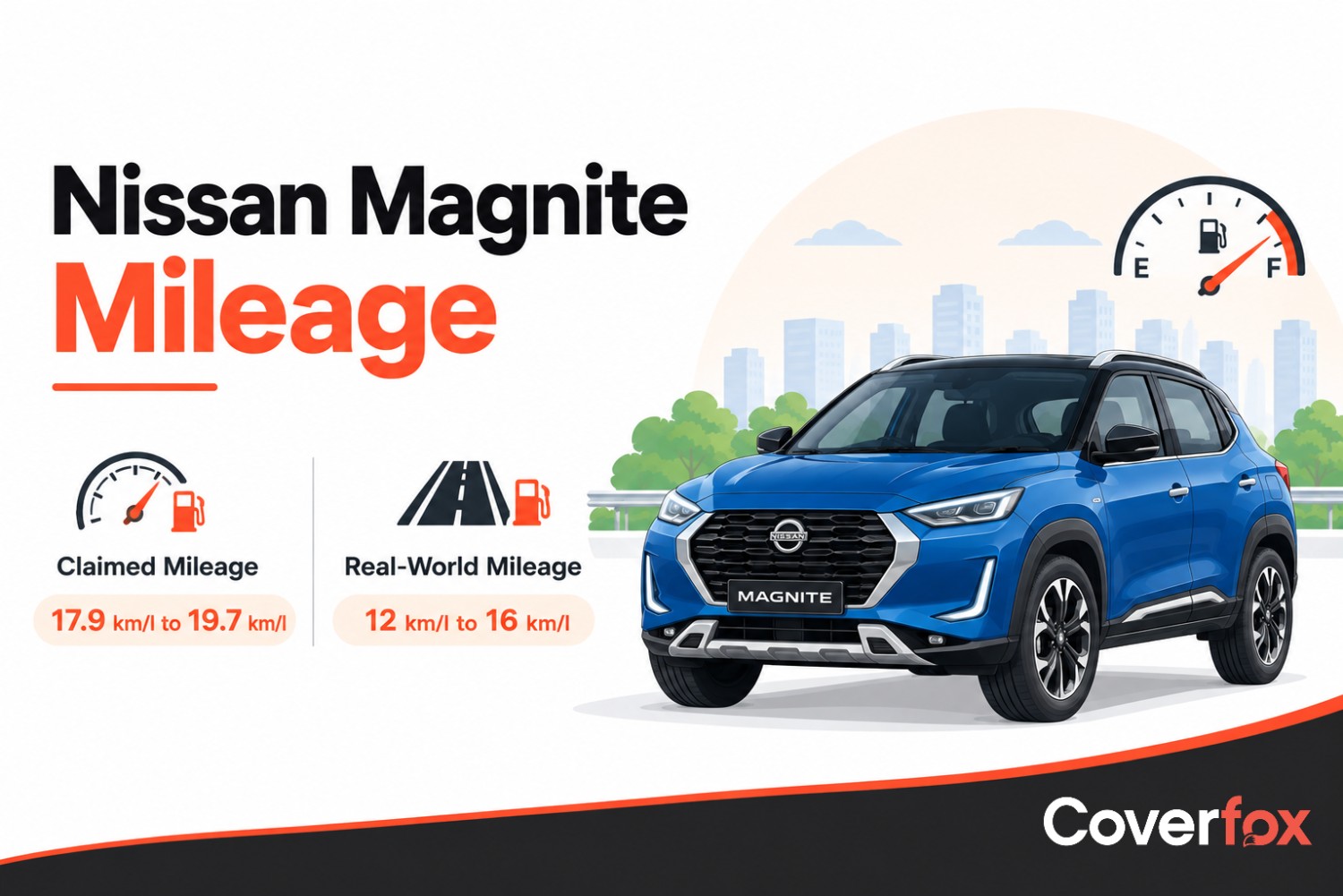
The Nissan Magnite offers a practical balance of fuel efficiency and everyday performance across its petrol engine and transmission options.
| Specification | Details |
|---|---|
| Engine Options | 1.0L Petrol, 1.0L Turbo Petrol |
| Transmission | Manual, AMT, CVT |
| Claimed Mileage | 17.9 km/l to 19.7 km/l |
| Real-World Mileage | Around 12 km/l to 16 km/l |
| Fuel Type | Petrol |
| Fuel Tank Capacity | 40 litres |
| Seating Capacity | 5 |
Note: The claimed figures are ARAI-certified mileage figures. Actual fuel consumption can differ from these numbers depending on traffic, speed, air-conditioner use, road conditions and driving habits.
The Nissan Magnite offers competitive mileage across both manual and automatic variants, with differences depending on the engine and transmission combination.
| Powertrain | Manual Mileage | Automatic Mileage |
|---|---|---|
| 1.0L Petrol | 19.4 km/l | 19.7 km/l (AMT) |
| 1.0L Turbo Petrol | 17.9 km/l | 19.9 km/l (CVT) |
The Nissan Magnite mileage manual figures are competitive for daily driving, while the AMT and CVT versions offer automatic convenience. The turbo CVT has the highest claimed figure at 19.9 km/l, although real-world testing can produce different results.
The Nissan Magnite delivers different fuel efficiency in city and highway conditions, with steady highway driving generally offering better mileage than stop-and-go city traffic.
Magnite Turbo-petrol manual: Around 12.8 km/l in real-world city testing.
Magnite Turbo-petrol CVT: Around 9.5 km/l in more recent real-world city testing.
City traffic reduces fuel efficiency because the car spends more time accelerating, braking and idling. Short trips and continuous AC use can also increase fuel consumption.
Magnite Turbo-petrol manual: Around 16.1 km/l in real-world highway testing.
Magnite Turbo-petrol CVT: Around 15.22 km/l in real-world highway testing.
The Nissan Magnite highway mileage is higher than city mileage because steady-speed driving involves fewer stops and less frequent acceleration. Actual results will depend on cruising speed, traffic and road conditions.
The Magnite's fuel consumption can be kept under control by following Nissan's specified maintenance requirements and using the car's systems correctly.
Check the tyre pressure regularly and use the pressure specified for your Magnite variant on the vehicle's tyre-pressure label.
The Magnite has a 40-litre fuel tank, so tracking fuel consumed between refills gives a reliable measure of your personal mileage.
The 1.0L naturally aspirated petrol produces 72 PS and 96 Nm, while the turbo-petrol produces 100 PS and up to 160 Nm with the manual gearbox. Avoid using the turbo engine's full performance for routine acceleration when it is not required.
In the turbo manual, fifth gear is an overdrive ratio. During Autocar's test, the engine was running at around 2,500 rpm at 100 km/h, helping it return 16.1 km/l on the highway.
Progressive throttle inputs reduce the fuel required to repeatedly build speed in city traffic.
The EZ-Shift AMT has an Intelligent Creep function for low-speed stop-and-go traffic, allowing the car to move forward by releasing the brake without using the accelerator.
Nissan lists service recommendations according to kilometres or time, whichever comes first. Its current service information also lists free inspections for the Magnite at 2,000 km and 15,000 km.
Nissan recommends using trained technicians and genuine Nissan parts during maintenance. A clean air filter and properly maintained engine help keep the powertrain operating as intended.
The Magnite's driver display includes a Fuel History function, which can be used to monitor changes in fuel efficiency over time.
The Nissan Magnite offers competitive claimed mileage, although some rivals deliver higher figures depending on their engine and transmission options.
| Model | Claimed Mileage |
|---|---|
| Nissan Magnite | 17.9 to 19.9 km/l |
| Renault Kiger | 17.63 to 20.38 km/l |
| Maruti Suzuki Fronx | 20.01 to 22.89 km/l |
| Hyundai Exter | 19.4 km/l |
| Tata Punch | 18.8 to 20.09 km/l |
Yes. The Magnite mileage of 17.9 to 19.9 km/l is reasonable for a compact SUV, while real-world figures depend heavily on the powertrain and driving conditions. For daily usage, fuel costs should be considered alongside maintenance and Nissan Magnite car insurance to account for the overall running cost. Choosing the best car insurance can also help manage unexpected vehicle-related expenses.
The Nissan Magnite has a claimed mileage of 17.9 to 19.9 km/l, depending on the engine and transmission. The 1.0L petrol AMT is rated at 19.7 km/l, while the turbo-petrol CVT is rated at 19.9 km/l.
The 1.0L turbo-petrol CVT has the highest claimed mileage at 19.9 km/l.
The turbo-petrol manual returned 12.8 km/l in Autocar India's city test, while the turbo-petrol CVT returned 9.5 km/l in a more recent test.
The turbo-petrol manual returned 16.1 km/l, while the turbo-petrol CVT returned 15.22 km/l in real-world highway testing.
The Nissan Magnite highway mileage is around 16.1 km/l for the turbo manual and 15.22 km/l for the turbo CVT based on real-world testing.
The Magnite Turbo has a claimed mileage of 17.9 km/l with the manual and 19.9 km/l with the CVT. Real-world fuel efficiency is lower and depends on traffic, speed and driving style.
The Magnite Turbo CVT has a claimed mileage of 19.9 km/l. In real-world testing, it returned 9.5 km/l in the city and 15.22 km/l on the highway.
Aggressive acceleration, frequent braking and sustained high-speed driving increase fuel consumption. Smooth acceleration and steady cruising can help the Magnite achieve better fuel efficiency.
The Nissan Magnite has a 40-litre fuel tank across its listed petrol powertrains.

