
- Retail Insurance
- Business Insurance
- Resources
- Claims


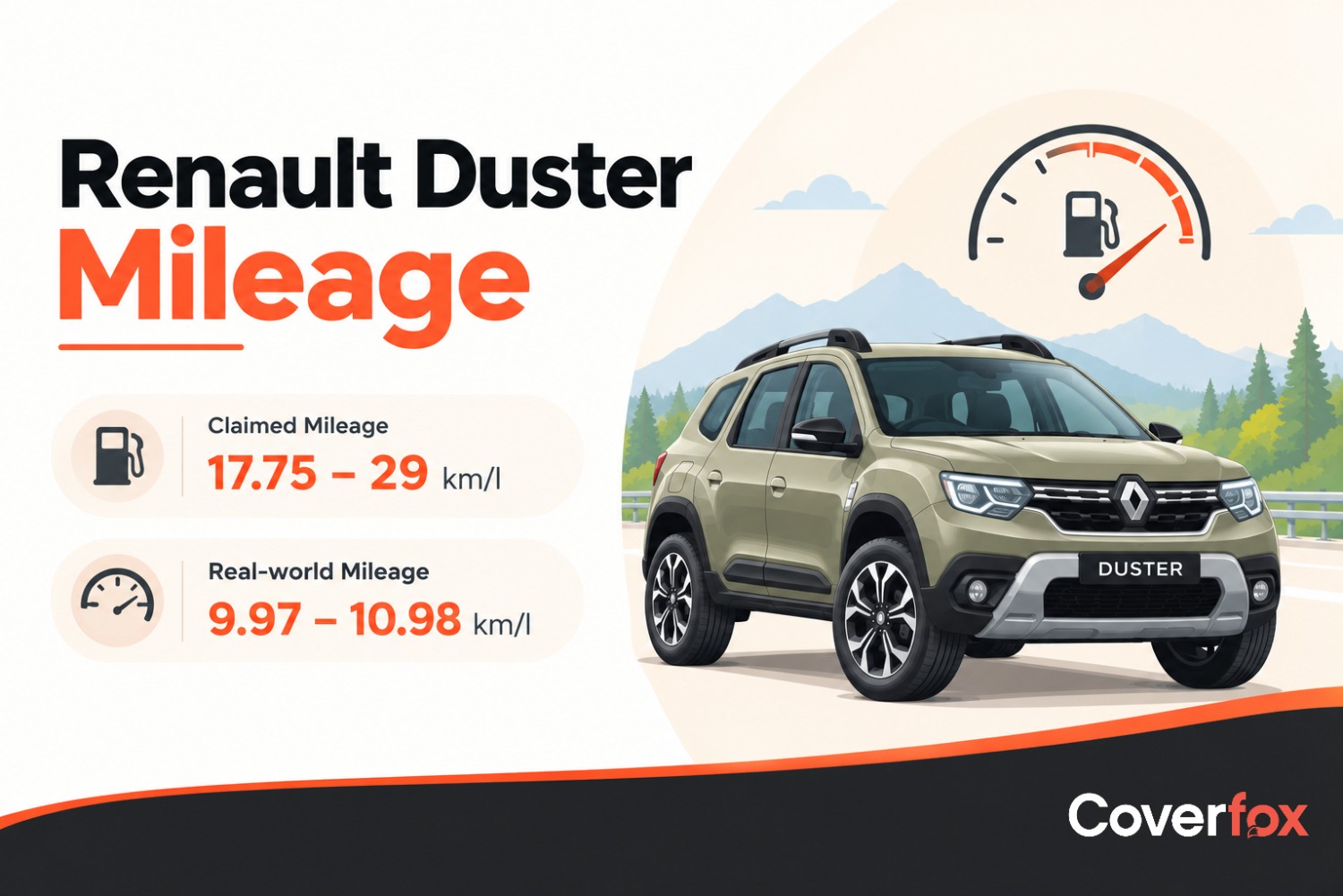
The Renault Duster mileage ranges from 17.75 km/l to 19.41 km/l across the turbo-petrol versions, depending on the engine and gearbox. The 1.0-litre turbo-petrol manual has a mileage of 19.41 km/l, while the 1.3-litre turbo-petrol returns 17.75 km/l with a manual gearbox and 18.45 km/l with a DCT automatic. The upcoming Strong Hybrid E-Tech 160 has an ARAI-certified mileage of 29 km/l.
| Parameter | Details |
|---|---|
| Engine Options | 1.0L Turbo Petrol, 1.3L Turbo Petrol, 1.8L Strong Hybrid |
| Fuel Type | Petrol, Petrol-Electric Hybrid |
| ARAI Mileage | 17.75–19.41 km/l (Turbo Petrol); 29 km/l (Strong Hybrid) |
| Real-World Mileage | Around 9.97–10.98 km/l in independent tests of the turbo-petrol versions |
| Fuel Tank Capacity | 50 litres |
| Transmission | 6-speed Manual, 6-speed DCT, 8-speed DHT (Hybrid) |
| Maximum Power | 100 PS (1.0L); 163 PS (1.3L); 160 PS (Hybrid) |
| Powertrain | Transmission | Mileage | Ex-Showroom Price |
|---|---|---|---|
| 1.0L TCe 100 Turbo Petrol | 6-speed Manual | 19.41 km/l | ₹10.49–12.99 lakh |
| 1.3L TCe 160 Turbo Petrol | 6-speed Manual | 17.75 km/l | ₹12.99–17.19 lakh |
| 1.3L TCe 160 Turbo Petrol | 6-speed DCT Automatic | 18.45 km/l | ₹14.49–18.49 lakh |
| 1.8L Strong Hybrid E-Tech 160 | 8-speed DHT | 29 km/l | To be announced |
Note: Prices for the turbo-petrol versions are indicative ex-showroom prices across available trims, including the Adventure and Iconic Launch Edition where applicable. The hybrid's price had not been announced as of 16 October 2026. Prices can vary by variant, location and manufacturer updates.
The Renault Duster’s city and highway mileage varies with driving conditions, with the 1.3-litre turbo-petrol DCT delivering around 7.5 km/l in the city and 13.5 km/l on the highway in independent tests.
The 1.3-litre turbo-petrol DCT got 7.47 km/l mileage in an independent city test. Frequent braking, slow-moving traffic and repeated acceleration increase fuel consumption. This figure is specific to the tested automatic version and should not be treated as the city mileage of every Duster variant.
The same 1.3-litre turbo-petrol DCT mileage deliver around 13.47 km/l on the highway. A steady cruising speed and fewer stops help the engine use fuel more efficiently, although speed, traffic, road gradients, air-conditioning use and vehicle load can change the result.
The Renault Duster offers three powertrain options a 1.0-litre turbo-petrol, a 1.3-litre turbo-petrol and a 1.8-litre strong hybrid—each balancing performance, transmission choices and fuel efficiency differently.
This three-cylinder turbo-petrol engine produces 100 PS and 166 Nm of torque. It comes with a 6-speed manual gearbox and has a claimed mileage of 19.41 km/l. It suits buyers who want the Duster's SUV body and ground clearance without choosing the larger engine.
The four-cylinder turbo-petrol engine produces 163 PS and 280 Nm. It comes with a 6-speed manual or a 6-speed DCT automatic. Its mileage is 17.75 km/l with the manual and 18.45 km/l with the automatic. Renault says the engine uses high-pressure fuel injection and low-friction coatings to support combustion efficiency.
This powertrain combines a petrol engine with two electric motors and a 1.4 kWh battery. It produces a combined 160 PS and uses an 8-speed DHT transmission. The system can drive on electric power under suitable conditions and recover energy during braking and deceleration. Its ARAI mileage is 29 km/l, and it does not need to be plugged in to charge.
Accelerate smoothly: Avoid heavy throttle inputs and sudden braking, especially in traffic. Repeatedly accelerating hard from low speeds increases fuel consumption.
Check tyre pressure: Keep all four tyres at the pressure recommended by Renault for the vehicle's load. Underinflated tyres increase rolling resistance.
Avoid unnecessary idling: Switch off the engine during longer stops when it is safe to do so.
Maintain a steady highway speed: Sudden changes in speed and prolonged high-speed driving can reduce fuel efficiency.
Keep up with servicing: Follow Renault's maintenance schedule for engine oil, filters, spark plugs and other service items.
Use the hybrid system as intended: In the E-Tech version, smooth driving and gradual deceleration can help the system recover braking energy. The battery charges while the vehicle is moving and does not require an external charger.
| SUV Model or Powertrain | Engine | ARAI/Claimed Mileage |
|---|---|---|
| Renault Duster 1.0 Turbo Petrol Manual | 999cc | 19.41 km/l |
| Renault Duster 1.3 Turbo Petrol Manual | 1,333cc | 17.75 km/l |
| Renault Duster 1.3 Turbo Petrol DCT | 1,333cc | 18.45 km/l |
| Renault Duster Strong Hybrid E-Tech 160 | 1.8L Petrol-Electric Hybrid | 29 km/l |
| Maruti Suzuki Grand Vitara Strong Hybrid | 1.5L Petrol-Electric Hybrid | 27.97 km/l |
| Toyota Urban Cruiser Hyryder Strong Hybrid | 1.5L Petrol-Electric Hybrid | 27.97 km/l |
| Hyundai Creta Petrol Manual | 1.5L Petrol | 17.4 km/l |
The Duster can suit daily commutes as well as highway trips. The 1.0-litre turbo-petrol manual has the highest claimed mileage among the turbo-petrol options, while the 1.3-litre DCT adds automatic convenience and stronger performance. The Strong Hybrid E-Tech 160 is worth considering for fuel economy, although its price and ownership costs should be compared when the full variant details are available.
Fuel is only one part of the overall cost of owning an SUV. Buyers should also factor in servicing, tyres and Renault Duster car insurance plan when planning their ownership budget.
The mileage of Renault Duster ranges from 17.75 km/l to 19.41 km/l across the turbo-petrol manual and automatic options. The Strong Hybrid E-Tech 160 has an ARAI-certified mileage of 29 km/l.
The Renault Duster petrol mileage is 19.41 km/l with the 1.0-litre turbo-petrol manual, 17.75 km/l with the 1.3-litre turbo-petrol manual and 18.45 km/l with the 1.3-litre DCT automatic.
The 1.3-litre turbo-petrol DCT returned 7.47 km/l in an independent city test. Actual city mileage can differ with traffic, idling and driving style.
The 1.3-litre turbo-petrol DCT returned 13.47 km/l in an independent highway test. Speed, road conditions and vehicle load can affect the result.
Independent combined tests recorded around 10.98 km/l for the 1.0-litre turbo-petrol manual, 10.64 km/l for the 1.3-litre manual and 9.97 km/l for the 1.3-litre DCT. Real-world fuel consumption varies by route and driving conditions.
The 1.0-litre TCe 100 manual has the highest claimed mileage among the turbo-petrol options at 19.41 km/l. The Strong Hybrid E-Tech 160 has a higher ARAI-certified figure of 29 km/l.
The Renault Duster Strong Hybrid E-Tech 160 has an ARAI-certified mileage of 29 km/l. Its 1.8-litre petrol engine works with two electric motors and a 1.4 kWh battery. Renault announced its Indian debut for 17 October 2026.
Yes. The 1.3-litre turbo-petrol manual has a mileage of 17.75 km/l, while the DCT automatic has a mileage of 18.45 km/l. The gearbox does not make the automatic version less fuel-efficient in the certified figures for this engine.

