
- Retail Insurance
- Business Insurance
- Resources
- Claims
Taxable income is the portion of a person’s total income on which income tax is calculated after applying eligible exemptions and deductions under the Income Tax Act, 1961. It differs from gross income (total earnings before deductions) and total income (income after certain adjustments). Understanding taxable income helps individuals accurately calculate tax liability and plan their taxes effectively.
Taxable income provisions apply to different categories of taxpayers recognised under the Income Tax Act, 1961.
Salaried persons, professionals, or any individual earning income above the taxable limit.
Family units recognised as separate taxable entities under tax law.
Partnership firms earning business or professional income.
LLP entities taxed separately from their partners.
Both domestic and foreign companies operating in India.
A group of individuals or entities earning income together.
Individuals jointly earning income but not forming a formal partnership.
Municipalities, panchayats, and other local governing bodies.
Entities recognised by law as separate persons for taxation.
Tax liability for these taxpayers also depends on their residential status, such as Resident, Non-Resident (NR), or Resident but Not Ordinarily Resident (RNOR), which determines how their income is taxed in India.
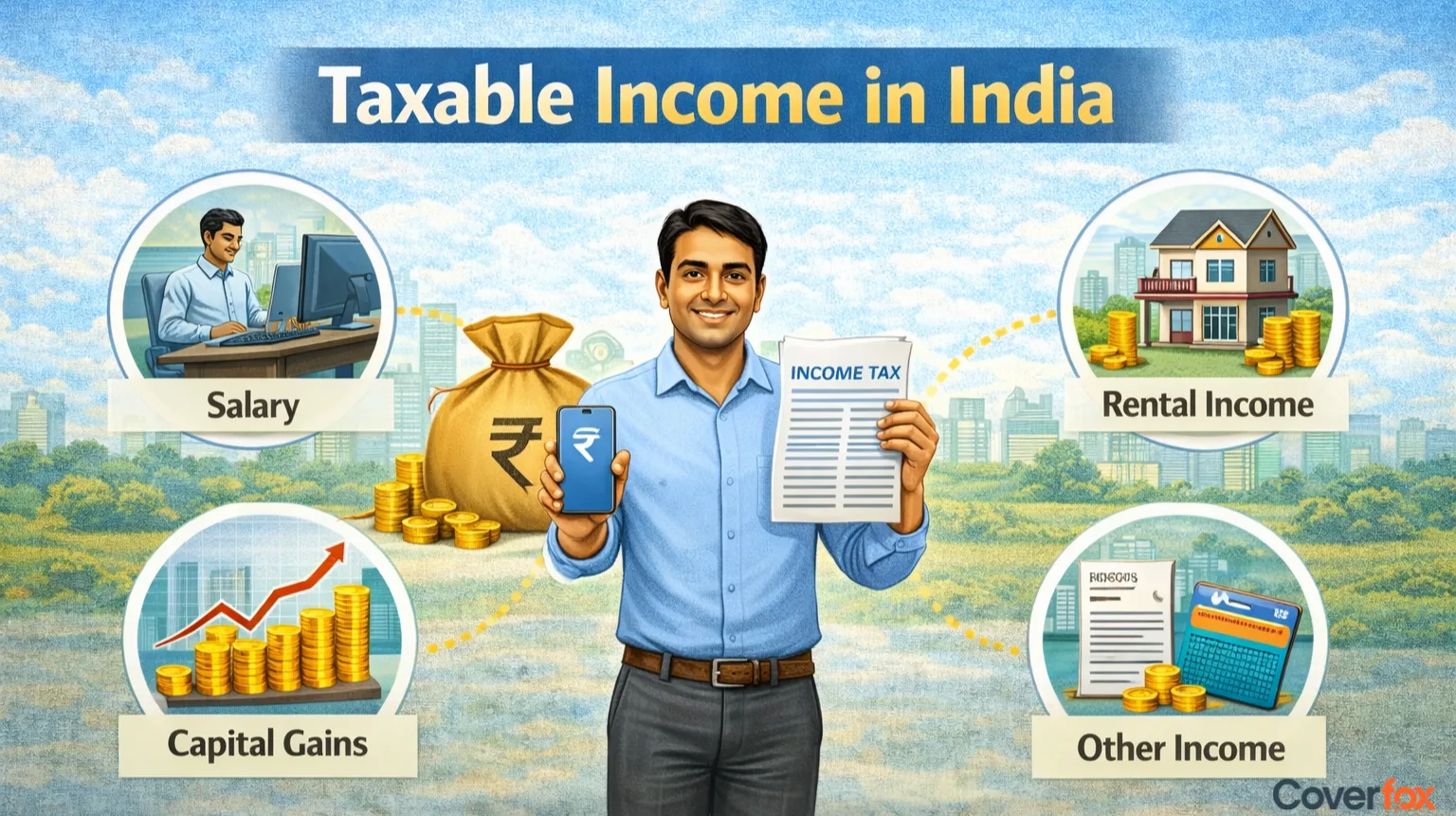
Under the Income Tax Act in India, income is classified into five heads, and a taxpayer’s taxable income is calculated after aggregating income from all applicable heads and applying eligible deductions and exemptions.
This head includes income received from employment such as basic salary, allowances, bonuses, commissions, perquisites, pension, and the taxable portion of gratuity. Salaried taxpayers can also claim a standard deduction of ₹75,000 under the new tax regime (₹50,000 under the old regime), which reduces taxable income.
Income earned from renting out residential or commercial property is taxed under this head. Even deemed let-out properties may be taxable, while self-occupied property generally has no rental income but allows deductions such as interest on a home loan (up to ₹2 lakh under Section 24 in the old regime) along with a 30% standard deduction on rental income for maintenance.
This head includes income from business activities, professional services, freelancing, consultancy, and self-employment. Taxpayers can deduct legitimate business expenses, and small businesses or professionals may opt for presumptive taxation schemes to simplify compliance and tax calculations.
Capital gains arise from the sale or transfer of capital assets such as property, shares, mutual funds, bonds, or securities. These gains are classified as short-term capital gains (STCG) or long-term capital gains (LTCG) depending on the holding period, and each category is taxed at different rates under tax rules.
This head covers residual income that does not fall under the other four heads, such as interest from savings or fixed deposits, dividends (taxable in the hands of the taxpayer), lottery winnings, taxable gifts, royalties, and miscellaneous earnings.
In India, most earnings are treated as taxable income unless specifically exempt under the Income Tax Act, 1961, and they must be included while calculating your total taxable income.
Basic salary, allowances, and other compensation received from employment.
Incentives or performance-based payments from employers.
Interest from savings accounts, fixed deposits, recurring deposits, and bonds.
Earnings from businesses, freelancing, consultancy, or self-employment.
Regular pension received after retirement.
Income earned from letting out residential or commercial property.
Profits from selling assets such as property, shares, mutual funds, or securities.
Fully taxable income, typically taxed at 30% plus surcharge and cess.
Scholarships that do not qualify for exemption under tax provisions.
Amount exceeding the ₹20 lakh exemption limit is taxable.
Certain recurring alimony payments may be taxable depending on the arrangement.
Income earned from intellectual property, patents, copyrights, or licensing agreements.
Not all receipts are automatically tax-free, so taxpayers must verify whether a particular income qualifies for exemption, deduction, or special tax treatment under current tax laws.
Certain types of income are fully exempt from tax under the Income Tax Act, 1961, mainly under Section 10 and related provisions, provided the specified conditions are satisfied.
Income earned from agricultural activities in India is fully tax-exempt.
Maturity proceeds or death benefits from life insurance policies may be tax-free if conditions under Section 10(10D) are met.
Interest and maturity proceeds from PPF accounts are fully exempt from tax.
Withdrawals after at least five years of continuous service are generally tax-free.
Scholarships granted to meet education expenses are exempt from tax.
Money or property received through inheritance or a will is not taxable.
Gifts received from specified relatives or within prescribed limits may be exempt.
Gratuity received on retirement is tax-free up to specified exemption limits under tax rules.
Some employer-provided allowances qualify for exemption under Section 10 subject to conditions.
Interest and maturity proceeds are fully tax-exempt.
Recent Budget-related update: Interest awarded to individuals by the Motor Accident Claims Tribunal (MACT) has been proposed to be exempt from income tax from FY 2026–27, offering relief to accident victims.
Taxable income in India is calculated through a structured process:
Add income from salary, house property, business or profession, capital gains, and other sources to arrive at gross total income.
Set off permitted losses (such as house property or business losses) against relevant income heads as allowed under tax rules.
Remove exempt income and claim deductions (for example, standard deduction of ₹75,000 for salaried taxpayers under the new regime and ₹50,000 under the old regime).
Eligible deductions such as Section 80C, 80D, and other provisions can reduce total income depending on the chosen tax regime.
After these adjustments, the remaining amount becomes taxable income, on which income tax slab rates are applied under the chosen regime.
For FY 2025–26, the new tax regime remains the default, with updated slab rates and rebates that can make income up to around ₹12 lakh effectively tax-free after rebate and standard deduction in many cases.
Eligible deductions under Chapter VI-A of the Income Tax Act, 1961 can reduce taxable income, but these largely apply only under the old tax regime, as most deductions are not available in the new regime introduced and continued under Budget 2026. Common examples include Section 80C (investments), Section 80D (health insurance), and other specified deductions, which help lower taxable income before slab rates are applied.
Taxable income calculation differs slightly depending on whether a taxpayer chooses the old tax regime or the new tax regime.
Allows multiple deductions and exemptions such as Section 80C, 80D, HRA, and home loan interest, which can significantly reduce taxable income. Tax is then calculated using higher slab rates.
Offers lower slab rates with fewer deductions and exemptions, though benefits like the standard deduction are allowed; it is the default regime as per recent tax updates.
The method of calculating taxable income remains broadly similar, but tax treatment and applicable provisions can vary depending on the category of taxpayer.
Taxable income is calculated after aggregating income from all heads and applying eligible deductions and exemptions depending on the chosen tax regime. Residential status also determines whether global or only Indian income is taxable.
The calculation process is the same as individuals, but certain benefits such as higher exemption thresholds, interest-related deductions, and special provisions may apply under the old regime.
Domestic and foreign companies compute taxable income after deducting allowable business expenses, depreciation, and eligible incentives under corporate tax provisions.
Firms calculate taxable income based on business profits after allowable expenses, with partner remuneration and interest allowed within prescribed limits.
LLPs are taxed similarly to partnership firms, where business income is determined after deducting operational expenses and permitted payments to partners.
Taxable income is computed after applying sector-specific deductions and benefits available to cooperative entities under relevant provisions of the Income Tax Act.
Below are simple examples showing how gross income converts into taxable income after deductions and adjustments.
A salaried employee earning ₹10,00,000 annually first receives the standard deduction and may claim eligible deductions (if under the old regime). After these reductions, the remaining amount becomes the taxable income.
A freelancer earning ₹8,00,000 from professional services can deduct business-related expenses such as equipment, internet, or workspace costs. The income left after allowable expenses becomes the taxable business income.
A property owner earning ₹4,00,000 annually from rent can claim the standard deduction for property maintenance and interest on a home loan (if applicable). The remaining amount after these deductions is considered taxable rental income.
Many taxpayers forget to include income such as interest from bank deposits, dividends, or side income.
Exempt income is excluded from taxation, while deductions reduce taxable income after calculation.
Failing to set off eligible losses (such as house property losses) can lead to incorrect taxable income.
Many deductions are not available under the new tax regime, leading to miscalculations.
Components like certain allowances, gratuity beyond exemption limits, or perquisites may still be partially taxable.
Taxpayers can easily estimate their taxable income using the official income tax calculator available on the Income Tax Department of India website.
To use the calculator, you typically need to enter income details (salary, business income, capital gains, etc.), eligible deductions, residential status (resident or non-resident), and the relevant assessment year. Based on these inputs, the tool provides an estimate of your taxable income and applicable tax liability under the selected tax regime.
Disclaimer:
* Tax benefits under Section 80D are subject to applicable tax laws and individual eligibility—please consult a tax advisor for guidance.
* The 0% GST benefit is as per the new GST 2.0 reforms, subject to change as per GST updates.
* All savings and online discounts are provided by insurers as per IRDAI approved insurance plans.
* ₹250/month is the cheapest premium price for an 18-year-old male living in Mumbai.
* STANDARD TERMS AND CONDITIONS APPLY. For more details on risk factors, terms and conditions, please read the policy document carefully.
No. Total income is calculated after aggregating income from all heads and applying exemptions and set-offs, while taxable income is the final amount on which tax rates are applied after deductions such as the ₹75,000 standard deduction (new regime) or ₹50,000 (old regime).
Yes. Agricultural income in India is fully exempt from income tax with no upper limit, though it may be considered for determining the tax rate if you also earn non-agricultural income.
No. Gratuity received by non-government employees is tax-exempt up to ₹20 lakh, and any amount above this limit becomes taxable.
Gifts from non-relatives exceeding ₹50,000 in a financial year are taxable. Gifts from specified relatives or received through inheritance or a will are fully tax-exempt.
No. Scholarships granted to meet education expenses are fully exempt from tax under Section 10(16) of the Income Tax Act.
Freelancers calculate taxable income by deducting allowable business expenses from gross professional receipts or by opting for presumptive taxation under Section 44ADA, where 50% of receipts are treated as taxable income if eligible.
EPF withdrawals are tax-free if made after 5 years of continuous service. If withdrawn earlier, the amount may become taxable depending on conditions.
Yes. Dividends are fully taxable in the hands of the investor and must be reported under Income from Other Sources in the income tax return.
Incorrect reporting may result in tax notices, interest under Sections 234A/234B/234C, penalties, or the need to file a revised return.
Yes. NRIs are taxed only on income earned or received in India, such as salary for services in India, rent from Indian property, or capital gains from Indian assets.
The calculation method is the same, but under the old regime senior citizens got a higher basic exemption limit of ₹3 lakh (₹5 lakh for super senior citizens).
No. Taxable income is the amount on which tax is calculated, while tax payable is the final tax after applying slab rates, rebates, and cess. For example, under the new regime a rebate of up to ₹60,000 makes taxable income up to ₹12 lakh effectively tax-free.


