
The moratorium period is an IRDAI consumer protection rule that restricts insurers from rejecting claims after a specified period of continuous coverage. Once completed, claims cannot be denied for past non-disclosure or misrepresentation except in cases of fraud or permanent exclusions, providing greater claim certainty - especially for policyholders with pre-existing conditions.
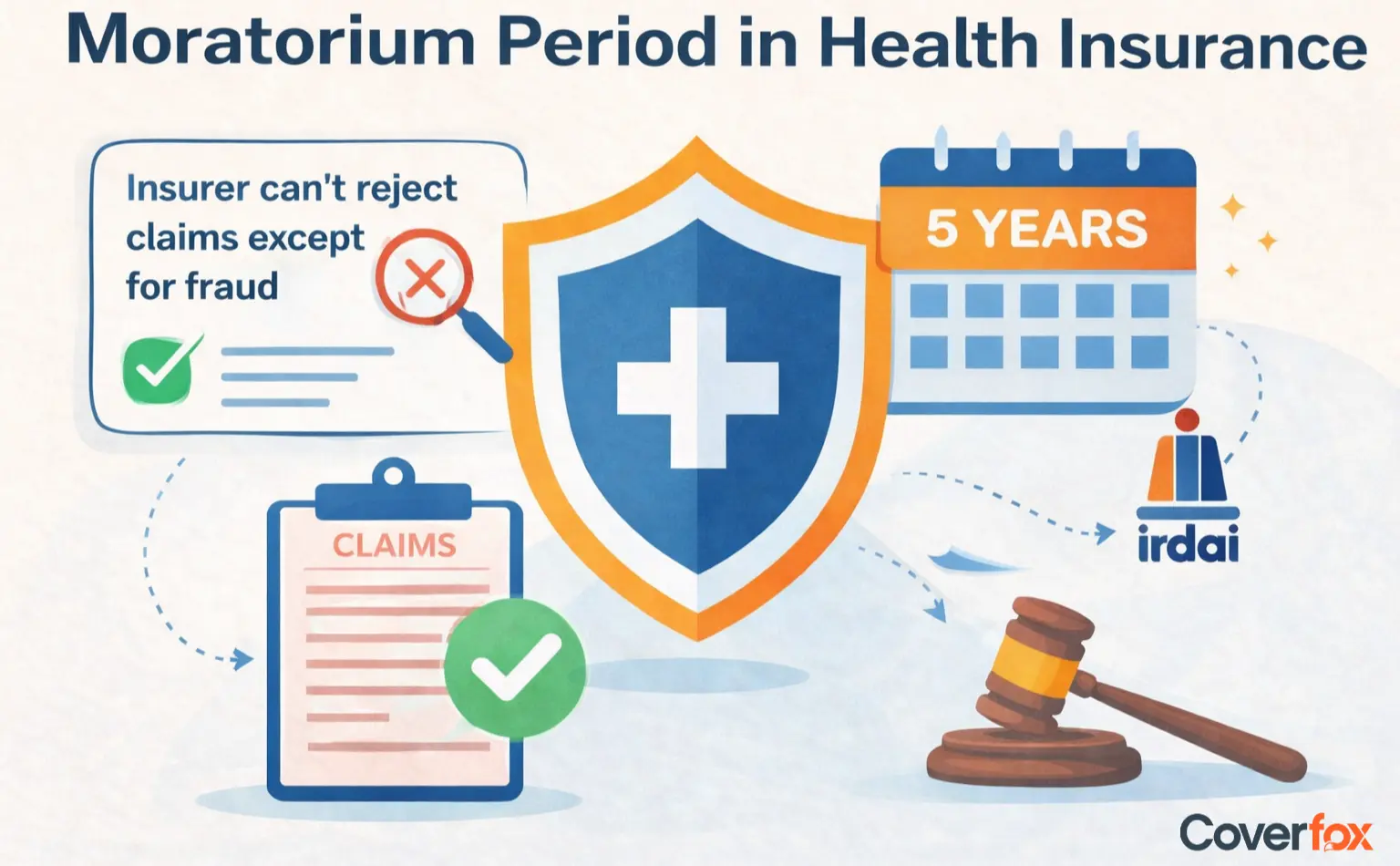
The moratorium period in health insurance is a long-term protection clause under IRDAI guidelines that restricts insurers from rejecting claims due to non-disclosure or misrepresentation after a defined period of continuous coverage, except in cases of proven fraud. This is especially important for policyholders with pre-existing diseases, as it offers greater claim certainty over time. This article explains what the moratorium period means, how it works, and why it matters for policyholders.
What Is a Moratorium Period in Health Insurance?
The moratorium period in health insurance is a defined long-term duration after which insurers cannot look back into past disclosures, which is why it is also referred to as a look-back period. As per IRDAI guidelines, once eight (now 5) continuous years of coverage are completed, claims cannot be denied due to non-disclosure or misrepresentation related to pre-existing conditions, except in cases of proven fraud or permanent exclusions stated in the policy. This provision is uniformly applicable across all health insurers in India under regulations issued by the Insurance Regulatory and Development Authority of India.
IRDAI Guidelines on Moratorium Period
The Insurance Regulatory and Development Authority of India regulates and standardises the moratorium period to protect long-term health insurance policyholders
The moratorium period has been reduced from 8 years to 5 years in 2024, making claim protection available sooner (Source - IRDAI Know Your Policy)
It is mandatory for all health insurers in India to ensure uniform application across the industry
Continuous policy renewal without any break is required for the moratorium period to apply
The guideline applies to both individual and family floater health insurance policies
Policy portability or migration does not reset the moratorium clock, provided coverage remains continuous

Purpose of Moratorium Period in Health Insurance
The moratorium period exists to balance insurer risk management with long-term policyholder protection under IRDAI regulations. It discourages misuse and promotes honest disclosure while preventing insurers from unfairly rejecting claims after years of continuous coverage. Overall, it builds long-term trust and encourages early and sustained participation in health insurance.
How Does the Moratorium Period Work in Health Insurance?
Here's how the moratorium period works in health insurance, at each stage:
At the Time of Policy Purchase
During the Moratorium Period
After the Moratorium Period Ends
At the time of buying a health insurance policy, the proposer is required to disclose all material health details for underwriting. Based on this, insurers may impose pre-existing disease PED waiting periods, typically ranging from 1 to 3 years, ask for medical tests, or apply specific terms. During this phase, non-PED treatments are generally covered as per policy conditions.
Once the policy is active and renewed continuously, the moratorium clock starts. Claims related to PEDs may be payable after the applicable waiting period, but insurers can still examine past disclosures and question claims if there is suspected misrepresentation or non-disclosure.
After completion of the moratorium period as defined by Insurance Regulatory and Development Authority of India, insurers cannot deny claims on grounds of past non-disclosure or misrepresentation. Claims can only be contested in cases of proven fraud or permanent exclusions explicitly stated in the policy.
Duration of Moratorium Period in Health Insurance
Earlier, the moratorium period in health insurance was 8 continuous years, after which insurers could not question past disclosures except in cases of fraud. As per updated guidelines issued by the Insurance Regulatory and Development Authority of India in 2024, this duration has now been reduced to 5 continuous years, allowing policyholders to receive long-term claim protection sooner, provided the policy is renewed without any break.
Difference Between Moratorium Period & Waiting Period in Health Insurance
The waiting period and moratorium period serve different purposes in a health insurance policy and operate at different stages of coverage.
Waiting Period
Moratorium Period
The waiting period is a predefined duration during which specific treatments or pre-existing diseases are not covered under a health insurance policy. During this time, claims related to these conditions are not admissible, as the waiting period directly restricts coverage.
The moratorium period is a long-term protection clause that limits an insurer’s right to reject claims after continuous policy coverage. Once this period ends, claims cannot be denied due to past non-disclosure or misrepresentation, except in cases of proven fraud or permanent exclusions.
Difference Between Moratorium Period & Look-In Period in Health Insurance
The differences between a Moratorium Period and a Lock-in Period are:
| Parameter | Moratorium Period | Look-In Period |
|---|---|---|
| Meaning | A long-term protection period after which insurers cannot contest claims except in cases of fraud or permanent exclusions. | A short initial review period provided to the policyholder. |
| Purpose | Restricts an insurer’s right to reject claims due to past non-disclosure or misrepresentation. | Allows the policyholder to review policy terms and cancel the policy if unsatisfied. |
| Duration | Earlier 8 years, now reduced to 5 years with continuous coverage. | Usually 15 days from receipt of the policy document. |
| Applicability | Applies to long-term policies with continuous renewals. | Applies only at the start of a new policy. |
| Impact on Claims | Prevents claim rejection after the period ends, except for fraud or permanent exclusions. | Claims made during this period may lead to policy cancellation if the policy is returned. |
| Who It Protects | Protects policyholders in the long run. | Protects policyholders at the time of purchase. |
| Nature | Limits the insurer’s right to reject claims. | Gives the policyholder the right to cancel the policy. |
What Is Considered Fraud Under the Moratorium Clause?
Even after the moratorium period ends, insurers can reject claims if there is proven fraud, as the moratorium does not protect deliberate or intentional wrongdoing. Fraud involves actions taken with the intent to deceive the insurer, not genuine or accidental mistakes.
Active concealment
False declarations
Manipulated documents
Intentional misrepresentation
Innocent omission vs fraud
Knowingly hiding important medical information while purchasing the policy
Providing incorrect or untrue health details in the proposal form
Submitting altered or fabricated medical reports or bills
Deliberately misstating facts to obtain policy benefits
Unintentional or honest omissions are protected after the moratorium, while deliberate deception is not
Does Increasing Sum Insured Reset the Moratorium Period?
Increasing the sum insured does not reset the moratorium period for the existing base cover. However, a fresh moratorium period applies only to the enhanced sum insured, counted from the date of increase, as per guidelines issued by the Insurance Regulatory and Development Authority of India.
Who Is Eligible for Moratorium Period Benefits?
Any policyholder who maintains continuous health insurance coverage without a break is eligible for moratorium period benefits. The benefit applies to both individual and family floater policies, including cases of portability or migration, provided continuity is maintained as per Insurance Regulatory and Development Authority of India guidelines.
How to Benefit Fully from the Moratorium Period?
Following these practices helps maximise long-term claim protection under guidelines issued by the Insurance Regulatory and Development Authority of India.
Buy health insurance early to start the moratorium clock sooner
Disclose all medical details honestly at the time of policy purchase
Ensure continuous policy renewal without any breaks
Review your policy periodically, especially after sum insured enhancements
Clearly understand permanent exclusions, sub-limits, co-payments, and deductibles stated in the policy
Conclusion
The moratorium period is a powerful long-term consumer protection mechanism that ensures greater claim certainty for policyholders who maintain continuous health insurance coverage. It rewards early planning, honest disclosure, and policy consistency, while strengthening trust between insurers and policyholders by limiting unfair claim rejections over time.
Reference - https://irdai.gov.in/document-detail?documentId=394691
Also Read:
FAQs on Moratorium Period in Health Insurance
What is the 5-year moratorium period in health insurance?
It is a long-term protection period after which insurers cannot reject claims due to non-disclosure or misrepresentation, except in cases of proven fraud or permanent exclusions.
What was the earlier 8-year moratorium rule?
Earlier, insurers could contest claims for up to 8 continuous years; this duration has now been reduced to 5 years under updated IRDAI guidelines.
Is the moratorium period mandatory for all insurers?
Yes, it is mandatory for all health insurers in India as regulated by the Insurance Regulatory and Development Authority of India.
Does the moratorium period apply to family floater plans?
Yes, it applies to both individual and family floater health insurance policies.
What happens if I miss a premium payment?
If there is a break in policy continuity, the moratorium clock may reset and benefits can be impacted.
Does porting reset the moratorium period?
No, porting does not reset the moratorium period as long as coverage remains continuous.
Can insurers reject claims after the moratorium period ends?
Claims cannot be rejected due to past non-disclosure or misrepresentation, except in cases of fraud or permanent exclusions.
Are permanent exclusions covered after the moratorium?
No, permanent exclusions mentioned in the policy remain excluded even after the moratorium period.
Does moratorium apply to critical illness policies?
No, the moratorium period applies to indemnity-based health insurance policies, not benefit-based plans like critical illness policies.
Is moratorium applicable to senior citizen health insurance?
Yes, it applies to senior citizen health insurance policies, provided coverage is continuous.
Are claims non-contestable after the moratorium period?
Claims become non-contestable on grounds of non-disclosure or misrepresentation, subject to fraud and permanent exclusions.
Does fraud override moratorium protection?
Yes, proven fraud can override moratorium protection and allow claim rejection.



.webp)
 in Insurance.webp)

