
RTO works at a regional or state level and supervises multiple districts, while DTO operates at the district level under the RTO. DTO handles routine services like vehicle registration and driving licences, whereas RTO manages everything, from registrations to inter-district or inter-state permits and higher-level transport matters.
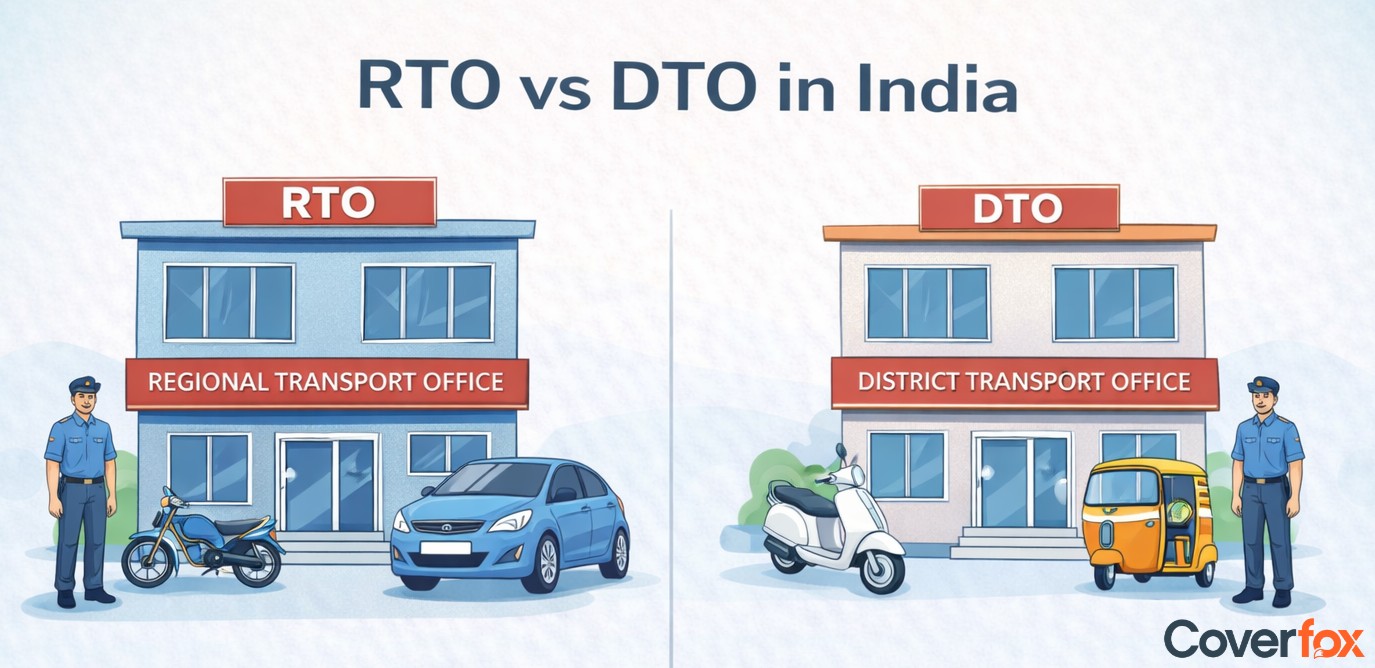
When it comes to registering your vehicle or applying for a driving licence in India, the words RTO or DTO surely must have crossed your path. While both the Regional Transport Office and District Transport Office are government-run authorities that deal with transport, they have separate and different jurisdictions and levels of authority. That sounds a bit confusing, right? But, do not worry, as you can understand the core differences between RTO and DTO through this article, and make informed decisions later.
RTO stands for Regional Transport Office. It is a government authority that operates at a regional or state level under the respective State Transport Department, as per the Motor Vehicles Act, 1988. An RTO typically supervises multiple DTOs within its jurisdiction and is responsible for broader transport administration.
At a higher level, the RTO oversees inter-district and inter-state transport regulation, implements transport-related policies, and ensures uniform application of motor vehicle laws across regions.
Issuing learner’s licences, permanent driving licences, commercial licences, and international driving permits
Vehicle registration and issuance of Registration Certificates (RCs)
Collection of road tax, registration fees, and licence fees
Granting state and national transport permits
Vehicle inspection and fitness certification, especially for commercial vehicles
Maintaining centralised records of vehicles and drivers
Enforcement of road safety norms and transport laws across regions
DTO stands for District Transport Office. It functions at the district level and works under the supervision of the RTO or the State Transport Authority. The DTO focuses on delivering transport-related services locally, making them more accessible to citizens.
While a DTO performs tasks similar to an RTO, its authority is limited to a single district, ensuring smoother day-to-day transport administration at the grassroots level.
Registering vehicles within the district and updating RC details
Issuing, renewing, and modifying driving licences
Conducting learner’s and permanent driving tests
Collecting district-level road taxes and fees
Issuing local permits, temporary permits, and No Objection Certificates (NOCs)
Vehicle fitness inspections and certification
Issuing and checking PUC (Pollution Under Control) certificates
Verifying insurance details during vehicle and licence services
Enforcing traffic rules and transport regulations at the district level
While both RTO and DTO play important roles in transport administration, they differ in authority, jurisdiction, and scope of work:
| Basis of Comparison | RTO (Regional Transport Office) | DTO (District Transport Office) |
|---|---|---|
| Full Form | Regional Transport Office | District Transport Office |
| Level of Operation | Regional or State level | District level |
| Jurisdiction | Covers multiple districts or an entire region | Limited to a single district |
| Scope of Authority | Wider authority over transport administration and regulation | Limited authority focused on local service delivery |
| Hierarchy | Senior authority that supervises and controls DTOs | Works under the RTO or State Transport Authority |
| Permit Issuance | Issues and regulates state and national permits | Issues local and district-level permits and NOCs |
| Administrative Control | Implements transport policies and oversees inter-district and inter-state matters | Executes policies and handles routine transport operations |
| Nature of Work | Policy implementation, supervision, and coordination | Day-to-day citizen services and ground-level enforcement |
Choosing the right office can save time, reduce multiple visits, and avoid unnecessary delays. Use the guide below to decide where to go based on your requirements.
Vehicle registration and RC-related services within your district
Learner’s licence, driving licence issuance, renewal, or correction
Driving tests for learners or permanent licences
NOC issuance for the transfer of a vehicle within or outside the state
Vehicle fitness certificates and inspection services
PUC verification, insurance checks, and other routine transport services
Payment of district-level road taxes and fees
Inter-district or inter-state transport permits
National permits for commercial vehicles
International Driving Licence (IDP) issuance
Resolution of complex or escalated transport matters
Services involving policy-level decisions or regional approvals
Matters that require supervisory authority beyond the district level
To reduce paperwork and physical visits, RTOs and DTOs provide a wide range of services online through Government transport portals. Most citizen-facing services are now accessible digitally, improving speed and transparency.
Learner’s licence application, DL issuance, renewal, duplicate DL, and address change via Sarathi Parivahan
New vehicle registration, RC download, RC transfer, address change, hypothecation update, and duplicate RC through Parivahan Sewa
Online slot booking for driving tests, biometric verification, and vehicle inspection
Digital payment of road tax, registration charges, and licence fees
Application and tracking of local, state, and national permits (as applicable)
PUC certificate status check and linkage with vehicle records
Real-time status tracking for licences, RCs, permits, and other services
Digitally signed RC, DL, and permit documents
Online complaint filing and status tracking related to transport services
Most DTO-level services like licence renewal and vehicle registration can be completed online with minimal physical visits, while RTO-level approvals for permits and specialised services also begin digitally, helping users save time and avoid queues.
As India’s transport ecosystem modernises, RTOs and DTOs continue to play a critical role in regulating and enabling sustainable mobility.
Streamlining EV registration, green number plates, and incentive-linked compliance
Enforcing stricter emission standards and digitised fitness certification
Supporting data-driven enforcement and intelligent traffic management
Expanding end-to-end online services and paperless approvals
Using technology and analytics to strengthen accident prevention and compliance
Regulating modern mobility while ensuring environmental responsibility
Whilst both RTO and DTO work towards the same goal, providing transport-related services within their designated areas, their scope and authority differ. An RTO functions as a wider regional authority, supervising multiple districts, while a DTO operates under the RTO and has jurisdiction limited to a single district, focusing on day-to-day transport services.
That said, whether you’re visiting an RTO or a DTO, one requirement remains constant – valid motor insurance. From vehicle registration to permits and inspections, having your motor insurance in place is essential at every step.
RTO stands for Regional Transport Office, while DTO stands for District Transport Office.
No. Both handle transport services, but RTO has wider regional authority, whereas DTO works at the district level under the RTO.
RTO is hierarchically higher. DTOs function under the supervision and administrative control of RTOs.
Yes. Most services like driving licence applications, RC services, appointments, and payments are available through government transport portals, reducing the need for physical visits.
Traffic challans are primarily issued and enforced by the traffic police, while RTOs/DTOs handle administrative actions related to licences, permits, and registrations.
RTO is a transport authority, whereas MVI (Motor Vehicle Inspector) is an enforcement officer responsible for vehicle inspections, fitness checks, and on-road compliance.
In logistics, RTOs manage regional and inter-state permits, while DTOs handle local vehicle registrations, district permits, and routine transport documentation.
In the context of cars, DTO refers to the District Transport Office, which manages local vehicle registration, licence services, and district-level transport compliance.


