A cooling-off period in health insurance is a waiting period imposed after an applicant has recovered from certain illnesses, undergone surgery, or received specific medical treatments. During this time, the insurer evaluates the individual's health status and recovery progress before making a final decision on policy approval and coverage terms.
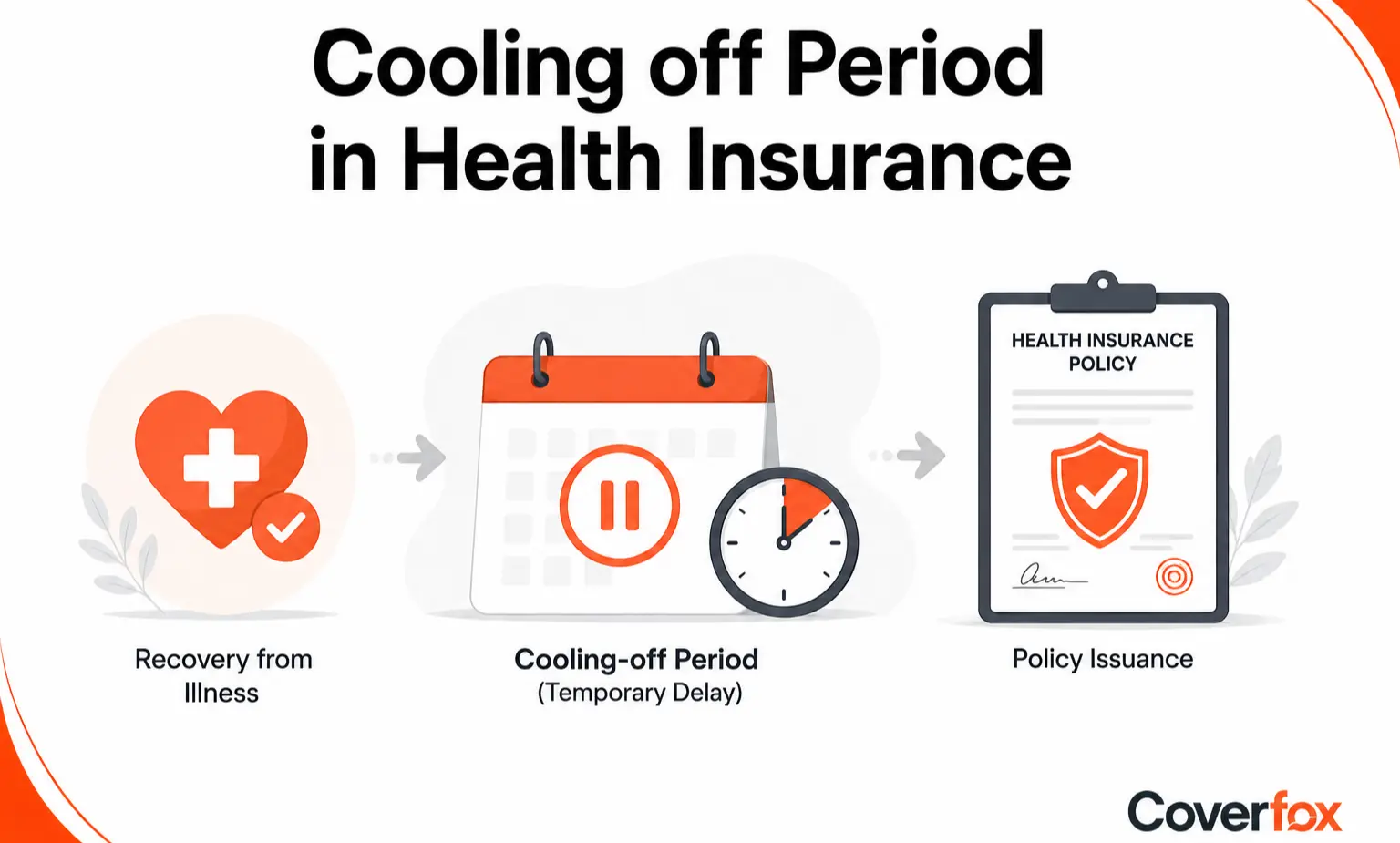
Planning to buy health insurance after recovering from an illness? You may come across something known as a cooling-off period. While many people expect their policy to be issued immediately, insurers may ask applicants to wait for a certain period after recovery to assess their health condition and associated risks. To know the meaning of cooling period in health insurance, read along.
What Is Cooling-Off Period in Health Insurance?
A cooling-off period in health insurance is a temporary period during which an insurer postpones policy issuance after an individual recovers from certain illnesses, surgeries, or medical conditions. This allows the insurer to evaluate the applicant's current health status and assess the likelihood of future medical complications as part of the underwriting process.
The duration of the cooling-off period can range from 15 - 90 days, depending on the medical condition, recovery timeline, and the insurer's guidelines. Once the required period is completed and the applicant's health is deemed stable, the health insurance policy may be issued, sometimes with specific terms or waiting periods.

Why Do Health Insurers Impose a Cooling-Off Period?
The cooling-off period is not intended to deny coverage but to help insurers assess medical risks more accurately. By allowing some time after recovery, insurers can better understand an applicant's health condition and make informed underwriting decisions. Here are some of the key reasons why insurers impose a cooling-off period:
-
Health Risk Assessment
After a major illness, surgery, or medical treatment, an individual's health condition may still be evolving. The cooling-off period gives insurers time to evaluate the applicant's recovery and determine the associated health risks.
-
Monitoring Post-Recovery Complications
Certain medical conditions can lead to complications even after treatment is completed. Insurers may wait to see whether any relapse, side effects, or additional health concerns arise before issuing the policy.
-
Preventing Immediate High-Risk Claims
If a policy is issued immediately after a serious illness or treatment, the chances of a claim occurring in the near term may be significantly higher. The cooling-off period helps insurers manage this immediate risk exposure.
-
Better Underwriting Decisions
Insurers use the cooling-off period to collect medical information, review health records, and assess the long-term impact of a medical condition. This enables them to make fair and informed underwriting decisions.
-
Reducing Future Claim Disputes
A thorough assessment before policy issuance helps minimise misunderstandings and claim disputes later. Clear documentation of the applicant's health condition at the time of purchase benefits both the insurer and the policyholder.
How Does the Cooling-Off Period Work?
The cooling-off period follows a structured evaluation process that helps insurers assess an applicant's health condition before issuing a policy.
-
Application Submission
The applicant submits the health insurance proposal form along with details about their medical history, existing conditions, previous treatments, or recent hospitalisations.
-
Medical Evaluation
The insurer reviews the disclosed medical information to understand the nature of the illness, treatment received, and current recovery status.
-
Additional Documents and Health Records
The insurer may ask for discharge summaries, doctor's certificates, diagnostic reports, prescriptions, or treatment records to obtain a complete medical picture.
-
Medical Tests (If Required)
In certain cases, insurers may recommend medical examinations or diagnostic tests to verify the applicant's current health condition and recovery progress.
-
Final Underwriting Decision
After reviewing all medical information, the insurer decides whether to issue the policy immediately, impose a cooling-off period, offer coverage with specific conditions, or request additional evaluation.
Note: Cooling period generally does not affect insurance premium, and the process may differ from insurer to insurer.
What Are Some of the Common Illnesses that May Trigger a Cooling-Off Period
Certain medical conditions may require a cooling-off period before a health insurance policy is issued. The duration varies depending on the illness, treatment, and the insurer's underwriting guidelines. Some commonly observed conditions include:
-
Cardiac Conditions
Heart attack, angioplasty, bypass surgery, or other heart-related ailments.
-
Cancer
Recent cancer treatment, chemotherapy, radiation therapy, or tumour removal.
-
Major Surgeries
Organ surgeries, joint replacements, spinal surgeries, or abdominal procedures.
-
Stroke and Neurological Disorders
Stroke, epilepsy, or certain neurological conditions.
-
Respiratory Diseases
Pneumonia, tuberculosis, or chronic lung disorders.
-
Liver and Kidney Disorders
Liver disease, kidney ailments, or related surgeries.
-
Severe Infections
Serious infections or illnesses that require prolonged medical care.
Note: This information is generic, and may not apply to every insurer. For exact details, refer to your insurer policy wordings only.
Cooling-Off Period vs Free-Look Period vs Waiting Period
Although free-look period, waiting period, and cooling-off period meaning in insurance are often mistaken for being one and the same, they are completely different terms having their own purpose in health insurance:
| Parameter | Cooling-Off Period | Free-Look Period | Waiting Period |
| Meaning | Temporary postponement of policy issuance after recovery from certain illnesses | Time allowed to review and cancel the policy after purchase | Period during which specific claims are not covered after policy issuance |
| When It Applies | Before the policy is issued | After the policy is issued | After the policy becomes active |
| Purpose | Assess health risks and recovery status | Allow policyholders to review policy terms | Prevent immediate claims for certain conditions |
| Who Decides It? | Insurer during underwriting | Regulatory guidelines and insurer terms | Insurer as per policy conditions |
| Coverage Status | Coverage has not yet started | Coverage can be cancelled during this period | Policy is active, but certain claims are restricted |
| Typical Duration | A few days to several months | Usually 15 to 30 days | 30 days to several years, depending on the condition |
| Applicable To | Recent illnesses, surgeries, or medical conditions | All new health insurance policies | Pre-existing diseases, specific illnesses, maternity, etc. |
| Impact on Premium | Generally does not affect premium | No impact on premium | No impact on premium, but affects claim eligibility |
Is the Cooling-Off Period the Same in Health Insurance and Term/Life Insurance?
No, the cooling-off period does not carry the same meaning in health insurance and term or life insurance. Health insurance cooling off period, usually refers to a temporary postponement of policy issuance after recovery from certain medical conditions to assess health risks.
In term and life insurance, the term is more commonly associated with the free-look period, which allows policyholders to review the policy and cancel it within a specified period if they are not satisfied with the terms and conditions.
Can You Skip the Cooling-Off Period While Buying Health Insurance?
In most cases, the cooling-off period in insurance cannot be skipped if the insurer considers it necessary during the underwriting process. The decision is based on factors such as the applicant's recent medical history, recovery status, and the nature of the illness or treatment.
However, maintaining complete medical records, undergoing recommended medical tests, and providing accurate health disclosures may help insurers assess the application more quickly. Since underwriting practices vary across insurers, the duration and applicability of the cooling-off period may differ from one insurer to another.
Common Misconceptions About Cooling-Off Periods
A cooling-off period in insurance means the policy has been rejected: It only indicates a temporary postponement of policy issuance.
Every health insurance applicant has to undergo a cooling-off period: It applies only in certain medical cases based on underwriting assessment.
The cooling-off period increases the premium amount: It generally affects only the timing of policy issuance, not the premium.
Coverage starts during the cooling-off period: Insurance coverage begins only after the policy is approved and issued.
A cooling-off period is the same as a waiting period: A cooling-off period occurs before policy issuance, while a waiting period applies after the policy becomes active.
The cooling-off period in insurance is identical across all insurers: The duration and applicability can vary depending on the insurer and the medical condition.
A cooling-off period always leads to policy rejection: Many applicants receive coverage once the required assessment period is completed.
Key Takeaways
A cooling-off period in health insurance is a temporary delay in policy issuance that allows insurers to assess an applicant's health after certain illnesses or treatments. It is different from a waiting period or free-look period and does not usually affect the premium amount. Understanding how cooling-off periods work can help applicants make informed decisions, complete the required medical assessments, and plan their health insurance purchase well in advance.
Also Read:
FAQ Cooling Period in Health Insurance
How long is the cooling-off period in health insurance?
The cooling-off period can range from 15-90 days, depending on the applicant's medical condition, recovery status, and the insurer's underwriting guidelines.
Is the cooling-off period the same as the waiting period?
No. A cooling-off period applies before the policy is issued, while a waiting period begins after the policy becomes active and restricts coverage for certain illnesses or conditions.
What is the difference between a cooling-off period and a free-look period?
A cooling-off period is a temporary delay in policy issuance for medical assessment, whereas a free-look period allows policyholders to review and cancel the policy after purchase.
Does a cooling-off period increase health insurance premiums?
Generally, no. The cooling-off period affects the timing of policy issuance and does not directly impact the premium amount.
Can an insurer reject my policy after the cooling-off period?
Yes. After reviewing medical records and assessing the health risk, the insurer may approve, postpone, modify, or decline the application based on underwriting guidelines.
Will I receive a full refund if I cancel during the free-look period?
The insurer may refund the premium after deducting applicable charges such as medical examination costs, stamp duty, and the proportionate risk premium, if applicable.
Is the cooling-off period applicable to all health insurance policies?
No. It is generally applicable only in cases involving recent illnesses, surgeries, or medical conditions that require additional assessment.
What is the free-look period in health insurance?
The free-look period is the time given to policyholders to review the policy terms and cancel the policy if they are not satisfied. It usually begins after the policy document is received.
What is the waiting period in health insurance?
A waiting period is the duration during which certain illnesses, pre-existing diseases, or treatments are not covered after the policy becomes active.
What is the minimum cooling-off period in health insurance?
There is no standard minimum cooling-off period. The duration depends on the insurer's underwriting guidelines and the applicant's medical condition.
Can I buy another health insurance policy during a cooling-off period?
Yes. You may apply for another policy, but the new insurer may also conduct its own medical assessment and underwriting process.
Does a cooling-off period affect claim settlement?
No. Since the policy is not yet issued during the cooling-off period, coverage and claim eligibility begin only after the policy is approved and becomes active.
Which illnesses commonly lead to a cooling-off period?
Conditions such as heart disease, cancer, major surgeries, stroke, respiratory disorders, liver and kidney diseases, and certain serious infections may trigger a cooling-off period.
Can I reduce the cooling-off period?
Providing complete medical records, undergoing recommended medical tests, and maintaining transparent health disclosures may help insurers complete the assessment process faster.
Does every insurer have the same cooling-off period?
No. The applicability and duration of the cooling-off period vary from one insurer to another based on their underwriting practices and risk assessment guidelines.