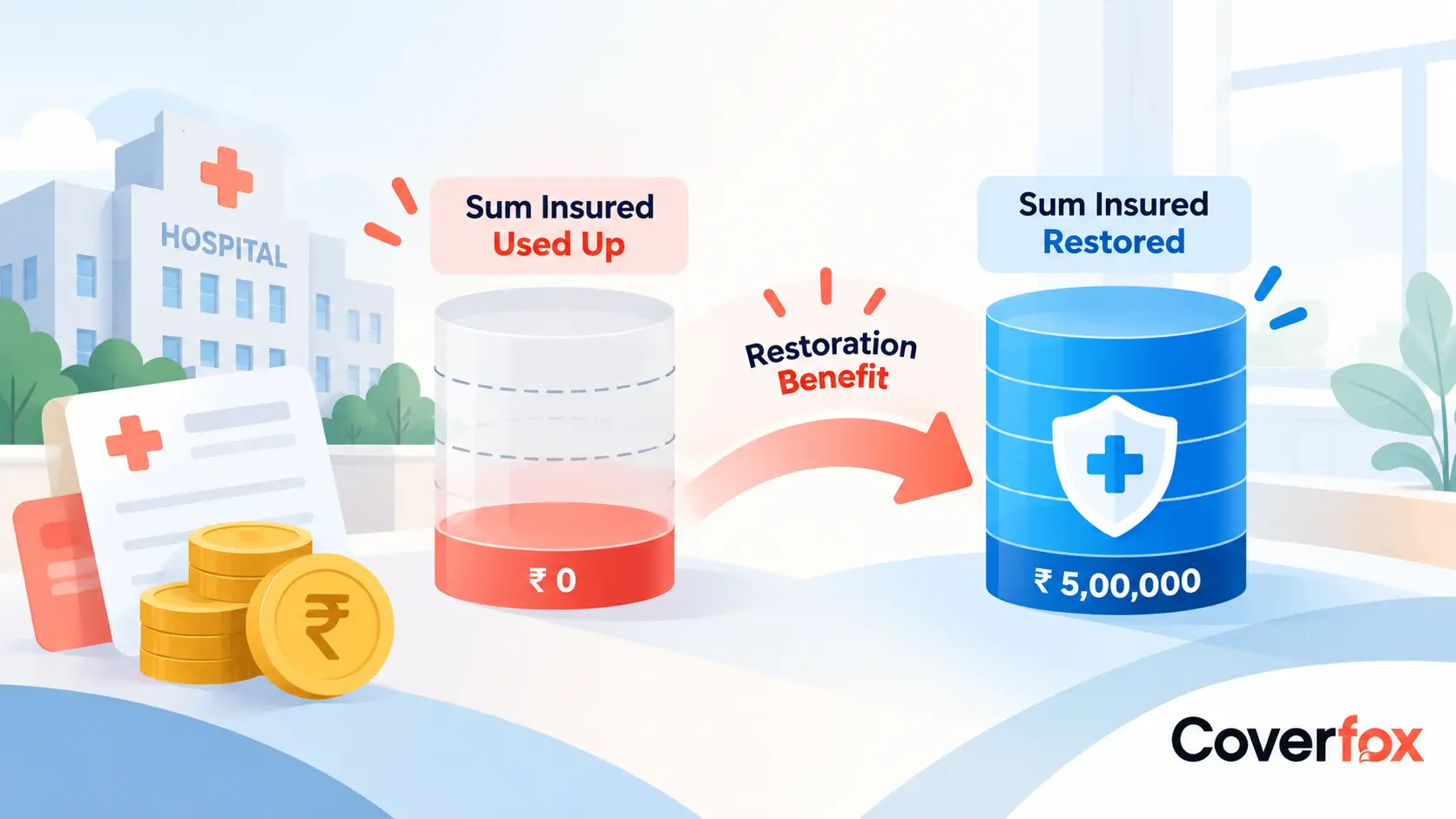
Restoration benefit refills your sum insured after claims have used it up, so you still have cover for another hospitalisation in the same policy year. The policy wording determines how the restoration benefit will work, whether it will apply to the same illness or to everyone in the family floater plan. The restoration benefit helps the policyholder stay covered even after the base sum insured is exhausted.
What Is Restoration Benefit in Health Insurance?
A health insurance policy pays claims up to your sum insured. On a standard policy, once that limit is reached, you pay every further bill yourself until the policy renews, unless you have restoration benefit in health insurance. The insurer puts the sum insured back, and you get a fresh limit for the rest of the year.
The restoration of cover benefit is available with both family floater plans and an individual health insurance policy. Some plans may have it as a standard inclusion. On others, you may have to buy it as an add-on for an extra premium. In some refill/recharge policies, the trigger looks at the base sum insured and any accumulated bonus together.
How Does Restoration of Cover Work in Health Insurance?
Let's assume you have a health insurance policy of ₹5 lakh and have a restoration benefit after it's exhausted.
In month three, you are hospitalised, and the claim comes to ₹5 lakh. The whole sum insured is used.
The insurer restores the ₹5 lakh. Health insurance restoration allows additional sum insured available for the policy, as per the terms.
In month eight, you are admitted again; this time the claim meets the restoration benefit criteria and the bill is ₹3 lakh. Eligible expenses are paid from the restored cover, which leaves ₹2 lakh for the rest of the year.
At renewal, the policy starts again at the original ₹5 lakh. The unused ₹2 lakh does not carry forward.
What Are the Different Types of Restoration Benefit?
Restoration After Full or Partial Exhaustion
Full exhaustion: Restoration triggers only after the entire sum insured is used. Say you claim ₹4 lakh on a ₹5 lakh policy. The remaining ₹1 lakh has to be used up before anything is restored.
Partial exhaustion: Restoration triggers even when only part of the sum insured has been used. On the same policy, the ₹4 lakh claim alone would take your cover back to ₹5 lakh.
The amount restored can also differ. Some policies restore the full sum insured. Others restore a fixed amount set in the policy, such as ₹3 lakh on an ₹8 lakh cover. The amount is available for eligible future expenses and can be used as per policy terms.
Once-Per-Year and Multiple Restoration
Some health insurance policies restore the sum insured only once during the policy year. If you use up the restored amount as well, you may have to wait until renewal for another restoration.
Other policies allow multiple restorations or offer them without a fixed limit. The amount restored varies too: a policy may restore 100% of the sum insured once, restore it several times, or restore up to 200% in a single reinstatement, depending on the insurer’s terms and conditions.
When Can You Use the Restored Sum Insured?
The restoration benefit in health insurance comes with conditions that are pre-set by the insurer in the policy wording.
Same Illness or a Different Illness
Different illness: Some policies allow the restored sum insured only for an unrelated illness or injury. For example, a claim for heart surgery may qualify for restoration towards a later hospitalisation following an accident.
Same illness: A second claim for the same condition may not qualify. Some policies allow it after a specified gap between treatments, while others restrict restoration to unrelated conditions.
Other policy limits: Restoration does not remove waiting periods, room rent limits, co-payments, deductibles or disease-specific sub-limits.
Note: Check your policy wording for the rules on repeat treatments and related illnesses.
Subsequent Claims and Family Floater Policies
Subsequent claims: Many policies make the restored sum insured available for a later claim. If one hospital bill exceeds the original sum insured, you cannot assume restoration will cover the shortfall. The policy must specifically allow it.
Family floater health insurance plans: The sum insured is shared by all insured family members. Restoration may replenish the cover after a claim, but the rules on who can use that amount vary by policy.
Multiple family members: Some policies restrict restoration when claims are made by different members, while others allow multiple members to use the benefit subject to their terms.
Same hospitalisation: Restoration may not apply to an ongoing hospitalisation or to the unpaid balance of an existing claim.
What Should You Check Before Choosing Restoration Benefit?
Go through these points in the policy wording or brochure:
Is restoration built in, or an add-on that costs extra?
Does it trigger on full use or partial use of the sum insured, and does accumulated bonus count?
How many times can it restore in a policy year, and is the amount restored full or fixed?
Does it apply to the same illness, and is there a gap period between treatments?
On a floater, can any member use the restored cover, or only one at a time?
Do waiting periods, room rent limits, sub-limits and co-pay still apply to the restored cover?
Does it cover only hospitalisation, or day care and other expenses too?
What does the brochure call the feature (restoration, refill, reset or recharge), and how does it define it?
If any answer is unclear, ask the insurer to confirm it in writing before you pay.
Conclusion
Restoration benefit in health insurance gives you cover again after claims have used up your sum insured, for the rest of that policy year only. Make the necessary checks before buying a health insurance policy, like how the restoration benefit works, when it activates, how much restoration benefit you receive, etc. If you are still confused regarding the restoration benefit, you can always ask Cover AI to help you out!
Frequently Asked Questions
Is restoration benefit mandatory in health insurance?
No. Restoration benefit may be included in your health insurance plan or available as an optional add-on at an extra premium. Check your policy brochure to confirm.
Can I add restoration benefit to my existing health insurance policy?
Sometimes. Insurers may allow you to add restoration cover when buying or renewing a policy, subject to the plan's terms. An additional premium may apply, and mid-term additions may not be permitted.
Is restoration benefit the same as a no-claim bonus?
No. A health insurance no claim bonus rewards claim-free years, often by increasing the sum insured at renewal. A restoration benefit replenishes the sum insured after it is exhausted, subject to policy conditions. The rules for both benefits vary by plan.