
- Retail Insurance
- Business Insurance
- Resources
- Claims
Endometrial cancer is a cancer that begins in the inner lining of the uterus, known as the endometrium. It is the most common gynaecological cancer in developed countries, largely due to factors such as higher life expectancy, obesity, and hormonal influences. It is a specific type of uterine cancer. Endometrial cancer can be further classified into type 1 and type 2 based on estrogen.
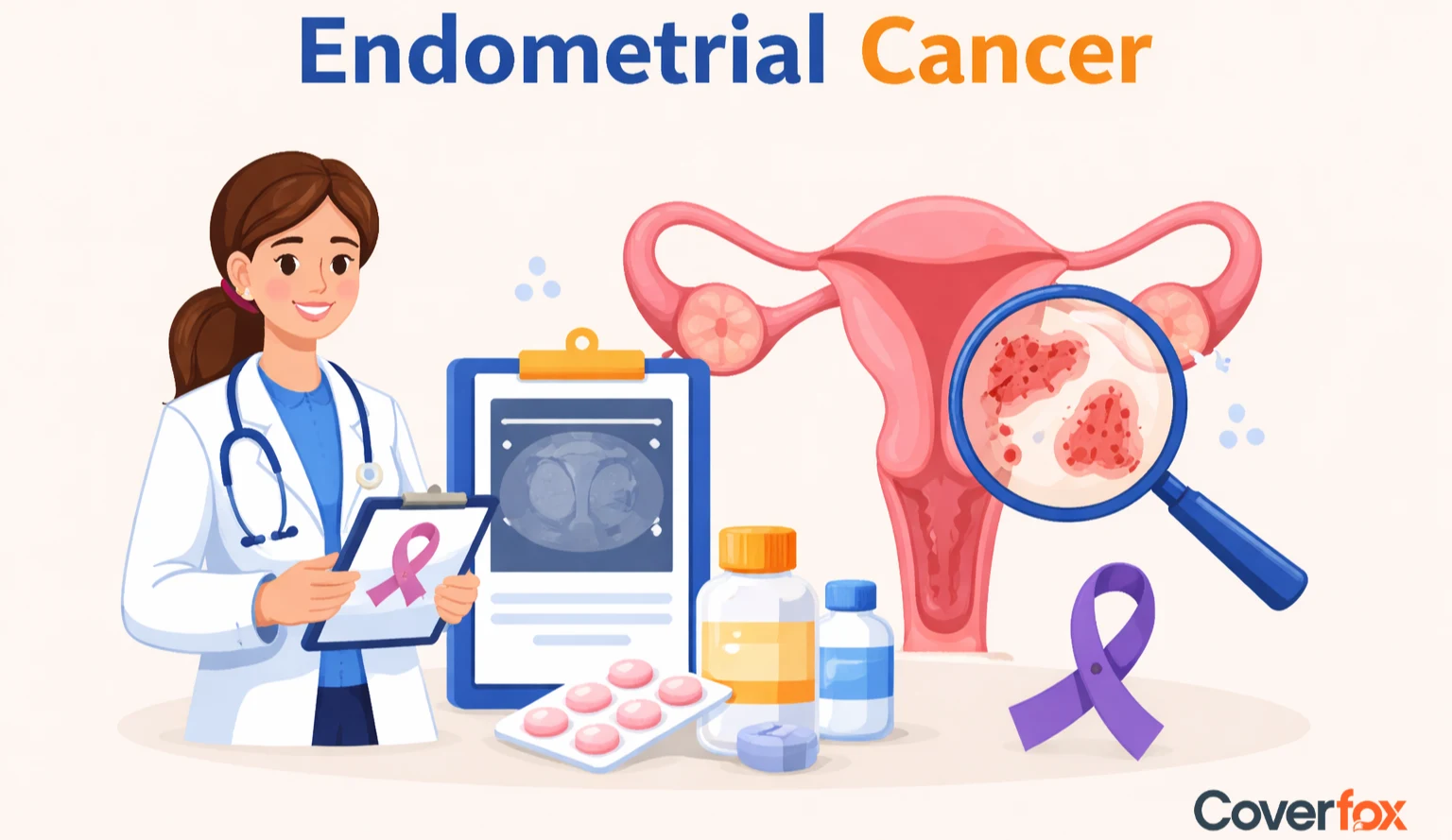
Endometrial cancer refers to the abnormal and uncontrolled growth of cells in the endometrium. The endometrium normally thickens during the menstrual cycle to support pregnancy and sheds if pregnancy does not occur. When these cells grow abnormally due to hormonal or genetic changes, they can form cancer. It is important to distinguish between the terms:
Cancer that starts in the lining of the uterus
A broader term that includes all cancers of the uterus
Endometrial cancer is the most common type of uterine cancer.
Endometrial cancer can be classified into two main types:
Associated with excess oestrogen
Usually low-grade and slow-growing
More common
Better prognosis
Not linked to oestrogen
High-grade and aggressive
Less common
Poorer prognosis
Endometrioid carcinoma: Most common subtype, typically Type I, better outcomes
Serous carcinoma: Aggressive, usually Type II
Clear cell carcinoma: Rare and aggressive
Carcinosarcoma (mixed Müllerian tumour): Contains both epithelial and connective tissue elements, highly aggressive
Endometrial cancer often presents with noticeable symptoms at an early stage, which helps in timely diagnosis and improves treatment outcomes.
The most important red-flag symptom; any bleeding after menopause should be evaluated
Periods that are unusually heavy, prolonged, or inconsistent
Unexpected spotting or bleeding outside the normal cycle
Unusual discharge that may be persistent or tinged with blood
Discomfort, pain, or a feeling of fullness in the pelvic area
In later stages, endometrial cancer may spread beyond the uterus, leading to more severe and systemic symptoms.
Discomfort or burning sensation while passing urine
Increased pain due to deeper tissue involvement
Persistent pain indicating spread to surrounding structures
Sudden weight loss without changes in diet or activity
Ongoing tiredness and weakness not relieved by rest
Difficulty passing urine or stool, or changes in normal habits due to tumour pressure or spread
Endometrial cancer is primarily caused by hormonal imbalance, especially when there is excess oestrogen without enough progesterone. Oestrogen stimulates the endometrium to grow, and without progesterone to regulate this growth, the lining can become excessively thick, increasing the risk of abnormal changes.
Over time, this endometrial thickening can lead to genetic mutations in the cells, causing them to grow uncontrollably and form cancer. These mutations disrupt normal cell regulation, allowing abnormal cells to multiply and survive longer than they should.
Certain factors increase the likelihood of developing endometrial cancer:
Excess body fat increases oestrogen levels, raising risk
Both are linked to hormonal imbalance and irregular ovulation
Longer lifetime exposure to oestrogen
Lack of progesterone exposure during pregnancy increases risk
Oestrogen-only therapy without progesterone
A drug used in breast cancer treatment that can affect the uterus
Conditions like Lynch syndrome and Cowden syndrome increase susceptibility
Most cases occur in women over 50
Endometrial cancer is usually diagnosed through a few simple steps that help doctors confirm if abnormal cells are present in the uterus.
The doctor asks about symptoms like abnormal bleeding and menstrual history
A physical exam to check for any abnormalities in the uterus or surrounding organs
Uses sound waves to see the uterus and measure the thickness of the endometrium
A small sample of the uterine lining is taken and tested for cancer cells (most important test)
A thin tube with a camera is used to look inside the uterus and guide biopsy if needed
If cancer is confirmed, further tests like scans may be done to check how far it has spread.
Endometrial cancer is staged using the FIGO (International Federation of Gynaecology and Obstetrics) system, which is mainly based on findings during surgery. Doctors remove the uterus and assess how far the cancer has spread. Imaging tests (like scans) and lymph node evaluation also help determine the stage more accurately.
Cancer is confined to the uterus
Cancer has spread to the cervix
Cancer has spread locally or regionally, such as to the ovaries, nearby tissues, or lymph nodes
Cancer has spread to distant organs, such as the bladder, bowel, or lungs
Source- Research on Endometrial Cancer
Treatment for endometrial cancer depends on the stage, grade (how aggressive the cancer is), and individual patient factors such as age, overall health, and fertility preferences. A combination of treatments is often used.
Main treatment options include:
Surgery
Radiation therapy
Chemotherapy
Hormone therapy
Targeted therapy and immunotherapy
Surgery is the primary and most common treatment for endometrial cancer, especially in early stages.
Removal of the uterus and cervix
Removal of both fallopian tubes and ovaries
Checking nearby lymph nodes to see if cancer has spread, often done through sentinel lymph node mapping
In carefully selected early-stage cases, fertility-sparing treatment using hormone therapy may be considered under strict medical supervision.
Radiation therapy uses high-energy rays to destroy cancer cells and is often used:
As adjuvant therapy after surgery to reduce the risk of recurrence
As vaginal brachytherapy: Internal radiation focused on the vaginal area
As external beam radiation therapy (EBRT), Used in more advanced cases or when cancer has spread
Chemotherapy involves using drugs to kill cancer cells or stop their growth. It is typically used in:
Advanced-stage disease
High-risk or aggressive cancer types
Recurrent cancer (when cancer returns after treatment)
Hormone therapy is used for cancers that are sensitive to hormones, particularly oestrogen.
Help counter the effect of oestrogen and slow cancer growth
Used for fertility preservation in early-stage cases
Suitable for patients not fit for surgery
Effective in hormone receptor–positive tumours
These are newer treatment options used mainly in advanced or recurrent cases.
Helps the immune system recognise and attack cancer cells (e.g., PD-1 inhibitors), especially in MMR-deficient tumours
Acts on specific molecular pathways that cancer cells depend on
Molecular testing is important to identify which patients are likely to benefit from these treatments.
The prognosis of endometrial cancer is generally favourable, especially when diagnosed early. This is because symptoms often appear in the initial stages, allowing timely treatment. Overall outcomes depend on factors such as stage at diagnosis, tumour grade, type of cancer, and patient health.
The overall 5-year survival rate for endometrial cancer is around 81% to 84% across all stages
When detected early and confined to the uterus, survival rates can be as high as 95% or more
~96% 5-year survival
~70 - 72%
~20 - 22%
Source - Cancer.org
Endometrial cancer and its treatment can lead to certain complications, and in some cases, the cancer may return after treatment.
Cancer may extend to the cervix, ovaries, bladder, or bowel
Can lead to swelling (lymphedema), especially in the legs
Pelvic or abdominal pain in advanced stages
Surgery: Early menopause, infertility
Radiation: Bowel or bladder irritation
Chemotherapy: Fatigue, nausea, hair loss
Recurrence means the cancer returns after initial treatment, either in the same area or elsewhere in the body.
In the vagina or pelvic region
In nearby lymph nodes
In organs such as the lungs, liver, or bones
Most recurrences occur within the first 3 years after treatment
Risk depends on stage, grade, and type of cancer
Symptoms of recurrence may include bleeding, pain, weight loss, or persistent cough
Regular follow-up and monitoring are essential to detect recurrence early and manage it effectively.
While endometrial cancer cannot always be prevented, certain measures can help reduce risk and enable early detection, especially in women at higher risk.
Reduces excess oestrogen levels linked to obesity
Proper control of diabetes, PCOS, and metabolic syndrome
Avoid unopposed oestrogen therapy; combine with progesterone if required
Long-term use may lower the risk by balancing hormones
Support hormonal balance and overall health
Routine screening is not recommended for the general population, but high-risk women may need closer monitoring:
May require annual endometrial biopsy starting at an earlier age
Genetic counselling is recommended
Help identify abnormalities early, though not a definitive screening tool
Used selectively to assess endometrial thickness in high-risk individuals
Prompt evaluation of any abnormal bleeding is the most effective way for early detection
See a doctor if you experience abnormal vaginal bleeding, especially after menopause, or bleeding between periods. Also seek medical advice for persistent pelvic pain, unusual discharge, or unexplained symptoms that do not go away.
Yes, most health insurance plans in India cover treatment for Endometrial Cancer, as it falls under serious medical conditions. Coverage typically includes hospitalisation, surgery, chemotherapy, and related treatments, subject to policy terms. However, benefits may depend on waiting periods, pre-existing condition clauses, and sum insured, so it’s important to review your policy details carefully.
Note: Not all health insurance plans may cover endometrial cancer, some plans may include it under critical illness plans. For exact coverage, please refer to your policy document carefully.
Endometrial cancer is a type of uterine cancer. It starts in the lining of the uterus and is the most common form of uterine cancer.
It is most common in women over 50, especially after menopause, though it can occur earlier in some cases.
Yes, it is often highly curable when detected early, particularly when confined to the uterus.
Some types grow slowly, but aggressive forms can spread faster, especially if not diagnosed early.
Yes, it is often detected early because of noticeable symptoms like abnormal bleeding.
No, Pap smears are mainly used to detect cervical cancer, not endometrial cancer.
Yes, although less common, it can occur in younger women, especially those with hormonal imbalances or genetic risk factors.
Yes, obesity increases oestrogen levels, which can raise the risk of endometrial cancer.
Yes, pregnancy increases progesterone levels, which can help protect the endometrium.
In some cases, yes. Genetic conditions like Lynch syndrome can increase risk.
Yes, there is a possibility of recurrence, especially within the first few years after treatment.
You can ask about the stage and type of cancer, treatment options, side effects, chances of recovery, and follow-up care plan.