
- Retail Insurance
- Business Insurance
- Resources
- Claims


Suzuki is one of the most respected two-wheeler brands in India. From dependable daily commuter scooters to high-performance superbikes, Suzuki has built a loyal rider base over decades. Whether you ride a Suzuki to work every morning or take it out on weekend highways, one thing remains constant: your Suzuki needs the right bike insurance.
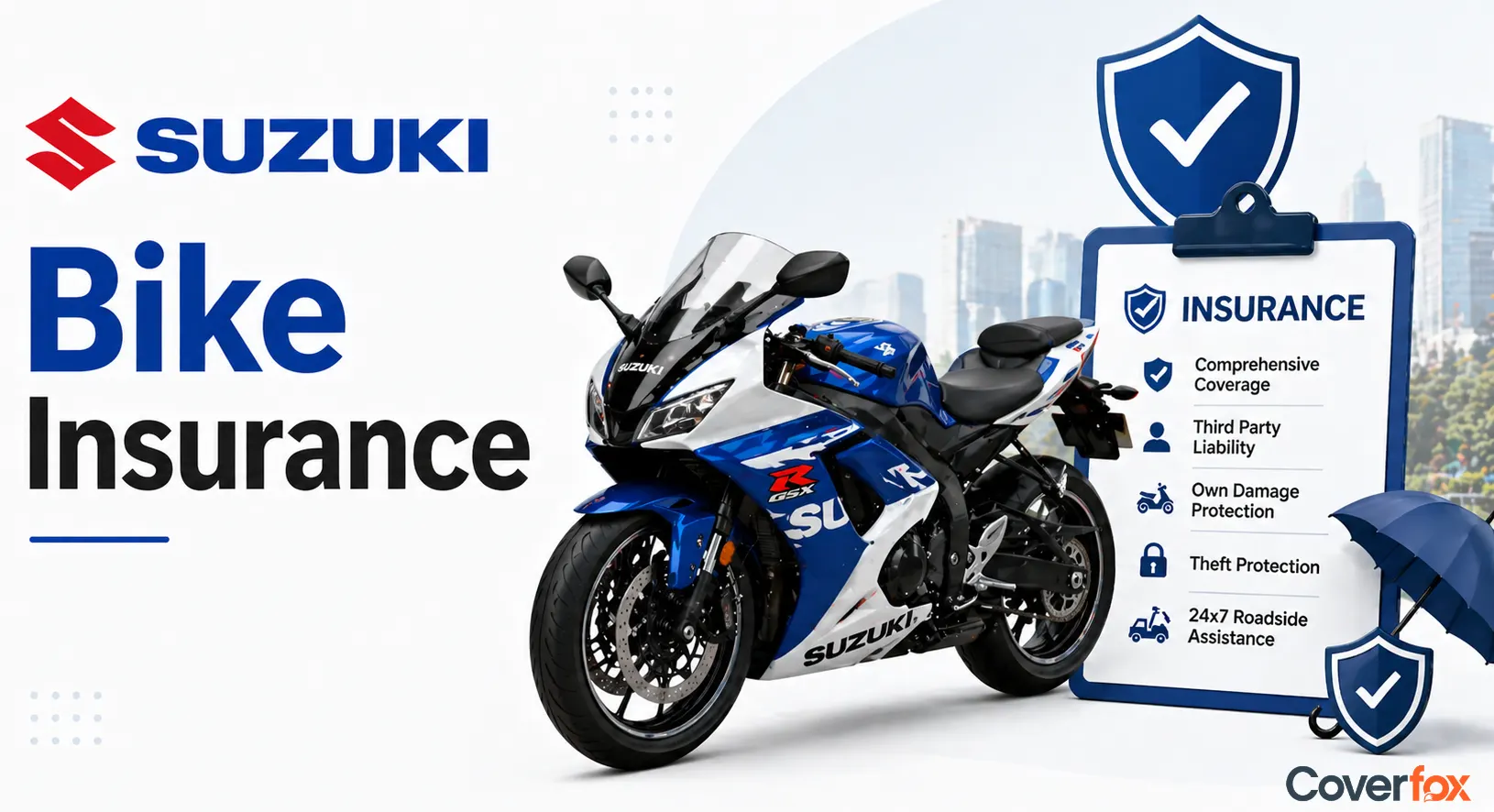
Under the Motor Vehicles Act, 1988, having at least a third-party insurance policy is mandatory for every two-wheeler on Indian roads. But going beyond the legal minimum with a comprehensive plan is what actually protects your investment, your finances, and you.
Suzuki Motor Corporation, founded in 1909 in Japan, entered the Indian two-wheeler market in 1982 through a joint venture with TVS Motor Company. After parting ways in 2001, Suzuki made a fresh start in 2006 as Suzuki Motorcycle India Private Limited (SMIPL), establishing its manufacturing plant in Gurugram, Haryana.
Since then, Suzuki has steadily grown into a brand that resonates with Indian riders across segments. It crossed 1 million customers in 2012, 5 million units produced in 2020, and recently hit the 10 million production milestone with bikes now exported to 77 countries. Today, Suzuki's tagline "By Your Side" reflects exactly what the brand stands for: reliability, refinement, and a genuine connection with the everyday rider.
Suzuki currently offers 14 models in India spanning 125cc scooters, sporty naked bikes, adventure tourers, and the iconic Hayabusa superbike catering to riders across every budget and riding style.
Owning a Suzuki is an investment and protecting it is essential. As per the law, having at least third-party insurance is mandatory, and riding without it can lead to fines, legal trouble, or even vehicle impoundment. Beyond compliance, insurance shields you from high repair costs, especially since Suzuki bikes use precision-engineered components that can be expensive to replace after an accident.
A comprehensive policy goes further by covering risks like theft, third-party liabilities, and damage caused by natural disasters such as floods or cyclones. With popular models like the Access 125 and Gixxer often targeted for theft, having the right insurance ensures you’re financially protected in both everyday and unexpected situations.
| Suzuki Bike Models | Insured Declared Value [1st Year] | Zero Depreciation | Net Premium [5 years] |
| Suzuki Access 125 | ₹49,131 | ₹147 | ₹5,702 |
| Suzuki Burgman Street 125 | ₹60,781 | ₹304 | ₹5,924 |
| Suzuki Gixxer | ₹69,350 | ₹313 | ₹10,561 |
| Suzuki Avenis | ₹58,927 | ₹295 | ₹5,898 |
| Suzuki Hayabusa | ₹12,93,012 | ₹5,819 | ₹42,526 |
Disclaimer: Premium figures and coverage details are indicative and subject to IRDAI guidelines and individual insurer terms. Please verify current rates and policy wordings before purchase.
Suzuki bike insurance comes in three main types. Third-party insurance is mandatory by law and covers damage or injury caused to others but not your own bike. Comprehensive insurance offers complete protection, covering both third-party liabilities and your bike against accidents, theft, fire, and natural disasters, along with personal accident cover for the owner-driver.
You can also opt for standalone own-damage (OD) insurance, which covers only your bike while keeping third-party insurance separate. Third-party plans suit older bikes, comprehensive plans are ideal for newer models, and standalone OD works best if you want flexible coverage.
Accidental damage to your own Suzuki bike
Theft of the insured vehicle
Damage caused by natural calamities such as floods, earthquakes, cyclones, storms
Fire, explosion, self-ignition, and lightning
Man-made incidents like riots, strikes, terrorism-related damage
Damage during transit by road, rail, air, or waterways
Third-party bodily injury, death, or property damage
Personal accident cover of ₹15 lakh for the owner-driver
Normal wear and tear and mechanical/electrical breakdown
Damage caused while riding without a valid licence or under the influence of alcohol or drugs
Damage incurred outside the geographical boundaries of India
Consequential loss (damage resulting from the original damage)
Damage sustained during racing, speed testing, or reliability trials
Using a private Suzuki bike for commercial purposes
ensures full claim on parts without depreciation and is ideal for bikes under 5 years.
lets you receive the original invoice value in case of total loss or theft.
protects against engine damage caused by water ingression or oil leakage, especially useful during monsoons.
provides support like towing, minor repairs, and fuel delivery during breakdowns.
pays for items like engine oil, brake fluid, nuts, and bolts used during repairs.
extends accident protection to your pillion rider.
Inform your insurer immediately through their website or mobile app after the incident.
Complete self-inspection by uploading photos or videos of the damage, if available.
Surveyor assessment may be arranged for major damages to evaluate the loss.
Choose claim type and opt for a cashless claim at a network garage or reimbursement at any garage.
Get your bike repaired as per the approved claim process.
Submit required documents including policy copy, RC, driving licence, claim form, FIR (if applicable), and repair bills.
Claim settlement is processed by the insurer as per policy terms, either directly with the garage or credited to your bank account.
Suzuki is expected to expand its India lineup in 2026 with several new premium bikes and an electric scooter. Models like the Suzuki GSX-8S, Suzuki GSX-S1000, Suzuki SV650, and Suzuki GSX-R1000R are expected to launch between mid-2026 and 2027, mainly for riders looking for more power and performance.
Suzuki is also likely to enter the electric segment with the Suzuki Burgman Electric for daily city use. In addition, new models like the Suzuki GSX-8T and Suzuki GSX-8TT are expected around August 2026. Overall, 2026 could be an important year for Suzuki in India with a mix of performance bikes and electric options.
Note: Launch timelines may change based on official announcements.
Disclaimer: *Premiums starting from ₹457 are indicative for third-party bike insurance for select models and may vary based on vehicle specifications, location, and insurer.


Yes. As per the Motor Vehicles Act, 1988, every Suzuki bike or scooter plying on Indian roads must have at least a valid third-party insurance policy.
You can buy or renew Suzuki bike insurance online in just a few minutes by entering your bike’s registration number to fetch details, checking your current policy status, comparing quotes from multiple insurers, customising your plan with preferred IDV and add-ons, and completing the payment to receive your policy instantly via email.
IDV is calculated based on the manufacturer's listed selling price minus depreciation, which increases with the bike's age. Your insurer provides IDV options at the time of purchase or renewal.
Yes. No Claim Bonus belongs to you, not your insurer. You can carry your accumulated NCB to any new insurer at renewal by submitting an NCB certificate.
If your policy lapses, you lose your NCB and may be required to get a physical inspection of your bike done before renewal. It also means you are riding uninsured, which is illegal.
Yes. For a new Suzuki bike not yet registered, you can purchase insurance using the chassis and engine number. Most online platforms offer this option.
Inform your insurer immediately after the incident. File an FIR if required, document the damage with photos, and take the bike to a network garage for cashless repairs. For reimbursement claims, keep all original repair bills and receipts.
Your Suzuki bike insurance premium depends on factors like the IDV (current market value), engine capacity (CC), and age of the bike, all of which influence the cost and coverage. It is also affected by your No Claim Bonus (NCB), registration location (RTO), and any add-ons selected, as these can either increase the premium or help you save through discounts.

