
- Retail Insurance
- Business Insurance
- Resources
- Claims
Thyroid cancer is a malignancy caused by the abnormal growth of cells in the thyroid gland, a butterfly-shaped organ located at the base of the neck. This gland plays a vital role in regulating metabolism, heart rate, and body temperature through hormone production.
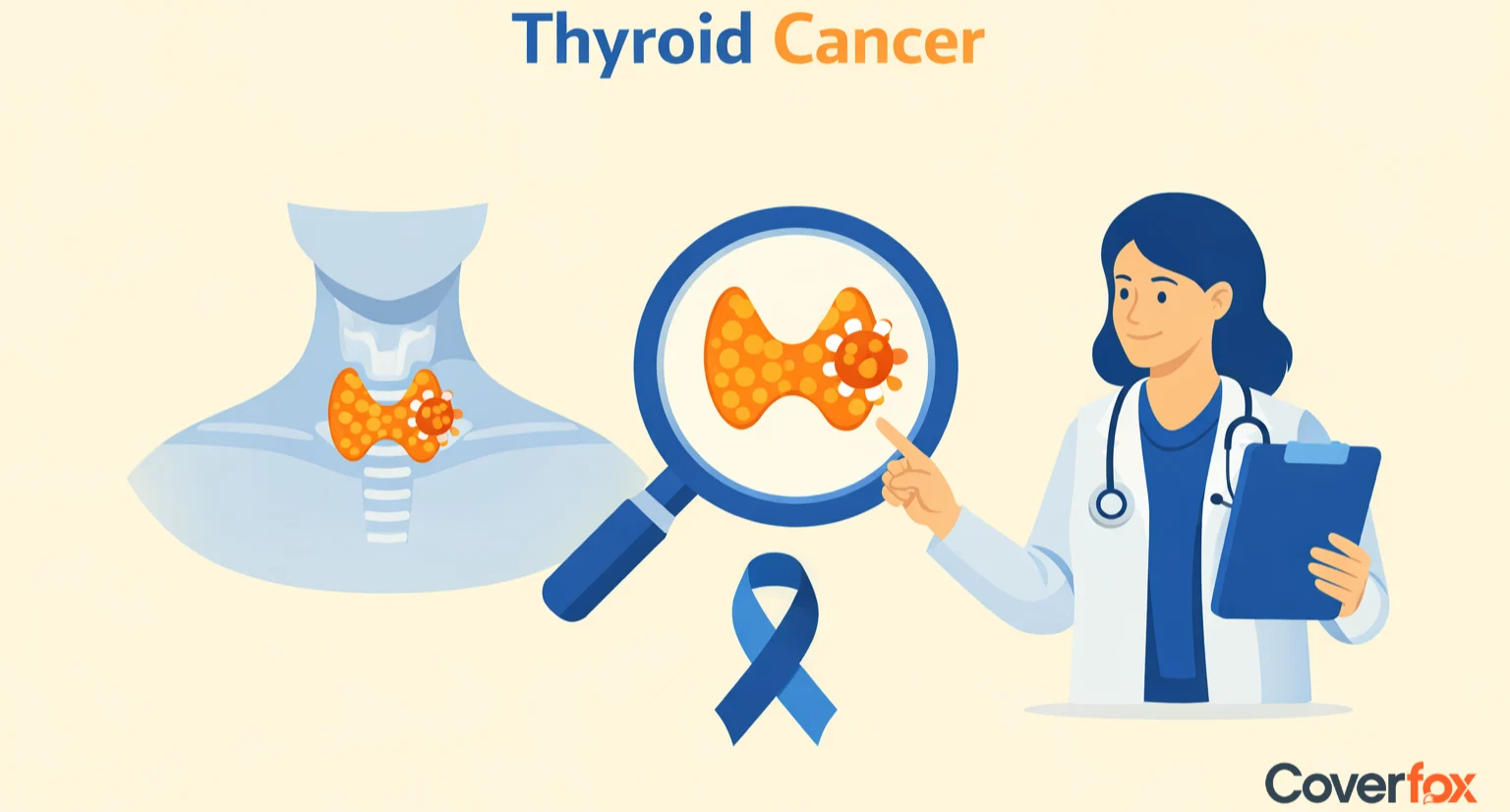
The best part about thyroid cancer is that it's highly treatable, especially if it is detected early. What this means is that early detection is absolutely crucial for a healthier recovery. Let us learn more about the thyroid gland and thyroid cancer. Understanding the symptoms, risk factors, and available treatment options can help individuals take proactive steps toward better thyroid health. Let us explore more about the thyroid gland and thyroid cancer in detail.
The thyroid gland is situated at the front of the neck, just below the Adam’s apple, and wraps around the windpipe. It looks like a butterfly-shaped gland is a crucial part of the endocrine system. It produces three important hormones:
Triiodothyronine (T3)
Thyroxine (T4)
Calcitonin
T3 and T4 regulate the body’s metabolism, influencing how energy is used, controlling heart rate, and maintaining body temperature. Calcitonin helps regulate calcium levels in the body.
Thyroid cancer is classified into several types, each with different characteristics, progression patterns, and treatment outcomes.
Papillary thyroid cancer is the most common type, accounting for about 80 to 90% of all cases. It is typically slow-growing and often affects younger adults. Although it may spread to nearby lymph nodes, it has an excellent prognosis and is highly curable.
This is the second most common type of thyroid cancer. It tends to spread through the bloodstream, commonly reaching the lungs and bones. Despite this, it remains highly treatable, particularly when identified early.
A variant of follicular thyroid cancer, Hürthle cell carcinoma is generally more aggressive and less responsive to radioactive iodine therapy, making treatment more complex compared to other differentiated thyroid cancers.
Medullary thyroid cancer arises from C-cells in the thyroid, which produce the hormone calcitonin. It can occur sporadically or be inherited and is often associated with genetic syndromes such as Multiple Endocrine Neoplasia type 2 (MEN2).
Anaplastic thyroid cancer is a rare but highly aggressive form of the disease. It grows rapidly, spreads quickly to other parts of the body, and is associated with a poorer prognosis.
Other uncommon types include thyroid lymphoma, sarcoma, and parathyroid cancer. These are rare and differ significantly in terms of behaviour and treatment approaches.
Not all thyroid-related conditions are cancerous. In fact, many thyroid issues are benign, meaning they do not spread to other parts of the body and are generally less serious. The key difference between cancerous and non-cancerous conditions lies in how the cells behave. These are thyroid conditions that are non-cancerous and benign:
An enlargement of the thyroid gland, often caused by iodine deficiency or hormonal imbalance; usually non-cancerous and manageable.
Lumps within the thyroid that are mostly harmless and non-cancerous, though they may need regular monitoring.
Fluid-filled sacs in the thyroid that are typically harmless and only require treatment if they grow or cause symptoms.
Inflammation of the thyroid gland due to infection or autoimmune conditions, usually temporary and treatable.
Thyroid cancer can be caused by genetic or environmental factors.
Genetic mutations can cause thyroid cells to grow uncontrollably, leading to cancer.
Radiation exposure, especially during childhood (such as radiation therapy to the head or neck), significantly increases risk.
Iodine imbalance, both deficiency and excess, can affect thyroid function and contribute to abnormal cell changes.
Inherited syndromes, such as Multiple Endocrine Neoplasia type 2 (MEN2), are linked to certain types of cancer, such as medullary thyroid cancer.
Certain factors can increase the likelihood of developing thyroid cancer, even if they do not directly cause it.
More commonly diagnosed in adults, though it can occur at any age.
Women are more likely to develop thyroid cancer than men.
A history of thyroid cancer or genetic conditions increases risk.
Conditions like MEN2 are strongly associated with medullary thyroid cancer.
Past exposure, especially in childhood, is a major risk factor.
Both low and high iodine intake can influence risk.
Existing thyroid conditions may increase susceptibility.
In many cases, thyroid cancer does not cause noticeable symptoms in its early stages, which is why it is often detected during routine check-ups.
A lump or swelling in the neck
Persistent hoarseness or voice changes
Difficulty swallowing or breathing
Pain in the neck or throat
Enlarged lymph nodes in the neck
It is important to seek medical advice if any unusual symptoms persist or worsen over time.
A lump in the neck that does not go away or grows rapidly
Ongoing hoarseness or voice changes without a clear cause
Difficulty swallowing or breathing
Persistent neck pain or swelling
Early evaluation can lead to timely diagnosis and significantly improve treatment outcomes.
Diagnosing thyroid cancer involves a step-by-step approach to identify abnormal growths and confirm whether they are cancerous.
Doctors begin by examining the neck to check for lumps (nodules), swelling, or enlarged lymph nodes that may indicate thyroid abnormalities.
This is usually the first-line imaging test used to evaluate thyroid nodules. It helps determine the size, structure, and whether a nodule appears suspicious.
Considered the gold standard for diagnosis, this test involves using a thin needle to collect cells from the thyroid nodule, which are then examined under a microscope to confirm cancer.
These help assess thyroid function and specific markers. TSH levels evaluate overall thyroid activity, thyroglobulin may be used as a tumour marker, and calcitonin is particularly important for detecting medullary thyroid cancer (MTC).
These advanced scans are used to determine the extent of the disease, check if cancer has spread (metastasis), and assist in staging for treatment planning.
The TNM system is used to stage thyroid cancer based on three key factors:
Size and extent of the primary tumour
Whether cancer has spread to nearby lymph nodes
Whether cancer has spread to distant organs
Staging helps determine prognosis and guides treatment decisions, with lower stages generally having better outcomes.
T1 (small tumour confined to thyroid), N0 (no lymph node spread), M0 (no distant metastasis); early-stage with excellent prognosis.
T2 (larger tumour but still within thyroid), N0 or N1 (may involve nearby lymph nodes), M0 (no distant metastasis); still highly treatable.
T3 (tumour extends beyond thyroid or into nearby tissues), N1 (spread to regional lymph nodes), M0 (no distant metastasis); locally advanced disease.
T4 (tumour invades surrounding structures), any N (may involve lymph nodes), M1 (distant metastasis present, such as lungs or bones); advanced stage with complex prognosis.
Treatment for thyroid cancer depends on the type of cancer, its stage, and the patient’s age and overall health. In many cases, a combination of treatments is used to achieve the best outcomes.
This is the primary treatment. A lobectomy involves removing one lobe of the thyroid and may be sufficient for small, low-risk cancers, while a total thyroidectomy removes the entire gland and is recommended for larger or more aggressive cancers.
Often used after surgery, this treatment helps destroy any remaining thyroid tissue or cancer cells by using radioactive iodine that selectively targets thyroid cells.
After thyroid removal, patients require lifelong thyroid hormone replacement. These medications also help suppress TSH (thyroid-stimulating hormone), which can otherwise promote cancer cell growth.
This is used in more aggressive or inoperable cases, where high-energy radiation is directed at cancer cells to control or reduce tumour growth.
These advanced treatments are used for cancers that do not respond to standard therapies like RAI. They work by targeting specific cancer pathways or enhancing the body’s immune response against cancer cells.
Life after surgery requires ongoing care, but most patients lead normal lives with proper management.
Hoarseness may occur if nerves are affected.
Parathyroid damage can cause a calcium imbalance.
Lifelong hormone replacement is required.
Regular follow-ups are essential.
Daily thyroid hormones and routine blood tests (TSH).
Balanced lifestyle and planned pregnancy if needed.
Generally good with proper treatment and care.
Depends on type, stage, and treatment.
Follow-ups with blood tests, ultrasound, and scans.
May include surgery, radioactive iodine, or targeted therapy.
Lungs, bones, rarely the brain.
Vary based on the organ affected.
RAI, radiation, or targeted therapy to control the disease.
Thyroid cancer generally has an excellent prognosis, especially when detected early. The overall 5-year survival rate is over 98%, making it one of the most treatable cancers.
The most common type, with survival rates of over 99%, particularly when the cancer is localised or detected early.
Also highly treatable, with overall survival rates around 98%, though slightly lower than papillary in advanced stages.
Has a good prognosis when detected early, with survival rates around 90%+, but outcomes vary more with stage and genetic factors.
A rare and aggressive type with significantly lower survival rates (around 10% overall), highlighting the importance of early detection.
Localised cancer (confined to thyroid): survival >99%
Regional spread (lymph nodes): around 97 - 99%
Distant metastasis: survival drops significantly (as low as 50 - 70% depending on type)
Source: Cancer.org
There is no guaranteed way to prevent thyroid cancer, but early detection and managing risk factors can significantly reduce complications and improve outcomes. Awareness and regular check-ups play a key role, especially for those at higher risk.
People with a family history or genetic conditions like MEN2 should consider genetic testing to assess risk early.
In certain high-risk cases, prophylactic (preventive) thyroid surgery may be recommended to reduce the chances of developing cancer.
Limiting unnecessary exposure to radiation, especially in childhood, is important.
In case of nuclear exposure, iodine protection (potassium iodide) can help block radioactive iodine from being absorbed by the thyroid gland.
While prevention may not always be possible, identifying risks early and taking proactive steps can make a significant difference.
A thyroid cancer diagnosis can lead to significant medical expenses, making health insurance an important financial safeguard. From diagnosis to long-term follow-ups, a comprehensive policy helps reduce out-of-pocket costs.
Most health insurance plans cover hospitalisation, surgery (thyroidectomy), diagnostic tests, and treatments like radioactive iodine therapy.
Expenses such as consultations, scans, and medicines before and after treatment are usually included, depending on the policy.
Access to network hospitals allows for smoother, cashless claims during planned or emergency treatments.
Treatments like radioactive iodine therapy may be covered under daycare benefits without requiring long hospital stays.
Coverage for thyroid conditions may be subject to waiting periods or exclusions if pre-existing.
Follow-ups, hormone therapy, and monitoring may require ongoing expenses, which a good policy can help manage.
Disclaimer: Content on this page is for informational purposes only and must not be taken as medical advice. Seek proper medical care from a healthcare professional for accurate results. Coverage in insurance depends on the policy terms and conditions.


Thyroid cancer is a type of cancer that occurs when abnormal cells grow uncontrollably in the thyroid gland, affecting its normal function and, in some cases, spreading to nearby or distant tissues.
Thyroid cancer can occur at any age, but it is most commonly diagnosed in adults between 30 and 60 years, with certain types also affecting younger individuals.
Yes, thyroid cancer is highly curable, especially when detected early, with survival rates exceeding 98% for common types like papillary thyroid cancer.
Thyroid cancer is usually not painful in its early stages, but some people may experience discomfort, neck pain, or pressure as the tumour grows.
Yes, thyroid cancer can spread (metastasise) to other organs such as the lungs, bones, or rarely the brain, particularly in advanced stages.
Most thyroid cancers, especially papillary types, grow slowly over years, while rare types like anaplastic thyroid cancer can grow rapidly.
Thyroid cancer does not usually prevent pregnancy, but treatment planning and hormone management are important to ensure a safe pregnancy.
Thyroid nodules are common lumps in the thyroid that are usually benign, whereas thyroid cancer involves malignant cell growth that can spread and requires treatment.
Blood tests alone cannot confirm thyroid cancer, but markers like calcitonin and thyroglobulin can help in diagnosis and monitoring.
Patients may be advised to limit iodine-rich foods before certain treatments like radioactive iodine therapy, while otherwise maintaining a balanced diet.
Some types, particularly medullary thyroid cancer, can be hereditary and linked to genetic conditions like MEN2.
Follow-up frequency depends on the individual case, but regular monitoring through blood tests and imaging is typically done every 6 to 12 months or as advised by a doctor.
Calcitonin is a hormone produced by thyroid C-cells, and elevated levels can be an important marker for detecting and monitoring medullary thyroid cancer.
If left untreated, thyroid cancer can grow, spread to other parts of the body, and become more difficult to treat, potentially leading to serious complications.


