Carburettors mix fuel and air mechanically, while fuel injectors use electronic control for accuracy and efficiency.
BS6 regulations in India pushed manufacturers to adopt fuel injectors due to their cleaner emissions and precise fuel delivery.
Fuel injectors provide better performance, mileage, and environmental compliance, whereas carburettors are simpler and cheaper to repair.
Choosing between them depends on rider needs: modern daily-use bikes favour FI, while hobbyists may still prefer carburettor-based machines.
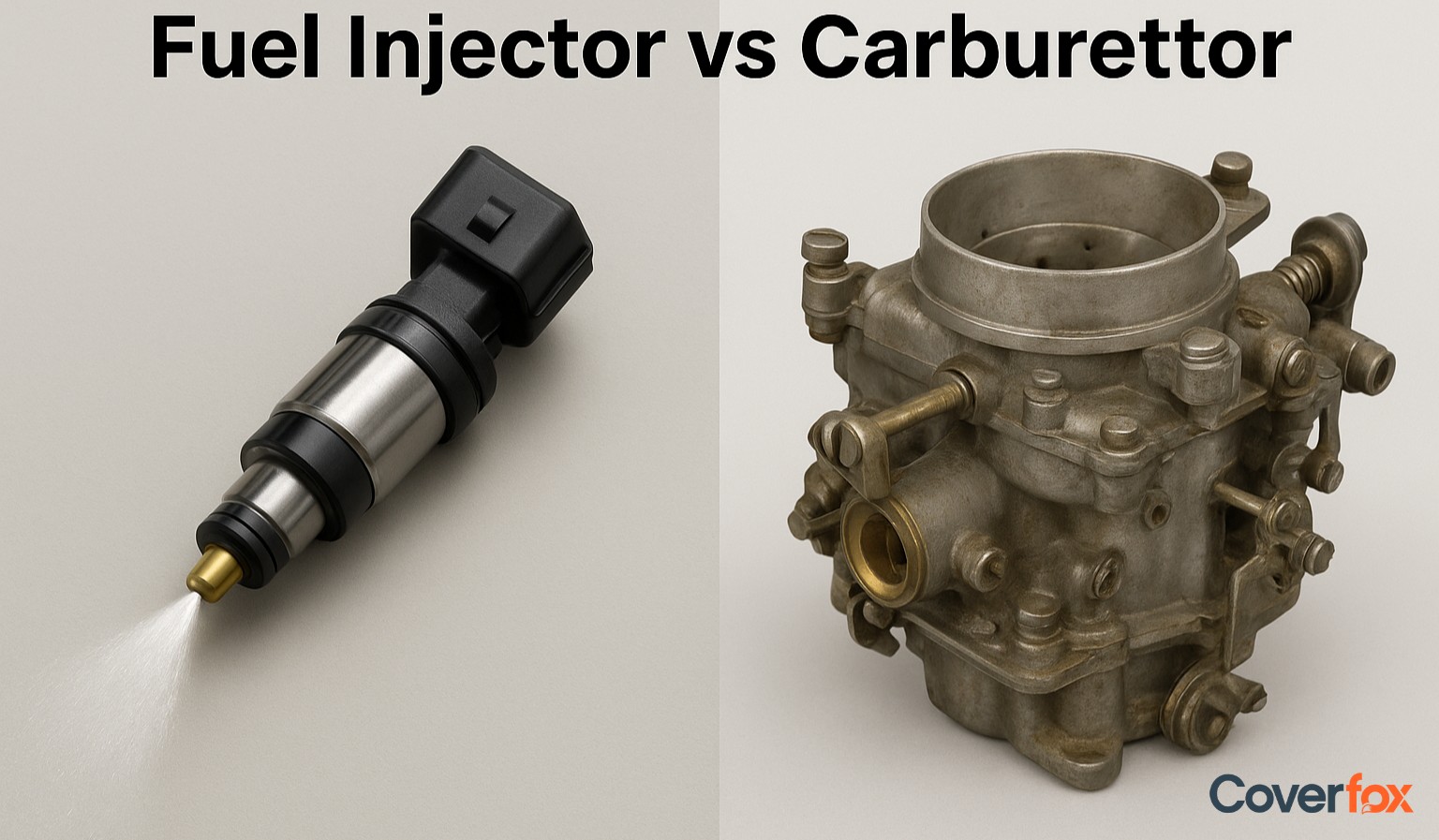
After the implementation of BS6 (Bharat Stage VI) from April 1, 2020 (MoRTH), bike manufacturers have to be careful and vigilant about the pollution norms. Hence, the shift from carburettors to fuel injectors was seen ever since. Fuel injectors and carburettors are fuel-delivery systems used in internal combustion engines, differing mainly in how they mix fuel with air.
Carburettors, common in older bikes and cars, rely on mechanical suction to blend fuel and air, while modern vehicles use fuel injectors that electronically spray precise amounts of fuel for better efficiency and performance. Let us learn more about Fuel Injectors vs Carburettors, their advantages and disadvantages, and which one is better through this article.
What are Carburettors and How Do They Work?
A carburettor is a mechanical fuel-delivery device used in older motorcycles and cars to mix air and fuel in the right proportion before sending it to the engine for combustion. It operates without electronic controls and relies purely on airflow, pressure differences, and mechanical linkages. Carburettors work on the Venturi principle, and here is how it works:
Air enters through the air filter, passes into the carburettor, and flows through a narrow tube called the Venturi.
The Venturi effect creates a vacuum as air speeds up in the narrow passage.
This vacuum draws fuel from the float chamber through a fuel jet.
Air and fuel mix together in the Venturi to form the combustible air–fuel mixture.
The throttle valve opens or closes based on the accelerator input, controlling how much mixture enters the engine.
The mixture is then sent to the engine cylinders, where it is compressed and ignited to produce power.
What are Fuel Injectors and How Do They Work?
Fuel injectors are electronically controlled devices used in modern vehicles to deliver precise amounts of fuel into the engine. They replace older carburettor systems by using sensors and an ECU (Engine Control Unit) to ensure accurate fuel delivery, better efficiency, lower emissions, and smoother performance. Here’s how fuel injectors work:
The fuel pump sends pressurised fuel to the injector through a fuel rail.
The ECU analyses sensor data (throttle input, air temperature, oxygen levels, engine load, etc.) to calculate how much fuel is required.
The injector opens and closes electronically, spraying fuel in a fine mist for optimal mixing with air.
Fuel is sprayed either into the intake manifold or directly into the combustion chamber, depending on the injection system.
The precise timing and quantity lead to efficient combustion, better performance, reduced emissions, and improved fuel economy.
| Feature | Fuel Injector | Carburettor |
|---|---|---|
| Fuel Delivery | Electronically controlled, precise spray | Mechanical mixing based on suction |
| Technology | Modern, sensor-based system | Older, mechanical system |
| Efficiency | Higher fuel efficiency | Lower efficiency |
| Maintenance | Lower, but costlier repairs | Higher, frequent tuning is needed |
| Performance | Consistent and responsive | Varies with weather and tuning |
| Emissions | Cleaner, meets modern norms | Higher emissions |
| Cold Starts | Quick and smooth | Often difficult |
| Cost | More expensive | More affordable |
Fuel Injector vs Carburettor - Performance, Power, & Efficiency
Fuel Injector
Carburettor
This gets you better throttle response, smoother acceleration, and more efficient combustion. It automatically adapts to riding conditions through sensors, resulting in better mileage, consistent power delivery, and improved overall efficiency.
This may provide a stronger low-end feel on some bikes, but it lacks consistency due to manual tuning. Its fuel delivery is less precise, leading to lower efficiency, reduced mileage, and performance that varies with weather and engine conditions.
Fuel Injector vs Carburettor - Maintenance & Repair Cost
Fuel Injector
Carburettor
Requires less routine maintenance but is costlier to repair due to electronic components and the need for diagnostic tools. Common issues include clogged injectors or fuel pump failures, which usually require professional servicing.
Cheaper and easier to repair or tune manually, but demands frequent cleaning and adjustment. Typical problems include clogged jets or improper tuning, which can affect performance and often need hands-on maintenance.
Fuel Injector vs Carburettor - Emissions, Mileage & Environmental Compliance
Fuel Injector
Carburettor
Delivers cleaner emissions, better mileage, and more precise fuel burn, enabling engines to meet strict BS6 and Euro norms. Electronic fuel injection systems are globally preferred because they help manufacturers comply with environmental standards. A study titled “An Emission Comparison Between a Carburettor and an Electronic Fuel Injection System (Utility Engines)” by SAE International found that fuel-injection systems significantly reduce exhaust emissions compared to carburetted engines — a key reason governments worldwide shifted to EFI technology.
Produces higher emissions and inconsistent fuel combustion, which leads to lower mileage and makes it difficult for engines to meet modern environmental regulations. Their mechanical design lacks the precision required for compliance with today’s BS6 and Euro norms, prompting regulators and manufacturers to move away from carburettor-based systems.
Which One Is Better: Fuel Injector or Carburettor?
Fuel Injector
Carburettor
Best suited for modern, performance-oriented, and daily-use bikes/cars thanks to their reliability, precise fuel delivery, better mileage, and ability to meet BS6/Euro emission norms. They require less frequent maintenance and offer smoother throttle response, making them the preferred choice for most riders and manufacturers today.
Still appreciated by enthusiasts who enjoy simplicity, DIY tuning, and lower repair costs. Carburettors can offer a stronger low-end feel and are easier to fix without specialised tools, but they lack the consistency, efficiency, and environmental compliance of fuel-injection systems.
For everyday commuting and modern vehicles, fuel injectors clearly outperform due to efficiency, cleaner emissions, and smoother performance. However, for hobbyists, vintage bikes, or riders who enjoy hands-on mechanical tuning, carburettors continue to hold nostalgic and practical value. Make sure your bike meets all the emissions norms, and is insured with the best bike insurance possible to make your journeys comfortable and hassle-free!
Read More:
Which is better for mileage - carburettor or fuel injector?
Fuel injectors provide better mileage because they deliver fuel more precisely and adjust automatically to riding conditions.
Do fuel injectors give more power than carburettors?
Yes, fuel injectors generally offer smoother and more consistent power delivery due to accurate fuel–air mixing.
Which is better, fuel injection or carburettor in bikes?
Fuel injection is better for modern bikes as it improves efficiency, emissions, and reliability, while carburettors suit riders who prefer simplicity and low-cost repairs.
Is a carburettor easier to repair than a fuel injector?
Yes, carburettors are easier and cheaper to repair since they use mechanical parts, unlike fuel injectors, which require diagnostic tools.
Why do modern bikes use fuel injectors instead of carburettors?
Fuel injectors help bikes meet BS6/Euro emission norms, offer better mileage, reduce emissions, and ensure consistent performance.
Can a carbureted bike be converted to fuel injection?
It is technically possible, but expensive and complex, as it requires an ECU, sensors, injectors, and wiring changes.
Do fuel injectors perform better in cold weather?
Yes, fuel injectors start easily and run smoothly in cold conditions because they automatically adjust fuel delivery.
What causes a fuel injector to fail?
Common causes include clogged injectors, poor fuel quality, fuel pump issues, electrical faults, or carbon deposits.
Which is cheaper to maintain – fuel injector or carburettor?
Carburettors are cheaper to maintain and repair, while fuel injectors have lower routine maintenance but higher repair costs.




 in Bikes.webp)
 in Bikes.webp)