
- Retail Insurance
- Business Insurance
- Resources
- Claims
A safe delivery can make all the difference for both mother and child. Janani Suraksha Yojana (JSY) helps eligible pregnant women access institutional healthcare by providing financial assistance and maternal health support. The scheme encourages safer childbirth and works towards reducing maternal and infant mortality across India.
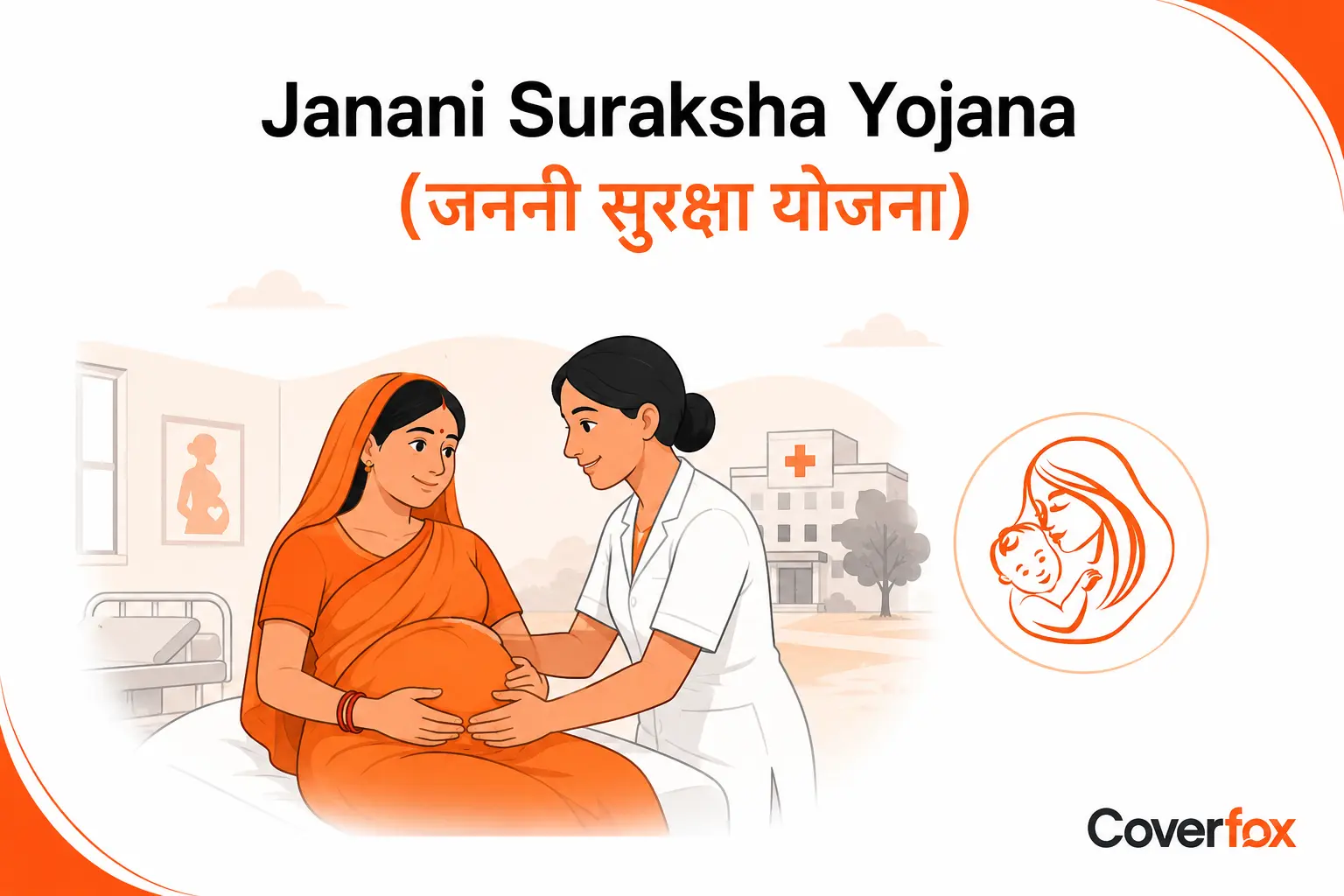
This government scheme supports expectant mothers by making healthcare services more accessible during pregnancy and childbirth. It aims to increase the number of births that take place in healthcare centres and offers financial support to eligible women, helping families access better care for mothers and newborns.
Janani Suraksha Yojana (JSY) is a centrally sponsored safe motherhood scheme launched by the Government of India on 12 April 2005 under the erstwhile National Rural Health Mission (NRHM), now part of the National Health Mission (NHM). The scheme was introduced by the Ministry of Health and Family Welfare to reduce maternal and neonatal deaths by encouraging pregnant women to opt for institutional deliveries at government and accredited private healthcare facilities.
Under the scheme, eligible pregnant women receive cash assistance to meet delivery-related expenses, while ASHA workers are provided incentives for facilitating antenatal care, institutional deliveries, postnatal visits, and newborn immunisation. JSY places special emphasis on states with historically low institutional delivery rates and aims to improve access to maternal healthcare services among economically vulnerable women, particularly those belonging to BPL, SC, and ST households.
The objectives of Janani Suraksha Yojana focus on making childbirth safer by increasing institutional deliveries and reducing maternal and newborn deaths.
Reduce maternal mortality rates (MMR).
Reduce neonatal and infant mortality rates.
Promote institutional deliveries at government and accredited health facilities.
Improve access to antenatal, delivery, and postnatal care.
Encourage regular pregnancy check-ups and timely medical care.
Strengthen community healthcare support through ASHA workers.
Increase awareness about maternal and newborn health.
Provide financial assistance to eligible pregnant women.
Support immunisation and postnatal care services.
Improve overall maternal and child health outcomes.
Pradhan Mantri Janani Suraksha Yojana combines financial assistance with maternal healthcare services to promote institutional deliveries among eligible pregnant women.
Eligible women receive financial assistance for delivering at government health centres or accredited private institutions.
The scheme gives special attention to states with low institutional delivery rates, including Uttar Pradesh, Bihar, Madhya Pradesh, Rajasthan, Jharkhand, Chhattisgarh, Assam, Uttarakhand, Odisha, and Jammu & Kashmir.
ASHA workers identify beneficiaries, facilitate antenatal registration, accompany women to health facilities, and provide postnatal support.
Every beneficiary receives a Janani Suraksha Yojana card along with a Mother and Child Health (MCH) card for tracking pregnancy and healthcare services.
ANMs and ASHA workers prepare a birth plan that includes ANC schedules, expected delivery dates, referral centres, and transportation arrangements.
Benefits are available for deliveries conducted at government hospitals and accredited private healthcare institutions.
The scheme includes post-delivery visits, breastfeeding counselling, and immunisation support for newborns.
Government health facilities can use scheme funds to hire specialists for Caesarean sections or obstetric emergencies where specialists are unavailable.
Beneficiaries can raise complaints regarding eligibility, delayed payments, or benefit disbursement through district grievance cells.
The amount payable under Janani Suraksha Scheme depends on the beneficiary's place of residence, state category, and place of delivery. Women delivering at government health facilities and eligible accredited private institutions can receive monetary support under the scheme.
Pregnant women delivering in government hospitals, PHCs, CHCs, sub-centres, district hospitals, or accredited private institutions can receive the following benefits:
| Low Performing States (LPS) | ₹1,400 | ₹1,000 |
| High Performing States (HPS) | ₹700 | ₹600 |
Women belonging to Scheduled Caste (SC) and Scheduled Tribe (ST) categories are also eligible for these benefits, subject to the applicable guidelines.
ASHA workers receive incentives for identifying beneficiaries, facilitating antenatal care, accompanying women for delivery, and providing postnatal support.
| LPS States | ₹600 | ₹200 |
| HPS States | ₹200 | ₹200 |
The incentive includes support for transportation, accompanying the beneficiary to the health facility, and post-delivery visits.
Pregnant women from Below Poverty Line (BPL) families aged 19 years or above who opt for home delivery can receive ₹500 per delivery. This benefit is available for up to two live births.
In cases where government specialists are unavailable for Caesarean sections or obstetric complications, government health institutions may utilise up to ₹1,500 per case to hire specialists. This amount is paid to the health institution and not directly to the beneficiary.
Apart from monetary benefits, beneficiaries may also receive support for:
Referral transportation through ASHA workers.
Antenatal check-ups and immunisation services.
Postnatal visits and newborn care.
Breastfeeding counselling and maternal health monitoring.
Referral services for pregnancy-related complications.
The eligibility criteria under Janani Suraksha Yojana vary depending on whether the beneficiary resides in a Low Performing State (LPS) or a High Performing State (HPS). The conditions also differ based on the place of delivery and beneficiary category.
All pregnant women delivering in government health centres or accredited private institutions are eligible to receive benefits under the scheme. These states include:
Uttar Pradesh
Uttarakhand
Bihar
Jharkhand
Madhya Pradesh
Chhattisgarh
Rajasthan
Odisha
Assam
Jammu and Kashmir
There is no restriction on age, birth order, BPL status, or marital status for women delivering in government or accredited health facilities in these states.
In High Performing States, the scheme benefits are available to:
Pregnant women belonging to Below Poverty Line (BPL) families.
Women aged 19 years or above.
Women delivering at government health facilities or accredited private institutions.
Benefits in these states are generally limited to up to two live births.
Women belonging to Scheduled Caste (SC) and Scheduled Tribe (ST) categories are eligible for JSY benefits when delivering at government health facilities or accredited private institutions, irrespective of the state category.
BPL pregnant women aged 19 years or above who choose home delivery are eligible for assistance of ₹500 per delivery. This benefit is available for up to two live births.
Women delivering at accredited private hospitals can avail scheme benefits if they satisfy the applicable eligibility conditions. Beneficiaries may be required to submit:
BPL certificate (where applicable)
SC/ST certificate
Referral slip from ANM or ASHA worker
MCH or JSY card
Pregnant women can register for Janani Suraksha Yojana through an ASHA worker, ANM, Anganwadi Centre, or the nearest government health facility. Registration during the early stages of pregnancy helps beneficiaries receive antenatal care, institutional delivery support, and scheme benefits on time.
Register the Pregnancy
The pregnancy should be registered at the nearest Sub-Centre, PHC, CHC, Anganwadi Centre, or government hospital, preferably during the early months of pregnancy. The registration is generally facilitated by the ASHA worker or ANM.
Obtain the JSY and MCH Cards
After registration, the beneficiary is issued a JSY card and a Mother and Child Health (MCH) card. These documents are used to track antenatal check-ups, expected delivery date, referral details, and benefit eligibility. The cards must be carried during hospital visits and at the time of delivery.
Complete Antenatal Check-ups
The beneficiary is advised to undergo regular antenatal check-ups, receive TT injections, and follow the healthcare schedule recommended by the ANM or ASHA worker. A micro-birth plan may also be prepared to identify the place of delivery and referral facility.
Deliver at an Eligible Health Facility
To receive institutional delivery benefits, the delivery should take place at a government health facility or an accredited private hospital, subject to the applicable eligibility conditions. The beneficiary may be required to present the JSY card and supporting documents at the health facility.
Benefit Disbursement
After verification of documents and delivery details, the eligible amount is disbursed to the beneficiary. The mode of payment may vary across states and can include direct bank transfer or payment through the approved state mechanism.
At present, there is no single national portal for Janani Suraksha Yojana online registration. In most states, registration is carried out offline through ASHA workers, ANMs, Anganwadi Centres, or government health facilities. Some states may provide registration or beneficiary tracking through their state health portals and RCH systems.
Women seeking to apply online should check the official state health department website or consult their local ASHA worker for the registration process applicable in their state.
Applicants may be required to submit the following documents during registration and benefit verification:
Aadhaar card or any government-issued identity proof.
Address proof or residence certificate.
Below Poverty Line (BPL) card, wherever applicable.
Scheduled Caste (SC) or Scheduled Tribe (ST) certificate, if applicable.
Janani Suraksha Yojana (JSY) card.
Mother and Child Health (MCH) card.
Bank account details for benefit transfer.
Aadhaar-linked bank account details, where required by the state.
Pregnancy registration records and antenatal care documents.
Hospital discharge summary or delivery records.
Referral slip issued by the ANM or ASHA worker, if applicable.
Birth certificate or newborn-related records, wherever required for benefit disbursement.
ASHA workers play an important role in the implementation of Janani Suraksha Yojana by acting as a link between pregnant women and healthcare facilities. They help identify eligible beneficiaries, facilitate pregnancy registration, and encourage institutional deliveries.
Their responsibilities include:
Identifying and registering eligible pregnant women.
Assisting with antenatal check-ups and immunisation.
Counselling women on institutional deliveries.
Escorting beneficiaries to health facilities for delivery.
Supporting postnatal care and newborn care.
Promoting breastfeeding and family planning awareness.
Facilitating newborn immunisation and follow-up visits.
Since its launch in 2005, Janani Suraksha Yojana scheme has become one of India's largest maternal healthcare programmes.
More than 54 million women benefited from the scheme during its first seven years of implementation.
Around 10.4 million beneficiaries received assistance during 2014-15 alone.
The JSY scheme is regarded as one of the largest conditional cash transfer programmes for maternal healthcare globally.
Studies have reported increased institutional deliveries among economically vulnerable women after the introduction of the scheme.
The programme has particularly improved access to institutional deliveries in low-performing states and rural areas
Source - PMC
While both support maternity-related expenses, Janani Suraksha Yojana and maternity health insurance differ in terms of eligibility, coverage, and benefits.
| Purpose | Promotes institutional deliveries and safe motherhood | Covers maternity-related medical expenses |
| Eligibility | Eligible pregnant women under the scheme guidelines | Individuals covered under a health insurance policy |
| Type of Benefit | Fixed cash assistance | Hospitalisation and treatment coverage |
| Coverage | Delivery-related financial support | Pre and post-natal care, delivery, and hospitalisation expenses |
| Delivery Location | Government and accredited private health facilities | Network and non-network hospitals as per the policy |
| Beneficiary Category | Primarily economically vulnerable women | Policyholders paying health insurance premiums |
| Caesarean Delivery | Limited support through government facilities | Covered as per policy terms and waiting periods |
| Cashless Facility | Not available | Available at network hospitals under eligible plans |
| Waiting Period | No waiting period | Usually 2 to 4 years, depending on the insurer |
| Premium Payment | No premium required | Requires regular premium payments |
Disclaimer: The information provided in this article is for general informational purposes only and is based on publicly available government guidelines and official sources. Eligibility criteria, benefit amounts, documentation requirements, and implementation procedures may vary across states and may change over time. Beneficiaries are advised to consult their nearest government health facility, ASHA worker, or official health department portal for the latest scheme guidelines and application procedures.
Eligibility depends on the state category and beneficiary group. In Low Performing States, all pregnant women delivering at government or accredited health facilities are eligible. In High Performing States, the scheme primarily covers BPL women aged 19 years and above and eligible SC/ST women.
Pregnant women from economically weaker sections, BPL families, SC/ST communities, and women residing in Low Performing States are the primary beneficiaries under the scheme.
JSY provides financial assistance to encourage institutional deliveries, whereas JSSK provides free medicines, diagnostics, diet, blood, transport, and delivery services at government health facilities.
In Low Performing States, women delivering at government or accredited health facilities generally do not require a BPL card. However, BPL certification may be required in certain cases in High Performing States.
The benefit amount is generally disbursed at the health facility after delivery and completion of the verification process.
If transportation is not arranged, the transport assistance component may be paid directly to the beneficiary as per the applicable guidelines.
In Low Performing States, there is no restriction on the number of births. In High Performing States, benefits are generally limited to up to two live births.
No. JSY encourages institutional deliveries through financial assistance, while PMMVY provides maternity benefits to support women during pregnancy and childbirth.
The JSY card is issued during pregnancy registration by an ASHA worker, ANM, or government health facility and is used to track pregnancy and benefit eligibility.
The scheme primarily targets economically vulnerable women and eligible beneficiary categories. Government employees generally do not fall under the intended beneficiary group.
Yes. Eligible women delivering at accredited private hospitals may receive benefits subject to the applicable scheme guidelines.
Yes. The scheme is implemented across all states and Union Territories, although eligibility conditions may vary between Low Performing States and High Performing States.
The scheme was launched in 2005 to reduce maternal and neonatal mortality by promoting institutional deliveries and improving access to maternal healthcare services.

