
- Retail Insurance
- Business Insurance
- Resources
- Claims


Return to Invoice (RTI) is an optional add-on that can be added to a comprehensive or standalone own damage car insurance policy, and it applies when your car is stolen or declared a total loss, helping you recover the car’s original invoice value, subject to the terms and conditions of the policy. RTI may be useful for newer cars because their IDV can fall below the original invoice value as depreciation is applied.
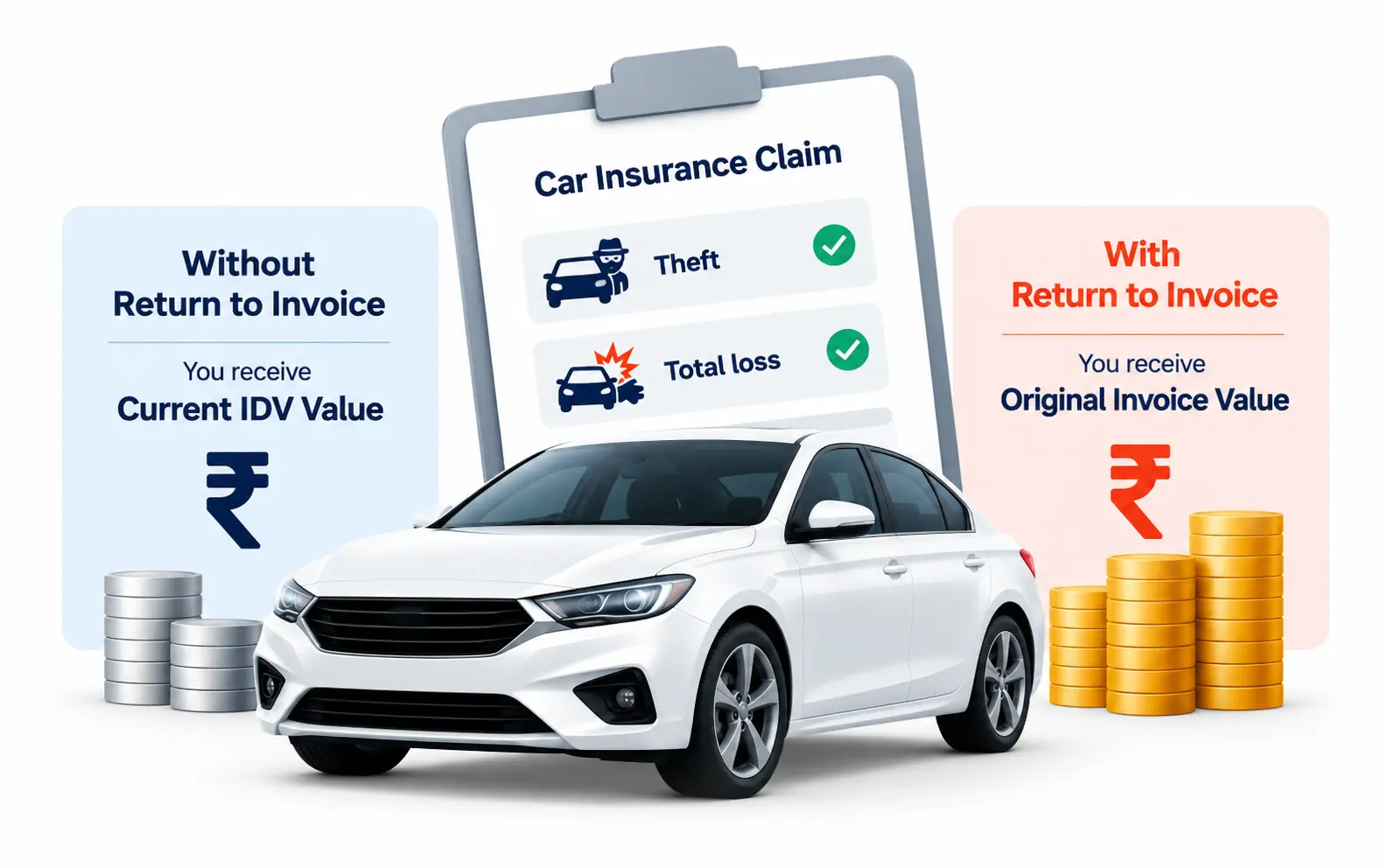
When a car is insured, its IDV generally reduces over time because of depreciation. If the car is stolen or declared a total loss, the standard policy settles the claim based on the applicable IDV.
If the claim qualifies for RTI, the add-on would cover the eligible difference between the base claim settlement and the covered invoice value, subject to policy limits and conditions.
Pro tip: Return to Invoice cover helps bridge the gap between your car’s depreciated IDV and its original invoice value after theft or total loss.
For example:
| Without RTI | With RTI | |
|---|---|---|
| Original invoice value | ₹10,00,000 | ₹10,00,000 |
| IDV at the time of claim | ₹6,50,000 | ₹6,50,000 |
| Base claim | ₹6,50,000 | ₹6,50,000 |
| RTI benefit | Not applicable | + ₹3,50,000 |
| Total claim amount | ₹6,50,000 | ₹10,00,000 |
Note: This is an Illustration only. The actual claim amount depends on the insurer’s policy terms, applicable deductibles and other conditions.
RTI ensures compensation for the difference between the car’s invoice value and the applicable IDV in case of theft or total loss.
In case the car is totalled, RTI will help you recover an amount that is closer to the original invoice of the car, rather than an IDV-based settlement.
Get financial support based on the eligible invoice value if the car is stolen and not recovered.
The RTI benefit covers part of the difference between the IDV and eligible invoice value, and thus you may need to contribute less toward a replacement vehicle. The actual difference depends on the replacement price and claim settlement.
RTI can be particularly useful for newer cars, where the difference between the invoice value and IDV may be significant.
If your car is stolen, the RTI add-on pays the original invoice price of the car.
In case the car is damaged beyond repair, RTI cover ensures the difference between the IDV and the original invoice price is paid in full.
RTO registration cost included in the invoice.
Road tax paid at the time of purchase, as reflected on the invoice.
Scratches, dents, bumper damage and other repairable damage are not covered under RTI.
Engine failure, electrical faults and other mechanical breakdowns are not covered.
Damage caused by regular use, ageing or gradual deterioration is excluded.
Accessories or modifications that were not declared to the insurer may not be covered.
RTI cannot cover a loss that is already excluded under the base car insurance policy.
RTI applies to the insured car and does not cover third party car insurance liability claims.
Note: Inclusions and exclusions of RTI in car insurance may vary from insurer to insurer. Check policy wordings for accurate coverage.
RTI in car insurance is event-specific, mainly when the insured car is stolen or declared a total or constructive total loss.
| Situation | RTI Applicability |
|---|---|
| Car stolen and not recovered | Applicable |
| Car stolen but subsequently recovered | Not an RTI event; treated as a normal claim, subject to any recovery-related damage |
| Car declared total loss | Applicable |
| Car declared constructive total loss | Applicable |
| Car recovered after theft but has repairable damage | Generally not an RTI event; claim is handled under applicable own-damage terms |
| Minor accident damage | Not applicable |
| Scratches or dents | Not applicable |
| Repairable accident damage | Not applicable |
| Mechanical breakdown | Not applicable |
| Normal wear and tear | Not applicable |
| Fire or flood damage declared a total loss | Applicable, subject to policy terms and survey report |
Note: Application of RTI may depend on insurer’s terms and conditions.
RTI can help protect the amount you paid for a new car if it is stolen or declared a total loss.
The cost of replacing a premium car can be high, making RTI worth it as an add-on.
If you live or frequently drive in an area where car theft is more common, RTI ensures the complete invoice value of your car is compensated.
If your car is stolen or declared a total loss, the insurance payout may not be enough to cover the outstanding loan. RTI can help reduce this financial gap, subject to the policy terms.
If you want to reduce the financial impact of depreciation when your car is stolen or declared a total loss, RTI may be worth considering.
Return to invoice insurance is priced as a percentage of the car's IDV or as an addition to the own-damage premium.
Premium is usually higher in the first year and reduces as eligibility narrows in later years.
Higher invoice value increases the premium, since the potential payout gap is larger.
Some insurers charge RTI insurance as a flat percentage of IDV; others price return to invoice insurance within a bundled add-on package.
Location-based risk factors can influence RTI in car insurance premiums quoted.
Provide your car registration and vehicle details to get car insurance quotes.
Compare the available comprehensive and own-damage policies based on your requirements.
Select Return to Invoice cover from the available add-ons, if your car is eligible.
Check the additional premium and coverage details before proceeding.
Enter the required details, make the payment and get your car insurance policy with RTI cover.
Start your renewal by providing your car registration or policy details.
Review the available plans and choose a policy that suits your requirements.
See if Return to Invoice cover is available for your car based on its age and the insurer's terms.
Add RTI to your policy if you are eligible and want the additional protection.
Check the policy details and premium, make the payment and complete your renewal.
Find out the maximum vehicle age for which the insurer allows RTI cover. This limit differs between insurers.
Check whether the RTI payout includes the car's ex-showroom price, registration charges and road tax, as specified in the policy.
RTI applies when your car is stolen or declared a total loss. It does not apply to partial or repairable damage.
Compare the RTI premium with the amount you could receive towards replacing the car if it is stolen or declared a total loss.
For a theft claim, check the documents and conditions the insurer requires before the RTI benefit can be paid.
Claiming return to invoice in car insurance follows the same initial steps as any total loss or theft claim.
Inform the insurer and file an FIR immediately in case of theft.
Raise the claim through Coverfox’s online claim request form, or directly with the insurer.
Submit the documents listed below for verification.
The insurer's surveyor assesses the vehicle or reviews the police report for theft cases.
The claim is processed as a total loss or theft settlement once confirmed.
The insurer determines the applicable IDV and invoice value, then RTI covers the eligible difference between them, subject to the policy terms.
| Parameter | IDV | Return to Invoice | Zero Depreciation |
|---|---|---|---|
| What it is | The insured value the base policy is built on | An add-on covering the gap between invoice price and IDV | An add-on that removes depreciation deduction on repaired parts |
| Applies to | Every claim, as the base sum insured | Theft and total loss claims only | Eligible depreciated parts only. |
| Payout basis | Current depreciated market value | Original invoice price | Full part cost without depreciation deduction |
| Mandatory or optional | Set at policy issuance, not optional | Optional add-on | Optional add-on |
Note: IDV is part of the base car insurance policy, while RTI and zero depreciation are optional add-ons. Their coverage and claim conditions differ, so choose based on the type of loss you want to protect against.


.jpg)


RTI stands for Return to Invoice, and in car insurance is an add-on that pays the difference between your car's invoice price and its IDV in a total loss or theft claim.
No, RTI in car insurance is an optional add-on available with a comprehensive car insurance policy or own-damage policy, not a default inclusion.
The validity of RTI cover depends on the insurer and is generally 3-5 years from the purchase date of the car.
Yes, IDV still matters because claims, apart from theft or total damage, would have IDV as the base for the sum insured.
IDV is the depreciated current value your policy is based on, whereas Return to Invoice in car insurance is an add-on that bridges the gap between IDV payout and the original invoice price in eligible claims.
Return to Invoice applies to theft and total loss claims and covers the invoice-IDV gap, while zero dep car insurance applies to repairable damage claims and removes depreciation deduction on replaced parts.
Most insurers do not offer RTI in car insurance beyond a set age limit, commonly between 3 and 5 years, so a 7- or 8-year-old car is unlikely to qualify with most insurers.
Availability of RTI in car insurance varies by insurer. Some restrict eligibility to within 3 years of the invoice date, while others extend it up to 5 years.
Yes, at renewal, provided the car still meets the insurer's age eligibility for this add-on and the base policy includes Own Damage Car Insurance.
Cost depends on the car's IDV, age and the insurer's pricing method for return to invoice insurance, usually calculated as a percentage of IDV or added within a comprehensive add-on package.
Only accessories listed on the original invoice are considered under RTI in car insurance. Aftermarket accessories added later and not billed with the car are excluded.
No, minor or repairable damage is handled under own-damage cover, not RTI in car insurance, which applies only to theft and total loss claims.
For a new or high-value car, the payout gap covered by return to invoice in car insurance can be significant, making it a practical add-on to evaluate at purchase or renewal.
The RTI claim amount under RTI in car insurance is the invoice price of the car, including registration and road tax, minus the IDV amount already settled under the base claim.
Disclaimer

