
- Retail Insurance
- Business Insurance
- Resources
- Claims


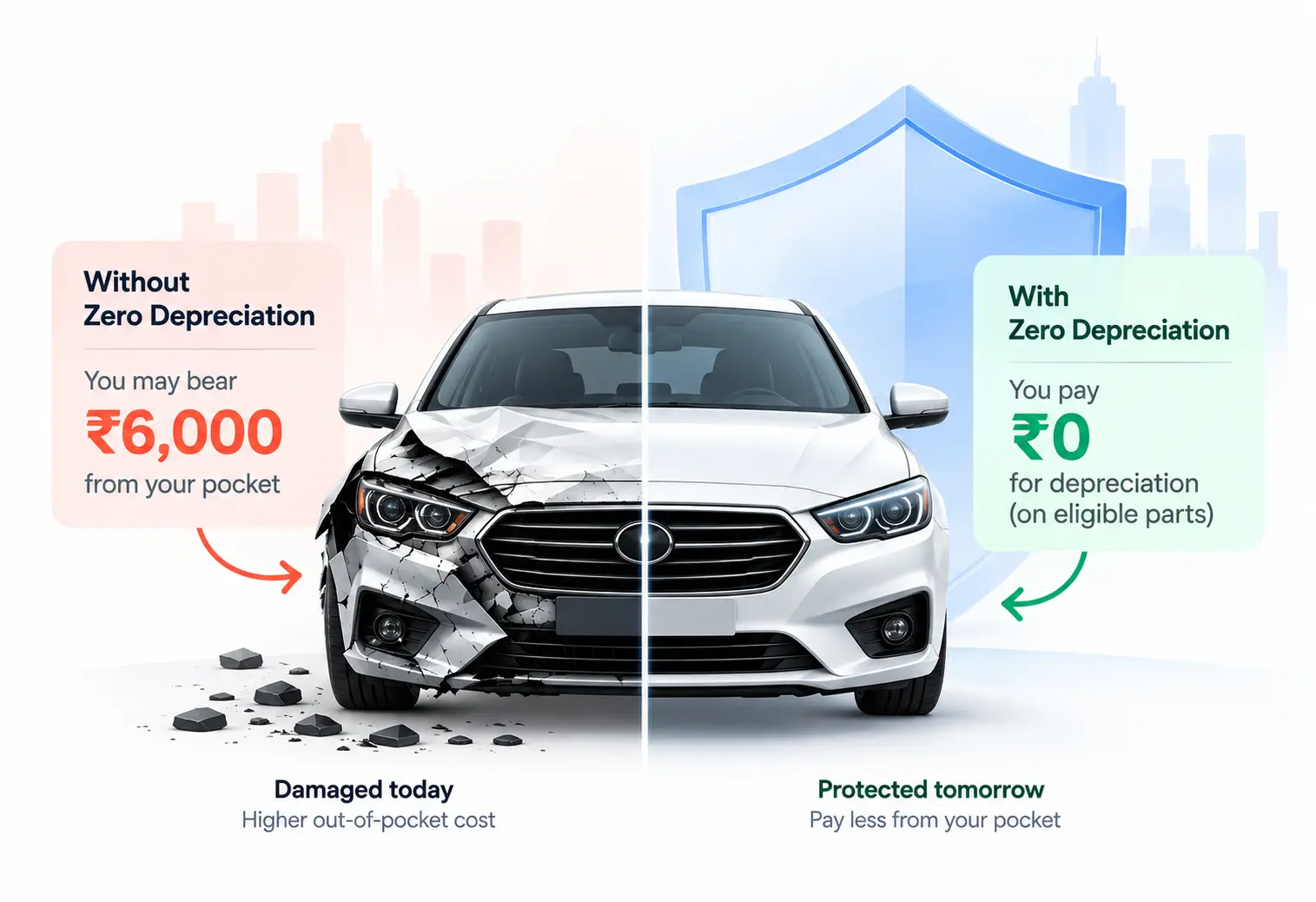
When a damaged car part is replaced, the insurer may apply depreciation while calculating the admissible claim amount. This means you may have to bear the depreciation-related portion of the replacement cost. With zero depreciation car insurance, the applicable depreciation deduction on eligible parts is waived or covered according to the add-on terms. This can reduce the amount you contribute towards an admissible repair claim. The IRDAI lists Nil Depreciation Cover as a motor insurance add-on that can be purchased with the base policy for an additional premium.
Suppose your car's plastic bumper is damaged in an accident and needs to be replaced. The replacement bumper costs ₹12,000.
Under the standard depreciation treatment reflected in motor policy wordings, plastic parts are subject to 50% depreciation during a partial-loss claim.
| Claim Scenario | Depreciation on the Bumper | Amount You May Bear for Depreciation |
|---|---|---|
| Without zero depreciation cover | 50% of ₹12,000 | ₹6,000 |
| With zero depreciation cover | Depreciation waiver as per the add-on | ₹0 towards the covered depreciation |
So, without the add-on, the 50% depreciation deduction on the ₹12,000 bumper would be ₹6,000. With a zero depreciation add-on that waives depreciation on the bumper, this ₹6,000 depreciation deduction would not apply.
Please note: This example only explains the depreciation component of the claim. The compulsory deductible, voluntary deductible, repair charges not covered under the policy and other exclusions may still be payable.
Disclaimer: The 50% depreciation used in this example is based on the standard depreciation treatment for plastic parts reflected in motor policy wordings. The final claim amount and zero depreciation benefit will depend on your insurer's current policy and add-on wording.
Zero depreciation cover comes into effect when an admissible own-damage claim involves replacement of parts on which depreciation would otherwise be deducted.
Select zero depreciation insurance with an eligible comprehensive or standalone own damage car insurance. The add-on is available on payment of an additional premium, subject to the insurer's eligibility conditions.
If your car suffers accidental damage covered under the own-damage policy, inform the insurer and register a “Zero Depreciation” claim.
The insurer assesses the damaged vehicle and the repair estimate. This determines the repair or replacement costs payable under the base policy.
The insurer applies the zero depreciation add-on while calculating the admissible claim amount, waiving the depreciation deduction on covered replacement parts as per the policy terms.
In short, the add-on changes how depreciation is treated during the claim calculation; it does not change the entire own-damage claim process.
Disclaimer: The exact parts covered, claim conditions and depreciation benefit can vary by insurer and policy. Refer to the current policy wording and add-on schedule for the terms applicable to your cover.
Zero depreciation cover can remove the depreciation deduction on covered replacement parts, reducing your contribution towards an admissible repair claim.
Cars and models with costly body parts or components can involve higher depreciation deductions. The add-on can reduce this expense.
If several covered parts need replacement, waiving depreciation on each applicable component can lower the overall amount paid by the customer.
Owners of newer vehicles may prefer to avoid depreciation deductions when damaged parts are replaced. Compare the add-on premium, vehicle eligibility and policy conditions before buying.
Zero depreciation cover helps reduce depreciation deductions on eligible parts.
Depreciation deductions on covered replacement parts are reduced or waived during an admissible claim.
Components such as bumpers, plastic panels and rubber parts may be covered without the standard depreciation deduction.
Depreciation on eligible fibre-glass or composite components may be waived.
Depending on the insurer's add-on wording, depreciation on other eligible replacement parts may also be waived.
The add-on is primarily useful when your car is damaged in an accident and eligible parts need to be repaired or replaced.
The base comprehensive car insurance policy covers theft or total loss according to its own terms. Zero depreciation does not create additional cover for these claims.
The applicable deductible under the policy can still be payable by the policyholder.
Any voluntary deductible in car insurance selected with the policy remains applicable.
Consumables may require a separate consumables cover.
A zero depreciation add-on does not automatically cover breakdown-related damage.
Normal deterioration is not treated as accidental damage.
Exclusions under the base policy continue to apply.
Coverage may not apply to modifications or accessories that are not covered under the policy.
If the base own-damage claim is not admissible, the zero depreciation benefit will not independently make the claim payable.
Note: Policy wordings show exclusions or different treatment for components such as tyres and tubes, as well as claim limits. These terms should not be treated as universal rules for every current policy.
| Part/Component | Without Zero Depreciation | With Zero Depreciation |
|---|---|---|
| Rubber, nylon and plastic parts | 50% depreciation is deducted | No depreciation deduction |
| Fibre-glass components | 30% depreciation is deducted | No depreciation deduction |
| Metal and other eligible parts | Depreciation is deducted based on the vehicle's age | No depreciation deduction |
| Tyres and tubes | 50% depreciation is deducted | No depreciation deduction |
| Batteries and airbags | 50% depreciation is deducted | No depreciation deduction |
| Glass parts | No depreciation deduction | No additional benefit as depreciation is already nil |
Disclaimer: The table is for illustrative purposes and reflects the standard depreciation treatment commonly used in motor insurance claims. The exact parts covered under a zero depreciation add-on, including tyres, tubes, batteries and airbags, can vary by insurer and policy wording. Deductibles, consumables, claim limits and other policy conditions may still apply.
There is no fixed bumper to bumper car insurance price for every vehicle. The cost of zero depreciation car insurance depends on the insurer, car and policy selected.
Eligibility and pricing can change based on the age of the car. Most insurers allow vehicles up to the age of 5-7 for the zero-dep add-on.
Cars with expensive replacement parts can have a different add-on premium.
The insured vehicle's value can influence the underlying policy premium.
Insurance pricing can vary based on the vehicle's registration location and applicable rating factors.
The own-damage or comprehensive policy selected affects the overall premium.
Claim conditions, exclusions and the scope of the add-on can differ.
When comparing zero dep car insurance, check the total premium as well as the policy wording. A lower-priced add-on may have different conditions from another insurer's product.
Vehicle age can influence depreciation calculations under the applicable policy. It can also affect whether an insurer makes zero depreciation car insurance available for the vehicle.
These are separate considerations:
Relevant when replacement parts are considered during an eligible partial-loss claim.
Determines whether the insurer offers the zero depreciation add-on.
Relevant to the sum insured and total-loss claim calculations.
Always check the current policy terms for your specific vehicle rather than relying on a universal vehicle-age limit.
Add zero depreciation cover for greater protection when your car needs repairs.
Newer vehicles often have expensive parts, and repair bills can add up after an accident.
Higher-value cars can have costly replacement components, making depreciation deductions more significant.
More time on the road means greater exposure to accidents and minor damage, making the add-on worth considering.
If replacing damaged parts out of pocket would be a concern, zero depreciation cover can help reduce the depreciation-related portion of an eligible claim.
Daily driving through congested roads can increase the likelihood of scratches, dents and accidental damage.
Minor accidents can be more common while gaining driving experience, making additional own-damage protection worth considering.
Zero depreciation does not mean zero out-of-pocket expense. The amounts that can remain payable even when the add-on applies to eligible replacement parts are:
The compulsory deductible in car insurance is the portion of the claim that you must bear according to the policy terms.
The zero depreciation benefit does not automatically remove this amount.
If you selected a voluntary deductible when buying the policy, the applicable amount can remain payable during a claim.
Repairs can involve consumables that are outside the scope of the zero depreciation add-on.
A separate consumables cover may be required if you want coverage for eligible consumable expenses.
A workshop estimate may include repairs or replacements that are not admissible under the policy.
The zero depreciation benefit does not convert an excluded expense into a covered expense.
Suppose your car undergoes an admissible repair, and the workshop replaces covered parts worth ₹20,000.
In this example, the zero depreciation add-on removes the applicable depreciation deduction on the covered replacement parts, but the policyholder still pays the compulsory deductible and non-covered expenses.
Disclaimer: This is an illustrative example. The actual deductible, covered repair costs and customer contribution depend on the policy terms and the details of the claim.
Enter your car registration number and provide the required vehicle details.
Compare car insurance plans available for your vehicle.
Choose zero depreciation car insurance from the available add-ons and include it in your selected policy.
Compare the available plans based on the premium, coverage and policy features.
Select a suitable plan and pay the applicable premium online.
Once the purchase is completed, your car insurance policy with the selected zero depreciation add-on is issued.
Provide your existing policy details along with the required car information.
Choose zero depreciation insurance from the available add-ons, subject to your car's eligibility.
Compare the available plans, coverage and premiums.
Select a suitable renewal plan and pay the applicable premium.
Complete the renewal and check your policy document to confirm that the zero depreciation add-on has been included.
Here’s how a zero depreciation car insurance claim is filed and settled:
Inform the insurer about the incident and provide the required claim details.
Choose or request the zero depreciation add-on benefit for the claim, if the insurer's claim process requires you to do so.
The insurer or surveyor assesses the damage and reviews the repairs required.
The damaged parts and proposed repair or replacement costs are assessed.
The insurer applies the add-on while calculating the admissible claim amount and waives depreciation on covered replacement parts according to the policy terms.
Compulsory deductibles, voluntary deductibles, non-covered items and other applicable charges are considered.
For a cashless claim, the insurer settles the admissible amount with the network garage. For a reimbursement claim, the admissible amount is paid after assessment and document verification.
Note: Some insurers may limit the number of zero depreciation claims allowed during a policy year, allowing only up to two claims in a year. Check your policy wording and add-on terms to confirm the claim limit applicable to your policy.
Disclaimer: Claim approval and settlement are subject to the policy terms, claim admissibility, required documents, assessment and applicable exclusions.
Get zero depreciation cover for enhanced protection on eligible claims.
Nil depreciation cover is an add-on that covers or waives the applicable depreciation deduction on eligible replacement parts during an admissible partial-loss claim.
It depends on the insurer and product. Vehicle-age eligibility differs between policies, so check the current quote and policy terms for your car.
Availability depends on the insurer's eligibility criteria. There is no single age limit that applies to every zero depreciation car insurance policy in India.
Tyre coverage is policy-specific. Some add-ons exclude tyres or apply separate conditions, while other products may have different treatment. Check the policy wording before making an assumption.
Bumper-to-bumper insurance is the same as zero depreciation insurance, it's a market term that is interchangeably used by insurers.
Yes. Zero depreciation insurance is an optional add-on and requires payment of an additional premium.
The number of claims allowed depends on the insurer and policy wording. Some products may have claim limits, while others may have different conditions.
Buying the add-on does not itself affect your NCB. However, an own-damage claim can affect the car insurance claim bonus available at renewal. The IRDAI states that NCB is linked to claim-free policy periods and can be lost when a claim is lodged, subject to applicable policy provisions.
This depends on the insurer's rules. Some insurers may allow changes during the policy period, while others may require you to select the add-on when purchasing or renewing the policy.
It can be worth considering if the potential reduction in depreciation-related repair costs justifies the additional premium. Compare the premium, vehicle eligibility, coverage conditions and exclusions before deciding.
Check your policy schedule and add-on section for terms such as Zero Depreciation, Nil Depreciation or Depreciation Waiver. If it is not clearly listed, confirm the coverage with your insurer.
This information is intended for general understanding of zero depreciation car insurance. Coverage, eligible parts, exclusions, deductibles, vehicle-age criteria, claim limits and premium can vary between insurers and policies. Please read the applicable policy wording and issued policy schedule before purchase or making a claim.

