Some vehicles use AWD, others use 4WD, and many drivers see the two labels and assume they work in almost the same way. Examining the systems more closely reveals a slightly different reality.
The difference between AWD and 4WD affects how a vehicle behaves in rain, in mud, on clean tarmac, and even how parts wear with time. It may also influence how a car insurance policy is set for the model, since repair costs change with the drivetrain. The subject is not complex, but it often becomes unclear because many terms sound similar.
What Is AWD?
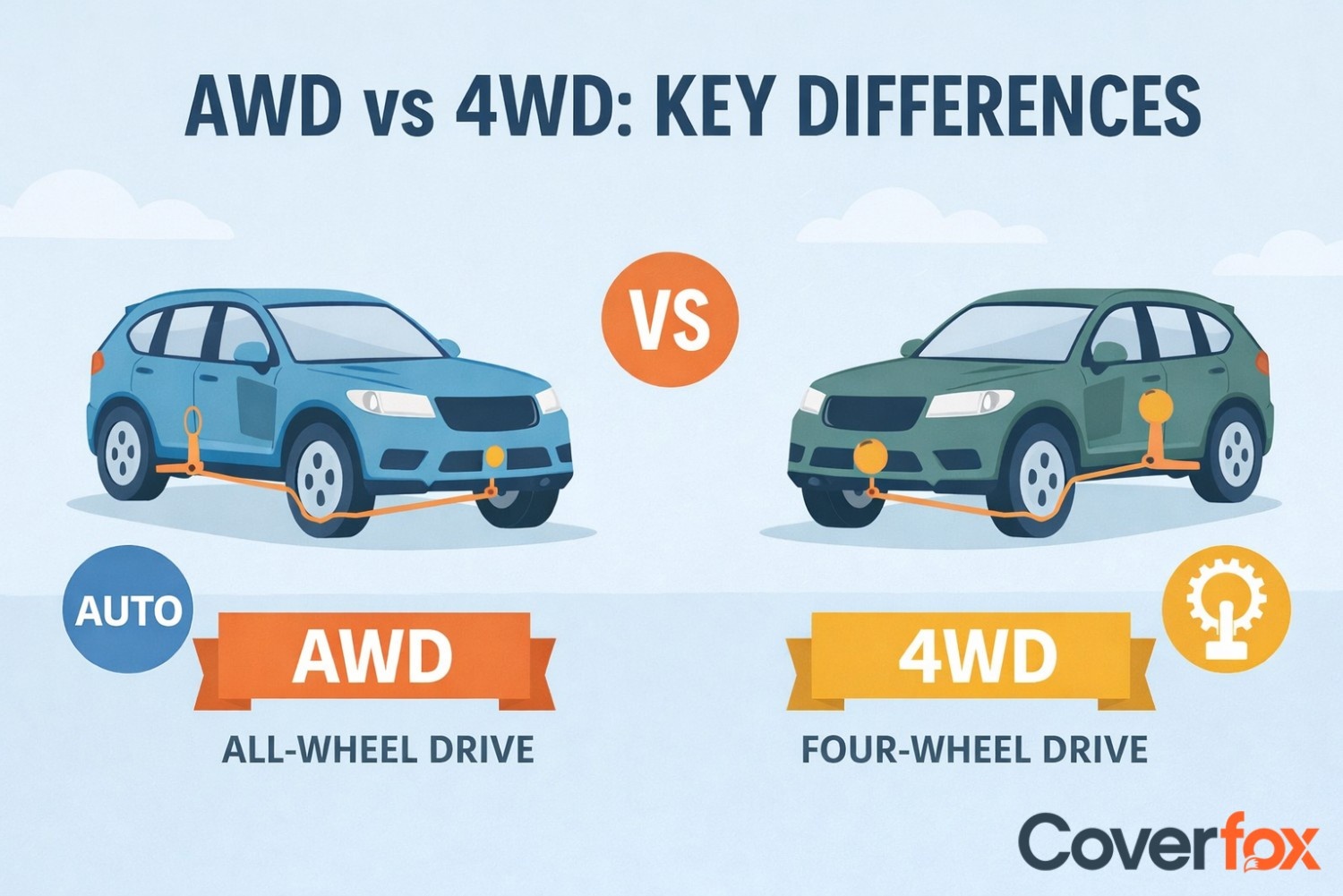
AWD full form is 'All-Wheel Drive', and as the name suggests, this drivetrain distributes engine torque across all four wheels via electronic controls. The system automatically adjusts power to wheels with optimal grip during changing road conditions, seamlessly correcting minor slips. Popular in crossovers and compact SUVs, most AWD systems remain continuously active, dynamically reallocating torque based on traction sensors. Ideal for frequent rain, patchy tarmac, or light off-road, it provides confident handling without driver intervention.
How Does All-Wheel Drive (AWD) Work?
AWD depends on sensors. These sensors look at wheel speed and note when one wheel begins to spin too freely. Once the system notices a slip, it moves torque to the wheel that still has grip. A central differential, or electronic clutch, usually handles this. The work happens quietly, sometimes with tiny delays that a driver barely notices. Some AWD models run in two-wheel mode until they need more traction, though many run full-time.
What Is a Four-Wheel Drive (4WD or 4×4)?
Four-Wheel Drive (4WD ) emphasises power delivery to all four wheels and is activated manually by the driver rather than running continuously. A transfer case divides torque between front and rear axles, with low-range gearing (typically 2.5:1-4:1 reduction) enabling high-torque crawling at 1-5 km/h for steep inclines or deep mud. Technical caveat: Fuel efficiency drops 15-25% in 4WD mode; high range suits moderate off-road, while low range risks drivetrain stress above 40 km/h. Large SUVs and trucks favour 4WD on unstructured terrain, like sand, rocks, or mud, where 2WD fails, though tyre wear accelerates on tarmac.
How Does 4-Wheel Drive Work?
The system stays off until the driver switches it on. Once activated, the vehicle sends torque to all four wheels with equal force. Some models allow full-time 4WD, though part-time is still very common. Locking differentials show up in many off-road units. These locks hold both wheels on an axle at the same pace and help when one wheel does not touch the ground properly. The system is heavy and more mechanical than AWD.

What Are the Differences Between AWD and 4WD?
Below is a simple table showing how all-wheel drive vs 4-wheel drive differ. The points may look small, but they change how the vehicle behaves.
Comparison Between AWD and 4WD
The table shows AWD fits daily roads, while 4WD suits tough terrain.
| Point | AWD | 4WD |
|---|---|---|
| Control | Automatic | Manual selection |
| Terrain | Wet roads, mild off-road | Heavy mud, stones, sand |
| Power Flow | Moves torque around | Sends equal torque |
| Driver Role | None | Switch needed |
| Fuel Use | Lower | Higher |
| Vehicle Type | Crossovers, smaller SUVs | Trucks, large SUVs |
The table makes it clearer that AWD suits daily driving, while 4WD suits extreme ground where grip comes and goes fast.
Advantages & Disadvantages of All-Wheel Drive (AWD)
| Advantages (AWD) | Disadvantages (AWD) |
|---|---|
| Works without manual steps | Lower fuel economy |
| Power Flow | Moves torque around |
| Smooth control during turns | Weak on very rough ground |
Advantages & Disadvantages of 4WD
| Advantages of 4WD | Disadvantages of 4WD |
|---|---|
| Strong force for mud and stones | More fuel needed |
| Low-range gears for slow climbs | More parts to service |
| Can pull heavy loads | Not ideal for long use on clean roads |
Also Read: Front Wheel Drive vs Rear Wheel Drive - Which is Better?
AWD vs FWD: Which Is More Fuel-Efficient?
FWD usually wins in fuel economy. It is light and simple. It sends torque to the front wheels only. AWD carries more parts and stays ready to correct traction. Because of this, fuel numbers fall slightly. Many drivers still choose AWD because it stays steady in the rain. FWD, however, remains the simpler and cleaner option for people driving only on plain urban roads.
Wrapping Up
AWD aims for comfort and grip on mixed surfaces. It acts without commands and suits cities with regular rain. 4WD aims for strength. It fits ground that shifts shape, such as sand or steep stone climbs. Both systems can affect how a car insurance policy outlines costs because the drivetrain influences part pricing and typical travel use.
Related Articles:
Car Axles: Function, Importance and How They Work
Traction Control System in Cars: How It Works and Why It Matters
FAQs on AWD vs 4WD
Is AWD or 4WD better for driving on muddy or unpaved roads?
4WD deals with heavy mud. AWD suits mild unpaved surfaces.
Does AWD help in city driving with heavy traffic?
Yes. It stays steady during constant slowdowns and movement on wet roads.
Does AWD improve fuel efficiency?
No. It uses more fuel than FWD.
AWD vs 4WD: Which drivetrain is better for long road trips?
AWD suits long highways. 4WD suits long, rough routes.
When should AWD be avoided?
Avoid deep ruts, sandy pockets, or extreme rocky slopes.
What problems can arise with AWD cars?
Common issues include worn sensors, differential noise and tyre mismatch.
Is AWD effective in rain?
Yes. It supports grip when the surface becomes wet.
What’s the difference between AWD, 4WD, and 4×4?
AWD automatically distributes torque via electronics; 4WD/4×4 typically requires manual activation. Variations: full-time AWD (permanent), part-time AWD (auto-shift), electronic 4WD (button-select), and mechanical 4WD (lever). Distinguishes automatic vs. driver-initiated control.
Can AWD be used as 4WD?
No. It lacks low-range gears.
Is AWD the safest option?
It offers better traction, but safety still depends on tyres, brakes, and careful driving.
Disclaimer: The information provided in this article is for general understanding only. Vehicle performance, drivetrain function, and repair costs can vary based on model and manufacturer. Please verify technical specifications directly with the vehicle brand and consult a professional before making any purchase or driving decision.