SUVs, MUVs, and XUVs represent three commonly discussed vehicle categories in India. Each one has its own distinct purpose, from providing a performance utility vehicle for use to providing urban-friendly comfort for passengers.
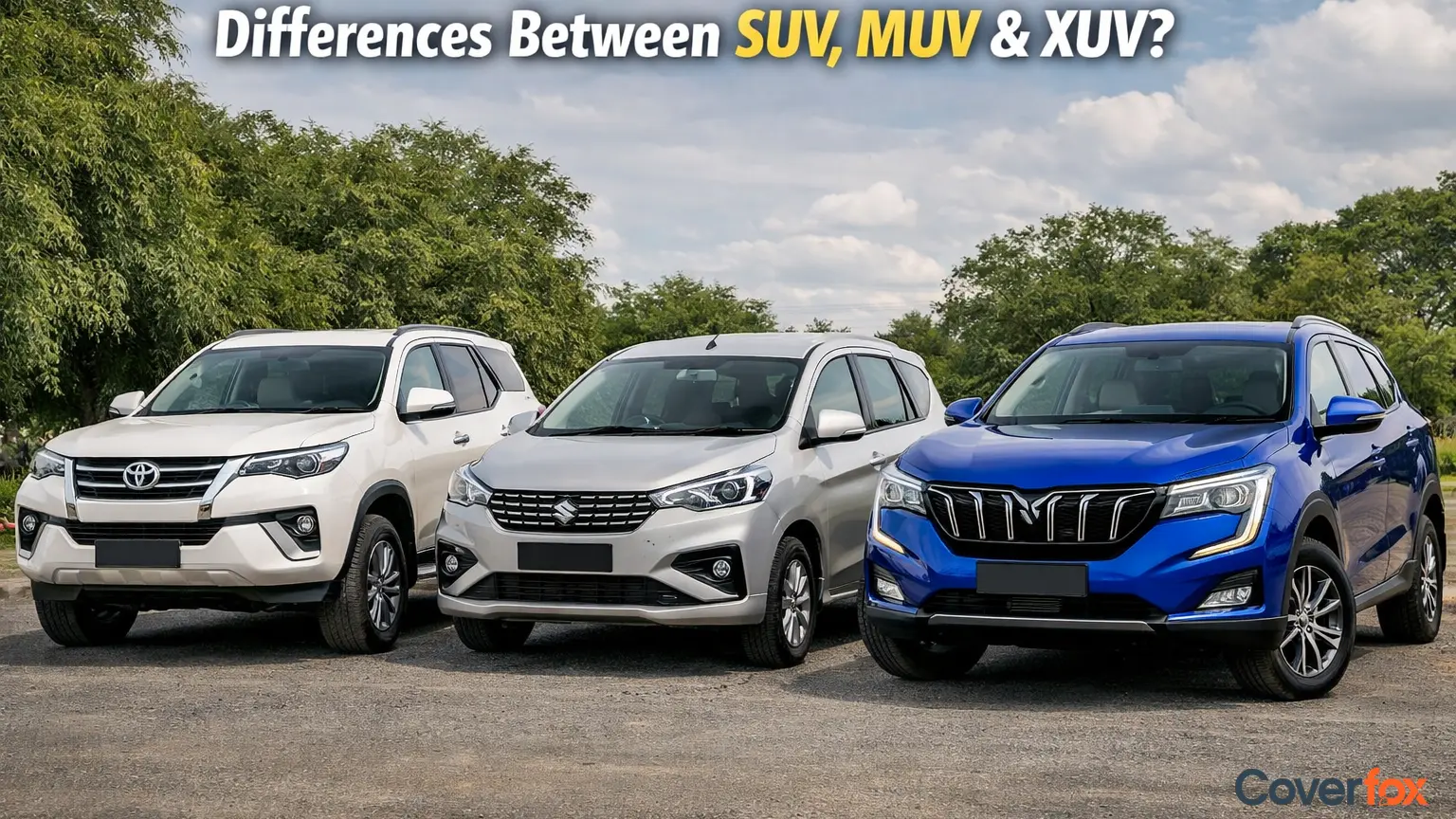
While many features overlap among these vehicles as well, the differences between an SUV and an MUV, as well as the difference between an SUV and an XUV, are based more on vehicle architecture, seating capacity, and the roads they will be driven on. In this article, we will explain all of these differences using clear definitions and comparisons relevant to Indian driving conditions.
What is an SUV Car?
Sport Utility Vehicles (SUVs) can be classified as vehicles with greater ground clearance than traditional hatchbacks and sedans. They have higher ground clearance than a typical hatchback and a greater body structure to accommodate all types of driving surfaces. There are two different styles of SUVs in India; these include the ladder-frame chassis (ex: Mahindra Thar, MG Gloster, Toyota Fortuner) and the reinforced monocoque chassis (ex: Tata Harrier, Volkswagen Taigun, Hyundai Creta).
What are the typical features of SUVs?
Some commonly found features are:
Higher ground clearance than hatchbacks and sedans
Upright seating position
Multiple drivetrain options
Capability across varied terrains
Larger tyres and reinforced suspension systems
This helps in navigating rough roads, speed breakers, and mild off-road conditions. However, some compact crossovers may offer only marginally higher clearance than sedans.
Provides improved road visibility and a commanding driving view.
Many traditional SUVs are available in rear-wheel drive (RWD) or all-wheel drive (AWD)/4x4 configurations, though smaller SUVs are often front-wheel drive (FWD) only.
Mid-size and full-size SUVs are better suited for highways, rural roads, and uneven terrain, while crossovers are primarily urban-focused.
Designed to handle heavier loads and rougher surfaces, though this varies by segment and model.

What Is an MUV Car?
The Multi Utility Vehicle (MUV) is mainly used to carry passengers and provide them with a comfortable experience on board. The main purpose of an MUV is to have a vehicle that can comfortably accommodate multiple passengers while being simple to drive and economical to own and operate.
Many large families and fleet operators in India use MUVs. This is because of the practicality of the design and the relatively low running costs associated with the MUV.
Key Features of an MUV
Key characteristics of most modern MUVs include:
Seating capacity typically ranges from 6 to 8 passengers
Lower ground clearance than SUVs
Car-like handling and ride comfort
Optimised for city driving and highway use
Generally better fuel efficiency compared to SUVs
Flexible interior configuration
Comfort-oriented suspension tuning
Essential safety features
Spacious three-row layouts make them suitable for family trips and group travel.
This enhances stability and makes entry and exit easier, especially for elderly passengers and children.
Built for smoother on-road performance rather than rough terrain driving.
Designed to handle daily commutes and long-distance travel comfortably.
Lighter construction and urban-focused engineering contribute to improved mileage.
Many MUVs feature foldable or split-folding rear seats, allowing owners to adjust cabin space for passengers or luggage as needed.
Suspension systems are typically tuned for stability and ride comfort during long journeys.
Modern MUVs commonly include dual airbags, ABS with EBD, rear parking sensors, and seatbelt reminders to enhance occupant protection.
Overall, MUVs focus on practicality, comfort, and efficient space utilisation, making them a dependable choice for larger families.
What is an XUV Car?
XUV is not an official vehicle classification recognised by Indian automotive regulators. The term "XUV" was introduced by Mahindra & Mahindra as a branding concept, first used with the Mahindra XUV500.
An XUV represents a crossover utility vehicle, combining SUV-inspired styling with the comfort and drivability of a monocoque chassis. From a regulatory standpoint, XUVs are classified as either SUVs or utility vehicles.
What are the key features of an XUV?
Key features commonly associated with modern XUVs include:
Monocoque construction
Bold, SUV-inspired design
Spacious and flexible interiors
Advanced connectivity features
Modern safety and driver-assistance systems
Comfort-focused suspension setup
Limited off-road capability
Enhances structural rigidity, improves handling, and delivers a smoother ride experience.
Aggressive front grilles, muscular body lines, alloy wheels, and elevated stance for a premium road presence.
Many XUVs offer 5- or 7-seater configurations, split-folding rear seats, and adjustable cargo space to balance passenger comfort and luggage needs.
Touchscreen infotainment systems, smartphone integration (Android Auto/Apple CarPlay), connected car technology, and voice-enabled controls.
Multiple airbags, ABS with EBD, electronic stability control (ESC), rear-view cameras, and in higher variants, features like ADAS (Advanced Driver Assistance Systems).
Tuned for city roads and highways, ensuring balanced handling and reduced cabin noise.
While some models may offer traction control or AWD options, XUVs generally do not match the rugged off-road strength of ladder-frame SUVs.
Overall, XUVs are positioned as feature-rich, tech-forward vehicles that deliver SUV styling with everyday practicality and comfort.
SUV vs MUV vs XUV: A Comparative Analysis
| Feature | SUV | MUV | XUV |
|---|---|---|---|
| Primary Purpose | Versatility and strength | Passenger capacity | Urban performance |
| Chassis Type | Ladder-frame or monocoque | Monocoque | Monocoque |
| Ground Clearance | High | Moderate | Moderate to high |
| Seating Capacity | 5–7 | 6–8 | 5–7 |
| Fuel Efficiency | Moderate | Higher | Moderate |
| Off-road Capability | High (select models) | Low | Limited (mostly soft-roading ability) |
| Drivetrain Options | RWD, AWD, 4x4 (model dependent) | Primarily FWD | Mostly FWD; AWD available in select models |
| Technology Features | Premium infotainment and integrated tech in higher variants | Practical infotainment, basic-to-mid tech | Advanced infotainment, connected car tech |
| Safety Features | Multiple airbags, ESC, traction control, and ADAS in higher trims | Standard safety features; ADAS rare | Multiple airbags, ESC, and ADAS in top variants |
| Cost of Ownership | Higher | Lower | Moderate |
Car insurance premiums generally depend on factors such as engine capacity, vehicle value (IDV), location, and claim history. However, vehicle type also plays a role:
SUVs
MUVs
XUVs (Crossovers)
Vehicles with larger engine sizes, higher replacement costs and expensive parts. This includes all 4x4 variants of the vehicle.
The premium costs for MUVs stay lower than those for SUVs because their design prioritises practical use over high performance, and their repair costs stay lower.
XUVs normally need moderate premium payments because they offer a combination of various features, technological elements and engine power.
The presence of advanced safety features in vehicles, which include ADAS and multiple airbags and anti-theft devices, will help drivers receive small premium discounts from some insurance companies.
SUV vs XUV vs MUV: Choosing the Right Vehicle Type
The choice depends on usage patterns and driving conditions.
An SUV is suitable for buyers requiring higher ground clearance, occasional off-road driving, and a stronger road presence.
MUV is appropriate for families prioritising space, comfort, and cost-effective daily travel.
XUV suits buyers seeking modern features, SUV-like styling, and car-like driving comfort.
Conclusion
Understanding the difference between SUV and MUV and the difference between SUV and XUV enables informed vehicle selection. SUVs emphasise strength and terrain capability, MUVs focus on passenger comfort and efficiency, while XUVs bridge the gap with modern design and urban practicality. Each category serves a distinct purpose within the Indian automotive ecosystem.
Also Read:
Disclaimer: The information provided in this article is for general informational and educational purposes only. Vehicle classifications such as SUV, MUV, and XUV may vary based on manufacturer specifications, regulatory definitions, and market positioning. Features, performance, fuel efficiency, and maintenance costs can differ depending on the specific model and variant. Readers are advised to verify details with the respective vehicle manufacturer or authorised dealer before making any purchase decision.
Frequently Asked Questions
What is the difference between SUVs, MUVs, and XUVs?
SUV designs prioritise ruggedness and performance, MUVs focus on passenger seating and comfort, and XUVs combine the SUV style with the advantages of monocoque construction.
Are SUVs more expensive to maintain compared to MUVs and XUVs?
Yes. Maintenance and insurance for SUVs typically cost more when compared to MUVs due to the larger engines and heavier construction.
Which vehicle type is more fuel-efficient?
MUVs are generally more fuel-efficient due to lighter construction and smaller engine configurations. This design focuses primarily on passenger transportation and is ideal for use in urban settings. In addition, MUVs consume less fuel than competitors.
Are XUVs suitable for off-road adventures?
Many XUVs are built on a monocoque platform and therefore do not provide much off-road ability; instead, they tend to perform better on paved roads and in light, semi-urban environments.
Is the XUV700 an SUV or MUV?
The XUV700 is classified as an SUV under the utility vehicle categories. Despite its crossover design, it meets SUV criteria based on ground clearance and vehicle dimensions.
Is an MUV better than an SUV?
MUVs are better suited for higher passenger capacity and lower running costs. SUVs are better suited for multiple road conditions and have increased ground clearance.