India has been moving towards blended fuels for a while, and E20 fuel has come into the picture more strongly after the BS6-II standards started in 2023. BS6 Phase II standards took effect on April 1, 2023, mandating Real Driving Emissions (RDE) testing alongside lab norms for all new vehicles.
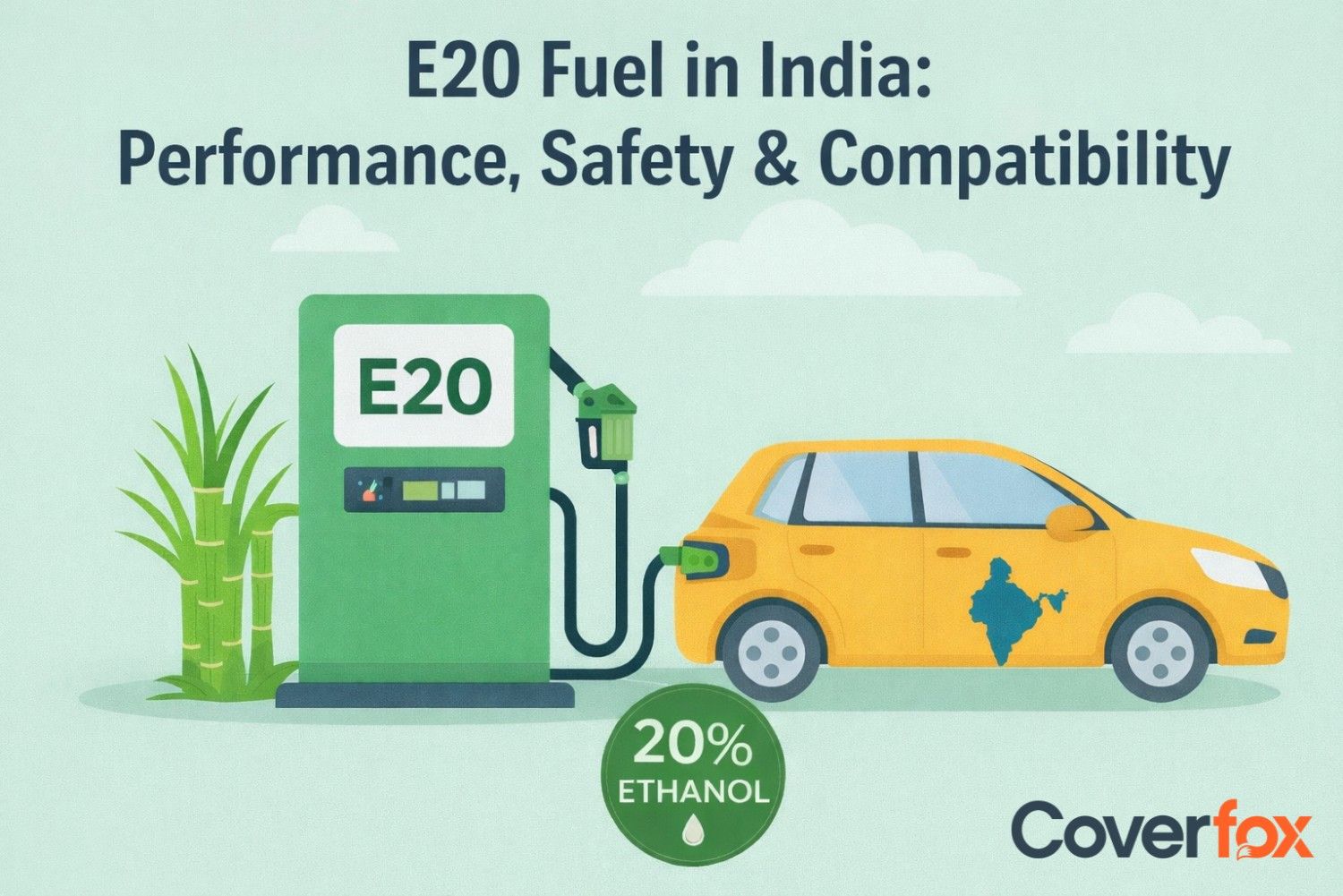
Several new vehicles are already made to use it, and the government wants E20 available across the country by 2025 as per the NITI Aayog roadmap for ethanol blending in India. Because of this shift, many people are trying to understand the blend properly, how it works in real engines, and whether it will change the way cars run daily.
Find out why ethanol is added, how India produces it, and what changes may appear in engines, pricing, and regular usage.
What Is E20 Fuel?
It is a mixture made from 20% ethanol and 80% petrol. When both are mixed, the fuel burns differently because ethanol carries more oxygen inside its structure. A few engines benefit from this, while older engines may not handle it well.
Ethanol is sourced from crops, so part of the fuel becomes renewable. Petrol remains the bigger portion, but the blend reduces overall oil use.
What Is Ethanol?
Ethanol (C₂H₅OH) forms through fermentation of plant materials like sugarcane or corn, yielding a clear liquid with a sharp odour that evaporates quickly. Fuel ethanol undergoes denaturation—adding chemicals like gasoline (2-5%) or bitterants (e.g., Bitrex at 10 ppm)—rendering it undrinkable and toxic to prevent diversion from fuel to beverage use. Thus meeting the excise regulations while enabling 20-27% blending in petrol.
Basic features include:
Comes from plant sugars
Breaks down quickly in an open nature
Burns reasonably clean
Mixes easily with petrol
What Are Ethanol’s Uses?
Ethanol had been used in different industries long before E20 blends appeared.
Mixed as E10, E20 fuel, E85 and other blends
Used for medicines and cosmetic production
Used in perfumes because it dissolves certain oils
Cleaning products often carry ethanol
Alcoholic drinks use a purer form, not the fuel type
How Much Ethanol Does India Produce?
India ranks as the world's 3rd largest ethanol producer with 1,990 crore litres of capacity as of November 2025, achieving 19.97% petrol blending (October 2025). Uttar Pradesh leads at 236 crore litres from sugarcane molasses, followed by Maharashtra (180+ crore litres) and Karnataka via grain feedstocks. Production taps sugarcane waste (molasses: 875 crore litres capacity), grains (505 crore litres), and farm residues under the PM JI-VAN scheme, supplying 1,000+ crore litres blended in ESY 2024-25.
The common making process goes something like this:
- Crop material is crushed or broken down to release sugar or starch.
- Liquid is mixed with yeast, which starts fermentation.
- Ethanol forms, but it is mixed with water.
- Distilling the mix removes water.
- Another step dries the ethanol more.
- This ethanol is then used to form blends like E20 fuel.
Sometimes different raw materials give slightly different yields, but the idea stays the same.

How Are Engines Running Ethanol Blends Different?
E20 ethanol blends demand engine upgrades, as ethanol absorbs moisture (hygroscopic nature) and corrodes incompatible metals/rubbers, unlike pure petrol. ARAI studies confirm flex-fuel vehicles need:
Ethanol-resistant fuel lines (fluoroelastomers replace nitrile rubber)
High-flow injectors (20% larger orifices for leaner AFR)
Reinforced pumps (stainless steel internals vs. aluminium)
Lambda sensors recalibrated for 10-15% richer mixtures
ECU remapping (advanced ignition timing +5-10° BTDC)
Durability validation (1,50,000 km E20 exposure tests)
Pre-2015 engines risk corrosion (brass/copper fittings) and vapour lock; post-2023 BS6-II models comply natively engines.
Key Advantages of E20 Fuel
Below are the key advantages of E20 fuel, highlighting its environmental, economic, and performance benefits.
Renewable Plant-Based Source
Sugarcane and corn – India generated 11 billion litres of the product in 2024, which is completely replacing fossil fuels.
Exhaust Pollution Reduction
NITI Aayog studies indicate that the reduction is 20-30% of CO₂ and 15% of particulate matter.
Farmer Economy Boost
Supports 5 million sugarcane farmers; E20 policy injected 45,000 crore into rural incomes (2020-2025)
Better Octane Performance
The 108-110 octane of Ethanol boosts the performance of high-performance engines by 10%.
Engine Knock Elimination
E20 formulation decreases pre-ignition by 25% in compatible engines according to ARAI tests.
Strategic Oil Import Savings
FY24 record lows of 4.4 million tonnes of crude imports saved $3.2 billion USD.
India aims at 20% blending of ethanol by 2025, reducing oil bills by 10% every year and generating 10 lakh green jobs.
Disadvantages of E20 Fuel
Below are the key disadvantages of E20 fuel, focusing on vehicle compatibility, infrastructure challenges, and environmental concerns.
Older Vehicle Compatibility Problems
Infrastructure Renovation
Hygroscopic Water Absorption
Risks of Material Degradation
Agricultural Sustainability Issues
Mitigation Progress
Cars made before 2010 have 15-20% greater corrosion rates; only 75% of 35 crore BS-VI vehicles in India are SIAM.
60,000+ petrol pumps to be replaced with stainless steel tanks/pipes – a 20,000 crore investment is required by 2025 as stipulated by the Petroleum Ministry.
Ethanol absorbs 3 times more moisture in the atmosphere, leading to phase separation and engine misfires in 30 days in humid weather.
Rubber hoses lose 40% of strength; 25% of plastic fuel lines crack according to the ARAI accelerated test of old components.
E20 targets increased sugarcane demand by 25 per cent, and without crop rotation, 15 per cent of soil nutrients are depleted, according to ICAR research.
BS-VI (after 2020) certified E20-safe; 80% pump upgrades by Dec 2025.
How To Check If a Car Is Compatible With E20 Petrol?
People can confirm E20 support by simple checks:
Fuel cap may show “E20” or “E20 suitable”
The car manual lists the fuel blends allowed
The manufacturer's website lists E20-ready models
Service centres can confirm using vehicle details
Most BS6-II vehicles introduced after 2023 are made for E20
Confirmed by ARAI Certification: 98% of 1,200+ BS6-II models tested (2023-2025) cleared E20 fuel standards per Automotive Research Association of India
OEM Compliance: Maruti Suzuki (70% market share), Hyundai, Tata Motors have engineered fuel systems with corrosion-resistant materials since the 2023 launch
Using E20 in an incompatible car may affect the fuel pump or rubber pipes.
Is E20 Petrol Cheaper Than Regular Petrol in India?
The E20 fuel price shifts by state because of taxes and is cheaper to produce, but the final price often remains close to normal petrol. This phenomenon happens because transport and tax rules matter more than production costs.
E20 pricing varies 10–20% across states due to VAT differences, not just production savings.
-
Current Price Range (Dec 2025): ₹95–₹110/litre vs regular petrol ₹102–₹118; E20 averages ₹4–6 cheaper nationally per IOCL data [PPAC Weekly Report]
-
Tax Impact Breakdown:
Maharashtra (35% VAT): E20 ₹108/litre
Delhi (31% VAT): E20 ₹98/litre
Kerala (39% VAT): E20 ₹112/litre [State Excise Notifications]
-
Ethanol Production Cost: ₹55–60/litre vs petrol ₹75 (pre-tax); 25% savings eroded by 70–80% taxes [NITI Aayog E20 Report 2024]
-
Transport Reality: Ethanol freight ₹8–12/litre (sugarcane belt to pumps); blending doesn’t pass full savings due to fixed dealer margins (3.5%) [Oil Ministry Pricing Order]
Net Effect: E20 consumer savings capped at 4-6% despite 25% raw cost advantage—tax harmonisation needed for bigger impact.
The bigger goal is energy security rather than big savings at the pump.
E20 vs Regular Petrol: A Quick View
Below is a quick comparison between regular petrol and E20 fuel, highlighting key differences in composition, engine requirements, emissions, and performance.
| Point | Regular Petrol | E20 Fuel |
|---|---|---|
| Ethanol mix | Often up to 10% | 20% ethanol |
| Engine type | Standard petrol engines | Needs E20-ready parts |
| Emission level | Higher fumes | Lower fumes |
| Knock control | Medium | Better among tuned engines |
| Moisture pull | Lower | Higher due to ethanol |
Final Thoughts
A proper car insurance plan protects the vehicle when sudden repairs or accidents occur. At Coverfox, you can compare plans from many insurers in one place so people can pick a policy that suits their needs without confusion.
Explore More Articles:
Petrol Density in India & Its Impact on Vehicle
Hydrogen Fuel Cell Cars In The World
FAQs on E20 Fuel
Is E20 fuel safe for all cars?
This is only applicable to cars that are marked as E20-supported.
Is E20 petrol better?
For engines prepared for E20, yes. For older ones, no.
Does E20 fuel affect mileage?
Usually, mileage drops slightly because ethanol has lower energy.
Can ethanol damage the engine?
Ethanol can damage the engine if the car is not specifically designed to use it.
Will E20 void the warranty?
If the car is E20-approved, the warranty remains safe.
Is E20 sold across India?
Many cities have it, with e20 petrol prices getting closer to normal petrol.