Car insurance offers financial protection, but the extent of coverage depends on whether you have a third-party or comprehensive policy.
Understanding inclusions and exclusions is essential, as certain situations like policy lapse, drunk driving, wear and tear, or mechanical failure are not covered under standard insurance.
Read all inclusions and exclusions of your car insurance policy to ensure there are no sudden surprises during claims.
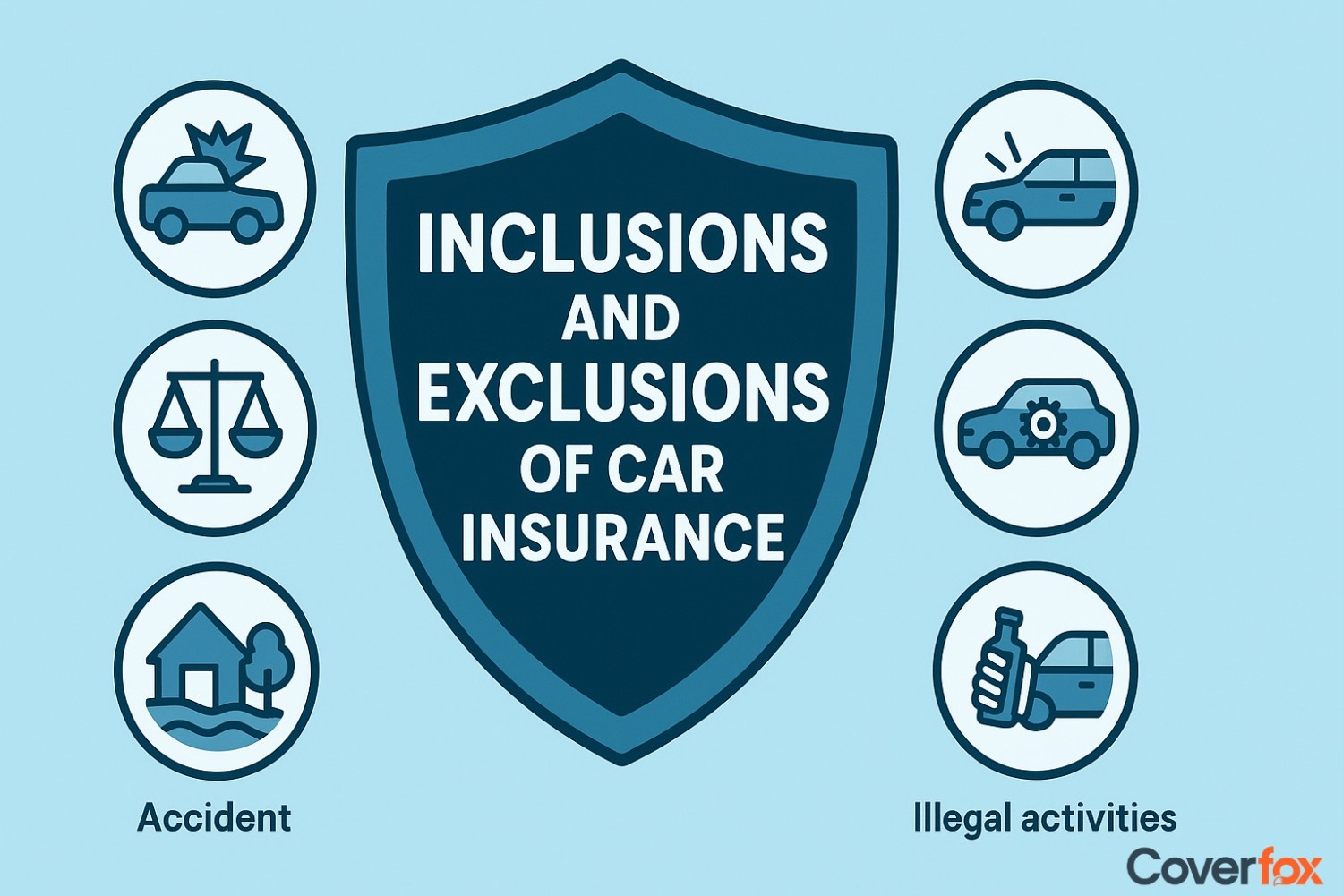
While reading your insurance policy, you will come across inclusions and exclusions of car insurance. It portrays what will be covered and what will not be covered while filing for a claim. Understanding these inclusions and exclusions will ensure you have smoother claims and you do not get any surprises. This page will keep you informed on what is generally included or not included in your car policy.
Inclusions in Car Insurance Policies
A car insurance policy is designed to protect you from financial losses and legal responsibilities arising from accidents, damages, or unexpected events. Below are the major coverages typically included in a motor insurance policy in India:
1. Third-Party Damage (Bodily Injury)
Car insurance covers legal and financial liabilities arising from bodily injuries caused to a third party due to an accident caused by the insured car. This includes medical expenses and compensation for disabilities.
2. Third-Party Damage (Death)
In the event that an accident involving the insured vehicle results in the death of a third party, the policy covers compensation for the third party involved. There is no limit to third-party compensation in case of bodily injury or death. The final amount is decided by the Motor Accidents Claims Tribunal (MACT) based on:
Age of the victim
Income and future earning potential
Nature and extent of injury or disability
Dependants (in case of death)
3. Third-Party Property Damage
Damages caused to third-party property, including another person’s vehicle, are covered under the car insurance policy. As per Indian regulations, this cover is available up to ₹7.5 lakh.
4. Accidental Damage to Your Car
If your car is damaged due to a road accident, the insurer covers the cost of repairs or replacement, subject to the policy terms and applicable deductibles. This helps reduce the out-of-pocket expense you would otherwise have to bear after an unexpected accident.
5. Fire and Explosion Cover
Losses caused by fire-related incidents such as explosions, self-ignition, or accidental fires are covered under a motor insurance policy. This coverage applies whether the fire originates internally or is caused by an external source.
6. Protection Against Natural Events
Comprehensive insurance provides financial protection if your car is damaged due to natural calamities like floods, cyclones, storms, earthquakes, lightning, or landslides. Natural disasters are uncertain and hence, covered under car insurance.
7. Cover for Man-made Incidents
Any damage caused to the insured vehicle due to riots, strikes, vandalism, malicious acts, or civil unrest is covered under a comprehensive car insurance plan.
8. Vehicle Theft Coverage
If your car is stolen, the insurance policy compensates you for the financial loss. In cases where the vehicle is not recovered, the insurer pays an amount equivalent to the car’s Insured Declared Value (IDV).
9. Personal Accident Cover for Owner/Driver
A mandatory personal accident cover provides financial support if the owner-driver suffers death or permanent disability due to a car accident. This cover of ₹15 lakh is included with both comprehensive and third-party-only car insurance policies.
Note: Third-party car insurance only covers third-party damages, and personal accident cover. Any other inclusions mentioned above are general inclusions of a comprehensive car insurance policy.

Exclusions in Car Insurance Policies
Although car insurance offers wide-ranging protection, certain situations fall outside the scope of coverage. These exclusions are standard across most car insurance policies and should be understood clearly to avoid claim rejections.
1. Claims Made on an Expired or Lapsed Policy
Car insurance remains valid only when renewed on time. If the policy has expired or lapsed, any loss or damage occurring during this period will not be covered by the insurer and can fetch fines from traffic cops.
2. Driving Without Legal Compliance
If the insured car is driven in violation of the law, insurance coverage will not apply.
Driving under the influence:
Invalid driving licence:
Damages caused while the driver is under the influence of alcohol, drugs, or intoxicating substances are excluded from coverage.
Claims will be rejected if the person driving the vehicle does not hold a valid or appropriate driving licence at the time of the incident.
3. Damage Occurring Outside India
Any accident, loss, or damage that occurs outside Indian geographical limits is not covered, unless the policy includes a specific international extension.
4. Ageing and Maintenance-Related Damage
Car insurance does not cover issues that arise due to regular usage or lack of maintenance.
Normal wear and tear:
Mechanical or electrical breakdown:
Gradual deterioration of parts due to everyday use is excluded.
Failures caused by internal mechanical or electrical faults are not covered unless they are the direct result of an insured accident.
5. Indirect or Consequential Losses
Losses that occur as a secondary effect of an incident—such as damage caused while towing the vehicle or continuing to drive after a breakdown—are not covered under standard policies.
6. Damage to Tyres and Tubes
Damage to tyres or tubes alone is not covered. However, if the tyres are damaged as part of a larger accident involving the insured car, the insurer may cover the cost subject to policy terms.
Customising Your Policy: Riders and Add-Ons
While a standard car insurance policy covers many common risks, certain exclusions can limit the scope of protection. Add-ons (also known as riders) help bridge these gaps by extending coverage to areas that are otherwise not included in basic policies.
Zero Depreciation Cover
Engine Protection Cover
Tyre Protection Cover
Consumables Cover
Return to Invoice (RTI) Cover
Roadside Assistance Cover
Personal Accident Cover for Passengers
Reduces the impact of depreciation by ensuring you receive the full cost of replaced parts during a claim, which is otherwise deducted under standard policies.
Covers repair costs for engine and gearbox damage caused by water ingress, oil leakage, or flooding—situations typically excluded under basic car insurance.
Provides coverage for tyre damage due to cuts, bulges, or bursts, which are generally not covered unless they occur as part of a larger accident.
Pays for consumable items such as engine oil, coolant, nuts, bolts, and brake fluid that are excluded from standard claims.
Ensures you receive the original invoice value of the car in case of total loss or theft, instead of only the depreciated Insured Declared Value (IDV).
Offers on-the-spot help for breakdowns, towing, flat tyres, or battery issues, services not covered under regular car insurance.
The add-on extends personal accident protection to co-passengers, whereas the basic policy covers only the owner-driver.
Bottom Line
While purchasing a car insurance policy, one must absolutely keep an eye on the inclusions and exclusions of the policy, to truly understand what coverage is offered. In that way, during claims, no surprises come out. Know what is covered and make your insurance journey a lot smoother.
Explore More Articles:
Is high IDV better in car insurance?
Compulsory and Voluntary Excess in Motor Insurance
All About Endorsement in Car Insurance
Frequently Asked Questions
What does a car insurance policy cover?
A car insurance policy covers financial losses arising from accidents, theft, fire, natural and man-made disasters, and third-party liabilities. The coverage depends on the type of policy and the add-ons chosen.
What’s covered under comprehensive insurance?
Comprehensive insurance covers third-party liabilities along with damage to your own car caused by accidents, theft, fire, floods, riots, and other unforeseen events.
What does third-party insurance cover?
Third-party insurance covers legal liability arising from injury, death, or property damage caused to a third party by the insured vehicle. It does not cover damage to your own car.
Is engine failure covered under a car insurance policy?
Engine failure due to mechanical or electrical breakdown is not covered under a standard policy. Engine damage caused by water ingress or flooding may be covered if an engine protection add-on is included.
Are additional fittings covered under a car insurance policy?
Factory-fitted accessories are covered under comprehensive insurance. Non-factory or aftermarket fittings are covered only if they are declared and included in the policy.
Are my personal belongings inside the car covered?
Personal belongings such as bags, electronic items, or valuables kept inside the car are not covered under a standard car insurance policy.
Do exclusions really differ from one insurer to another?
Most exclusions are standard across insurers as per motor insurance guidelines, though minor differences may exist based on policy wording and available add-ons.
Is roadside assistance included?
Roadside assistance is generally not included in the base policy and is offered as an optional add-on.
Disclaimer: Inclusions and Exclusions mentioned on this page are generic information. For exact details, refer to your policy document carefully.