Total loss in bike insurance means the bike is beyond repair or irrecoverable. The claim amount of total loss is calculated based on the IDV decided on policy purchase. Constructive Total Loss in bike insurance is a situation where the bike is repairable, but repair costs go beyond 75% of the total IDV of the bike.
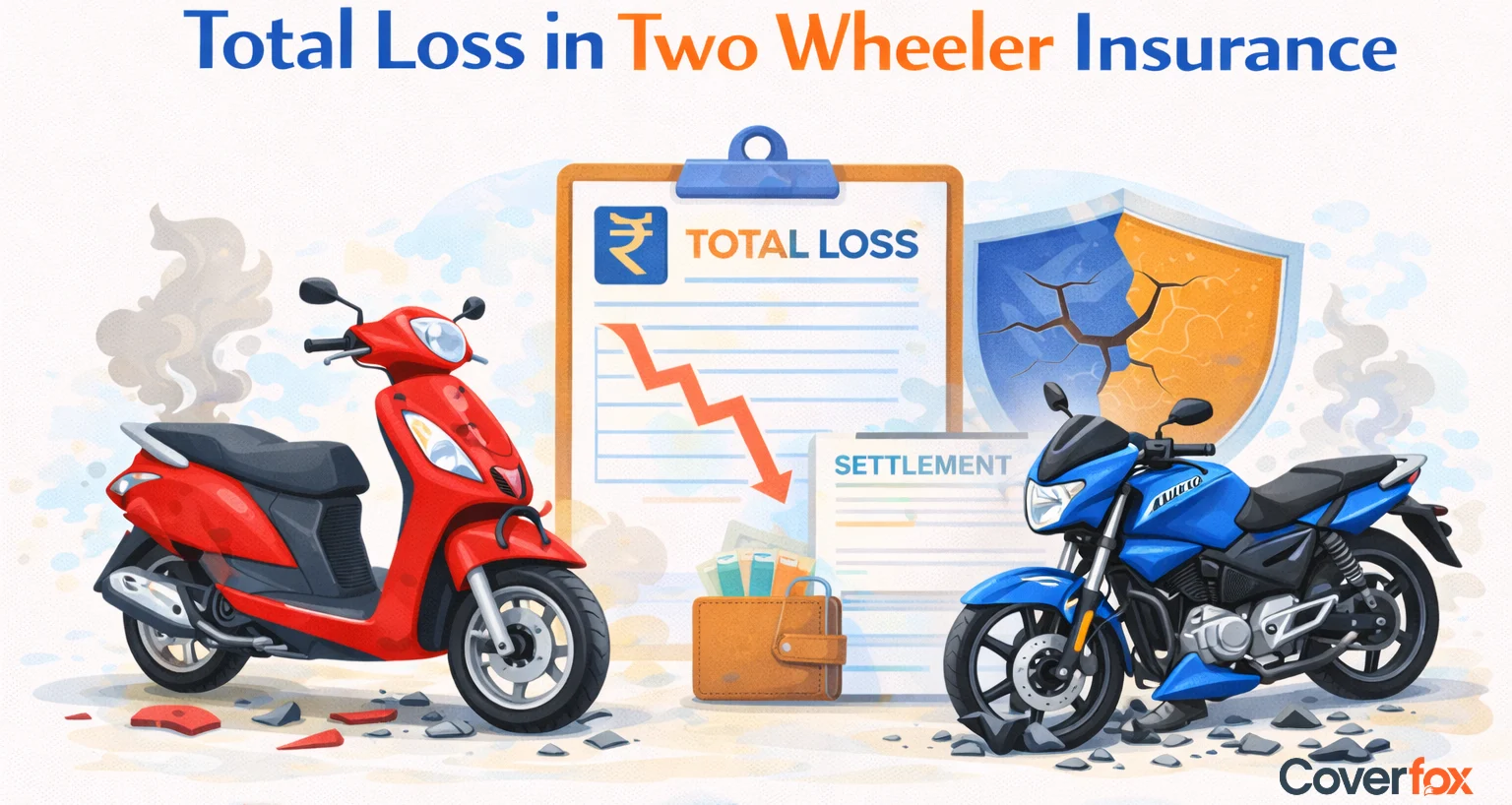
Total loss in bike insurance refers to a situation where the insured bike is either destroyed, stolen and not recovered, or damaged beyond economic repair. Under a bike insurance policy, the insurer compensates the policyholder based on the bike’s Insured Declared Value (IDV), as per policy terms and applicable deductibles. Total loss can occur due to events like major accidents, theft, fire, or natural disasters.
What is Total Loss in Bike Insurance?
In simple terms, total loss means the bike is completely damaged or lost beyond recovery, leaving no scope for repair or restoration. Since the vehicle cannot be brought back to a usable condition, the insurer settles the claim by paying the full IDV of the bike, subject to policy conditions. You can use a bike IDV calculator to estimate the correct IDV and understand your potential claim amount in advance.
What is Constructive Total Loss (CTL) in Bike Insurance?
Constructive Total Loss (CTL) in bike insurance occurs when the cost of repairing the damaged bike exceeds a certain percentage of its Insured Declared Value (IDV), typically around 75%. In such cases, even though the bike is not destroyed, it is considered uneconomical to repair, and the insurer settles the claim based on the IDV as per policy terms.
When is a Bike Declared Total Loss?
A bike is declared a total loss in these situations:
Theft with no recovery
Severe accident damage
Fire damage
Natural disasters
Irrecoverable damage
The bike is stolen and not traced by authorities
The bike is completely wrecked beyond recognition or use
The bike is fully burnt and cannot be restored
Events like floods, earthquakes, or landslides completely destroy the bike
The bike is lost or damaged in a way that makes retrieval or use impossible
Total Loss vs Constructive Total Loss
| Basis | Total Loss | Constructive Total Loss (CTL) |
| Meaning | The bike is destroyed, stolen or irreparable | The bike is damaged, but the repair cost exceeds 75% of IDV |
| Condition of Bike | Not usable or retrievable in any form | Repairable but not economically viable |
| Repair Possibility | No scope for repair | Repair is possible, but too expensive |
| Claim Settlement | IDV is paid to the policyholder | IDV is paid as the repair is not feasible |
| Common Scenarios | Theft (unrecovered), total burn, destruction | A major accident where the repair cost is very high |
| Decision Basis | Physical condition of complete loss | Cost of repair vs IDV (usually ~75%) |
How is the Total Loss Claim Amount Calculated?
In case of a total loss, the claim amount is calculated based on the bike’s Insured Declared Value (IDV), which represents its current market value at the time of policy purchase.
Claim Amount = IDV – Deductibles
The insurer pays the IDV after subtracting applicable deductibles, such as compulsory and voluntary deductibles chosen in the policy. In some cases, adjustments like depreciation (if relevant under policy terms) may also be considered. The final payout is always capped at the IDV and cannot exceed the bike’s insured value.
Depreciation and Its Impact on Total Loss Claims
Depreciation reduces the value of your bike over time, which directly lowers its Insured Declared Value (IDV). Since total loss claims are settled based on the IDV, a higher depreciation means a lower claim payout.
Standard Depreciation Rates (as per vehicle age):
Up to 6 months: 5%
6 months to 1 year: 15%
1 to 2 years: 20%
2 to 3 years: 30%
3 to 4 years: 40%
4 to 5 years: 50%
As the bike ages, the applicable depreciation increases, leading to a reduced IDV (on renewals) and lower compensation in case of total loss. Insurers follow these standard depreciation slabs to ensure a fair assessment of the bike’s current market value.
What is Return to Invoice Cover in Total Loss Claims?
Return to Invoice (RTI) cover is an add-on in bike insurance that enhances your total loss claim payout. Instead of receiving the depreciated Insured Declared Value (IDV), the insurer compensates you based on the bike’s original invoice value in case of total loss or theft.
Covers original purchase value
Overrides depreciation impact
Applicable in total loss scenarios
Bridges the value gap
Includes the bike’s invoice price along with registration costs and applicable taxes, as per policy terms
Unlike standard claims based on IDV, RTI ensures depreciation does not reduce your payout
Covers situations like theft (unrecovered) or complete damage beyond recovery.
Helps recover the difference between the current IDV and the actual purchase price
How to File a Total Loss Claim in Bike Insurance
Filing a total loss claim in bike insurance involves specific steps to verify that the bike is completely lost or beyond recovery and to ensure settlement based on the IDV.
Inform the insurer about total loss
File an FIR for total loss cases
Submit claim documents
Total loss verification & assessment
Transfer ownership (if required)
Claim approval based on IDV
Final settlement of total loss claim
Immediately report the incident (theft, fire, or complete destruction) and clearly state it as a total loss case
Mandatory in situations like theft or irrecoverable damage
Provide policy copy, RC, driving licence, FIR (if applicable), and duly filled claim form
The insurer evaluates whether the bike qualifies as a total loss based on its condition or recovery status
Complete formalities like signing transfer forms and handing over keys/documents to the insurer
The insurer approves the total loss claim as per the insured's declared value and policy terms
The claim amount is paid after deducting applicable deductibles
RC Cancellation After Total Loss Claim
After a total loss claim is settled, cancelling the bike’s Registration Certificate (RC) at the RTO is mandatory. This ensures the vehicle is legally de-registered and prevents any misuse of its registration details in the future.
Submit request to RTO
Provide insurer confirmation
Verification process
Legal importance
Apply for RC cancellation with required documents
Submit claim settlement proof and insurer’s intimation
RTO verifies details before cancelling registration
Prevents future liabilities, misuse, or illegal use of the vehicle’s identity
What Happens to the Bike After a Total Loss Claim?
Once a total loss claim is approved and settled, the damaged or unrecovered bike is typically transferred to the insurer as part of the claim process.
Ownership transfer
Salvage handling
No further rights
The insurer takes ownership of the damaged or salvaged bike
The insurer may scrap, auction, or recover usable parts
The policyholder no longer holds any ownership or claim over the vehicle
Situations Where Total Loss Claims May Be Rejected
Driving without a valid licence
Policy lapse
Fraud or misrepresentation
Driving under the influence
Delay in claim intimation
Missing or incomplete documents
Damage outside coverage
Claims can be denied if the rider was not legally authorised
No coverage if the policy was inactive at the time of the incident
Incorrect or false information can lead to rejection
Claims are not valid if the rider was under the influence
Late reporting may raise doubts and lead to denial
Lack of proper documentation can halt claim approval
Incidents not covered under the policy terms will not be accepted
Why Comprehensive Bike Insurance is Important for Total Loss Protection
Comprehensive bike insurance plays a crucial role in protecting you financially against total loss situations, where the bike is completely destroyed or stolen and not recovered.
Covers total loss scenarios
IDV-based compensation
Protection against major financial loss
Add-on benefits like RTI
All-round coverage
Unlike third-party insurance, it covers damages due to accidents, theft, fire, and natural disasters
Ensures you receive the bike’s insured value in case of total loss
Helps avoid bearing the full cost of losing your bike
Enhances claim payout by covering the gap between IDV and invoice value
Protects against both own damage and third-party liabilities
Key Takeaways
Understanding insurance terms helps you get a better grasp of your policy. Total loss in bike insurance refers to the condition of your bike, where the bike is either completely destroyed or irretrievable. In such cases, claims are given as per IDV upon approval. CTL or constructive total loss is a type of total loss wherein the bike is reparable, but its repair costs exceed 75% of the IDV value, making it economically impractical.
Also Read:
FAQs on Total Loss in Two Wheeler Insurance
What is the total loss in bike insurance?
Total loss in bike insurance refers to a situation where the insured bike is completely destroyed, stolen and not recovered, or lost beyond any possibility of use, making it impossible to repair or retrieve.
What is constructive total loss in bike insurance?
Constructive total loss (CTL) occurs when the bike is damaged but the cost of repair exceeds a certain percentage of its IDV, usually around 75%, making it uneconomical to repair.
What is the difference between total loss and CTL in bike insurance?
The difference is that total loss means the bike is completely destroyed or lost beyond recovery, whereas CTL means the bike is repairable but not economically viable to repair due to high costs.
How much damage qualifies as total loss in bike insurance?
Total loss is not defined by a percentage of damage but by the condition where the bike is completely destroyed or unrecoverable, while damages exceeding around 75% of IDV are usually treated as constructive total loss.
How is the total loss claim amount calculated in bike insurance?
The total loss claim amount is calculated as IDV minus applicable deductibles, and the final payout is limited to the insured declared value as per policy terms.
Will I get a full IDV in case of total loss?
You may receive up to the full IDV in case of total loss, but the final amount is subject to deductions such as compulsory or voluntary deductibles and policy conditions.
Does bike theft count as total loss in insurance?
Yes, bike theft is considered a total loss if the vehicle is not recovered, and the insurer settles the claim based on the IDV after completing required formalities.
What documents are required for a total loss bike insurance claim?
Common documents include the insurance policy, RC, driving licence, FIR (in case of theft), claim form, and keys of the bike, along with any additional documents requested by the insurer.
How long does total loss claim settlement take?
Total loss claim settlement typically takes a few weeks, depending on document submission, verification, and compliance with insurer procedures.
Is RC cancellation mandatory after a total loss claim?
Yes, RC cancellation is generally mandatory after a total loss claim to legally de-register the bike and avoid any future misuse or liabilities.
Can a total loss claim be rejected by the insurer?
Yes, a total loss claim can be rejected if there is a policy lapse, invalid driving licence, delay in intimation, fraud, intoxication, or if the damage falls outside policy coverage.
What happens to my bike after total loss claim settlement?
After settlement, the ownership of the damaged or salvaged bike is usually transferred to the insurer, who may scrap, auction, or salvage usable parts.
Does Return to Invoice cover help in total loss claims?
Yes, Return to Invoice (RTI) cover helps increase the payout by compensating the original invoice value instead of the depreciated IDV, subject to policy terms.
Can I file a total loss claim under third-party insurance?
No, third-party insurance does not cover total loss of your own bike, as it only covers damages caused to third parties.
How can I increase my total loss claim payout in bike insurance?
You can increase your total loss claim payout by choosing a higher IDV, opting for add-ons like Return to Invoice cover, and understanding deductibles and policy terms carefully.