A car chassis is the structural framework that supports the vehicle’s body, engine, and mechanical components while ensuring stability, safety, and performance. This guide explains what a chassis is, its functions, different types, and the materials used in modern automotive design.
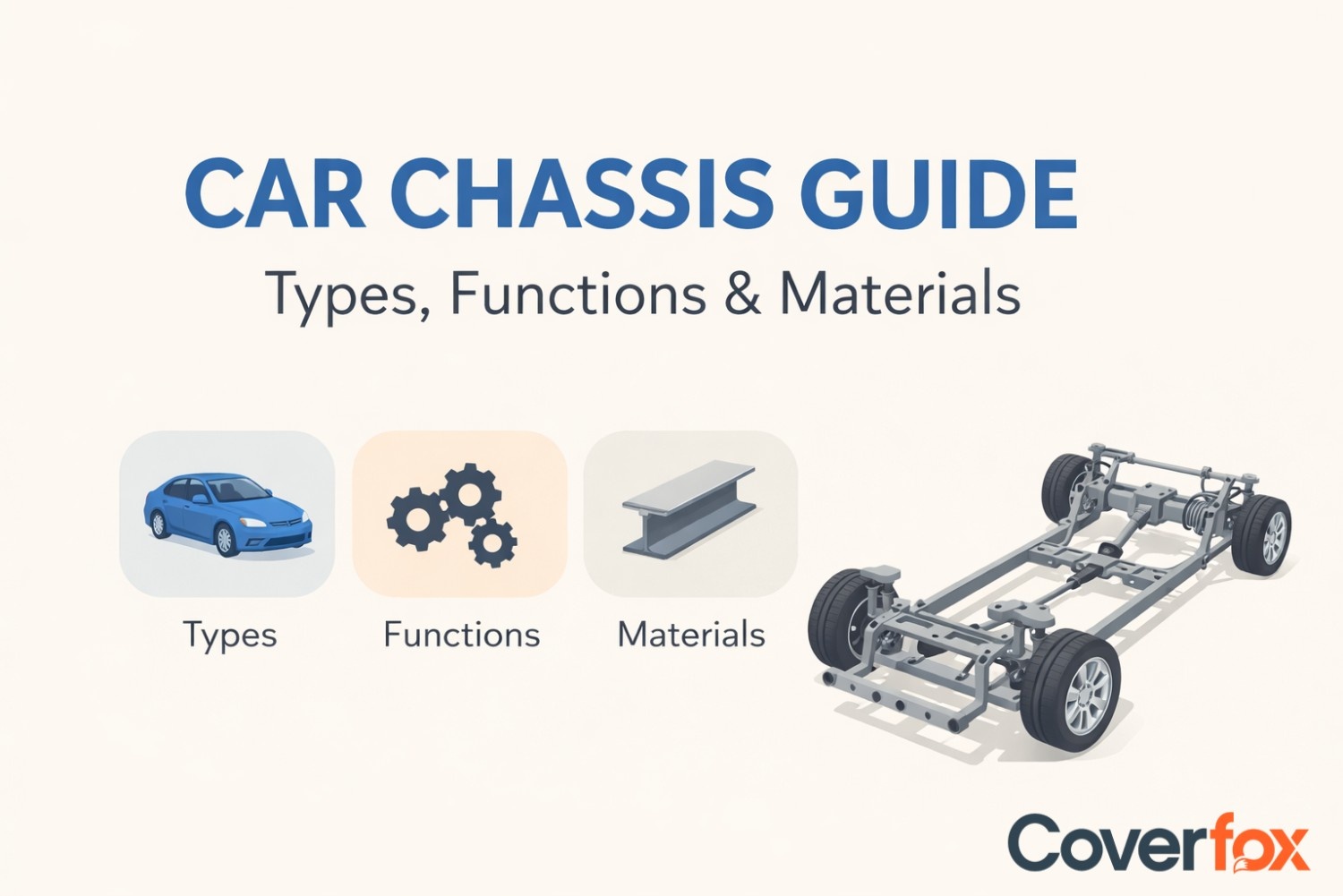
Ever wondered what the skeleton of a car is called? That’s the chassis! This crucial framework is responsible for keeping all the components of a car together, be it when idling or in motion. Knowing about the chassis is important for every car owner, as it can enhance the driving experience and maintenance.
Different cars have different types of chassis, and the guide below helps explain these in detail, along with their functions and the materials used to make them.
What is the Chassis of a Car?
Chassis meaning in simple terms, is the framework responsible for giving the required structural support to the body of the car. It bears the weight and holds all the pieces of a car together, ranging from the wheels and engine to the steering, suspension, and braking system. Not just this, it also absorbs any impact or force when driving the car.
Difference Between Chassis and Car Platform
Looking for the difference between a car chassis and a car platform? Check out the table below:
| Feature | Car Chassis | Car Platform |
|---|---|---|
| What is it? | The mainframe of the car | A shared design, structure and components used for many cars |
| What does it include? | Suspension, wheels, and frame | Chassis, engine layout, electronics, and wheel spacing |
| Is it a real part? | Yes, it’s the metal frame | Not all the time; it’s a design plan shared across models |
| How does it affect the car? | Changes strength, handling, and safety | Changes price, features, and how it drives |
| Why does it matter when buying? | Shows how solidly the car is built | Helps compare different cars and find value |
Disclaimer: The information provided above offers a simplified explanation of the differences between a car chassis and a car platform. Actual specifications, components, and engineering practices may vary across manufacturers and models. For accurate technical details, always refer to the official documentation provided by the car manufacturer or consult a qualified automotive expert.
Purpose of a Car Chassis
So, what exactly does a car chassis do? Let’s see the various functions it helps perform:
- It holds up the weight of the car.
- Provides space to attach other parts.
- Supports extra weight from passengers and luggage.
- Absorbs bumps and shocks from rough roads.
- Handles stress when the car speeds up or slows down.
Different Types of Car Chassis
After seeing the chassis' meaning and its functions, let us check out the different types of chassis:
1. Monocoque Chassis
What is it: A common type of car chassis frame, with a single shell or unibody frame, suitable for constructing modern compact SUVs, hatchbacks and sedans.
Benefits: The single-body structure makes it compact and lightweight while being budget-friendly and fuel-efficient. Offers a safer cage-like design and gives stability when taking turns.
Cons: Less off-road performance and flexibility due to a single-body structure; the combination of the frame and chassis makes the structure heavy. Repairing structural damage can also be more complex and costly, though the difficulty varies with the vehicle’s design and the extent of testing and reinforcement used.
Car Models: Most modern passenger cars, such as the Honda Civic, the Hyundai i20, the BMW 3 Series, and electric and hybrid cars.
2. Ladder Chassis
What is it: One of the oldest chassis types, it is shaped like a ladder, with two long heavy beams supported by two short beams. It is mainly used for vehicles transporting heavy loads.
Benefits: It is simple to manufacture and assemble, and has strong tensile strength.
Cons: Drivers need to pay more attention, as the car’s height may increase and ease; it may also be too heavy for performance or hatchback cars.
Car Models: Toyota Fortuner, Mahindra Thar, Ford Endeavour.
3. Backbone Chassis
What is it: True to its name, it appears like a hollow rectangular frame with a cylindrical tube (like a backbone) housing the driveshaft.
Benefits: Better axle contact for off-roading, offers a driveshaft protected by a tube, and has more flexible torsional strength than a ladder chassis.
Cons: It is pricier to produce, and driveshaft failure requires full chassis dismantling.
Car Models: Lotus Elan, Škoda Rapid, DMC DeLorean, and vintage Škoda models.
4. Tubular Chassis
What is it: This is a cage-like structure, considered the 3D version of the ladder chassis, and is stronger than it. It is commonly used in race cars.
Benefits: Offers a lightweight structure with high rigidity, making it ideal for race cars. It is also considered safer than a monocoque chassis due to its 3D structure.
Cons: A complex design, time-consuming production, and slightly harder cabin access due to raised doors. It may not be suited for mass production.
Car Models: Race cars and high-performance models like Caterham 7, TVR Griffith, off-road buggies, etc.

Comparison of Different Car Chassis Designs
Check out the table below to understand the main differences between the various chassis designs:
| Parameter | Monocoque Chassis | Ladder-on-Frame Chassis | Backbone Chassis | Tubular Chassis |
|---|---|---|---|---|
| Structure | It uses a single shell where the frame and body are integrated. | It has a separate ladder-like frame with the body mounted on top. | It features a strong central spine-like tube that holds the axles. | It is built using tubular pipes arranged as a 3D cage. |
| Weight | It is generally lightweight. | It is usually heavy. | It has a moderate weight. | It is lightweight. |
| Rigidity | It offers good rigidity, though less than ladder or tubular setups. | It provides very high rigidity. | It delivers high rigidity. | It offers extremely high rigidity. |
| Off-Roading Ability | It has poor off-road capability. | It offers excellent off-road capability. | It provides moderate off-road performance. | It delivers excellent off-road ability but is not ideal for public roads. |
| Repair Support | It is difficult to repair when structurally damaged. | It is relatively easy to repair. | It is difficult to repair due to the enclosed driveshaft. | It is difficult and costly to repair. |
| Manufacturing Cost | It has a low manufacturing cost. | It has a moderate manufacturing cost. | It is expensive to manufacture. | It is very expensive to manufacture. |
| Fuel Efficiency | It generally offers high fuel efficiency. | It typically has low fuel efficiency. | It provides moderate fuel efficiency. | It offers high fuel efficiency. |
| Safety | It provides high safety due to built-in crumple zones. | It delivers high safety because of its strong frame. | It offers moderate safety. | It provides extremely high safety in racing conditions. |
| Used In | It is common in hatchbacks, sedans, and compact SUVs. | It is used in SUVs and pickup trucks. | It appears in a few luxury or speciality cars. | It is used in racing cars and sports prototypes. |
| Example Cars | Examples include the Tata Tiago and Maruti Swift. | Examples include the Mahindra Thar and Toyota Fortuner. | Examples include the Skoda Superb and Skoda Rapid. | Examples include the Ariel Atom and Formula 1 cars. |
Disclaimer: The information provided in this comparison is based on publicly available automotive engineering references and commonly accepted industry characteristics of different chassis types. Actual performance, safety, and durability may vary depending on the vehicle manufacturer, specific model, build quality, and usage conditions. Readers should refer to official manufacturer specifications or consult a qualified automotive expert for precise technical guidance.
Parts and Structure of a Car Chassis
| Part | Description |
|---|---|
| Frame | The frame serves as the primary structure that provides support to all other parts. Types include monocoque, ladder, and backbone, with different strengths and weights. |
| Suspension System | Connects the chassis to wheels, absorbs shocks, and keeps tyres on the road for comfort and stability. |
| Steering Mechanism | Allows the driver to control direction by turning the wheels using parts like the steering column and rack & pinion. |
| Braking System | Helps stop or slow the car with parts like brake pedals, brake lines, callipers, and discs or drums. |
| Engine & Transmission Mounts | Holds the engine and transmission in place and reduces vibrations and noise for smooth power delivery. |
| Wheels and Tyres | Provide grip and handling, supported by the chassis and suspension for proper alignment and road contact. |
Common Materials Used for Car Chassis
What is the chassis of a car made up of? Take a look at the common materials used to build them:
Aluminium
Steel
Magnesium Alloys
Composites
It is light and doesn’t rust, helping save fuel and reduce pollution. It is used in parts like body panels and engine blocks, but needs careful design because it’s not as strong as steel in some spots.
The metal is rigid and tough, being used in safety cages and frames. While heavier than aluminium, new types of steel are considered lighter and still safe.
Used in racing and sports cars to speed them up; it's lighter than aluminium. It can be brittle and rust easily, so it needs protection.
Very strong and light materials, like carbon fibre, are being used in luxury and sports cars for better performance. It is considered expensive and harder to make.
Summary
Before purchasing a car, it is necessary to know the chassis to understand its structure better. Every car is manufactured differently, making the types of chassis different for cars based on their type and function. Having a clear understanding of chassis types can also help when choosing a car.
But just understanding a car’s build is not enough, as it’s equally important to protect the investment. That’s where reliable car insurance comes in to get peace of mind on Indian roads. Use IRDAI-authorised platforms, like Coverfox, that make it easy to find the right insurance by comparing car insurance policies tailored to the car's make and model.
Articles to Read:
Car Trunk vs Car Boot: Differences, Uses, and Care
Leather Car Seats vs. Fabric Car Seats: Choosing the Right Interior for Your Car
Quick Guide to Your Car's VIN, Chassis, and Engine Numbers
Frequently Asked Questions about Car Chassis
Which Indian cars use a ladder frame chassis?
Cars in India, like the Toyota Fortuner, Mahindra Thar, and Ford Endeavour, known for their off-road capabilities, use the ladder frame chassis.
What is the main drawback of a backbone chassis?
A backbone chassis can be expensive to manufacture, and repairs may require dismantling the entire frame due to the enclosed driveshaft design.
Is the chassis same as the car’s frame?
While both these terms are used interchangeably, the chassis is the entire load-bearing structure, including suspension, steering, and more, while the frame is the basic skeleton that supports the vehicle body.
Can the monocoque chassis of a car be replaced?
Replacing a monocoque chassis is difficult and expensive, and could also involve car insurance or legal issues. That is why vehicle owners need to know the legal and practical implications of such modifications well in advance.
Disclaimer: The information provided in this article is for general understanding only and may vary based on vehicle make, model, and manufacturer specifications. It should not be treated as professional automotive advice. For accurate guidance, always refer to your vehicle’s official manual or consult a certified automotive expert.