Car depreciation in India directly impacts insurance premiums, claim settlements, resale value, and tax benefits. The Insurance Regulatory and Development Authority of India (IRDAI) defines standard age-based depreciation slabs used to calculate the Insured Declared Value (IDV) of vehicles. Additionally, the Income Tax Act allows depreciation on business vehicles using the Written Down Value (WDV) method at 15% annually (for non-rental cars). Understanding depreciation helps vehicle owners make informed decisions about car insurance coverage, zero-depreciation car insurance add-ons, resale timing, and financial planning.
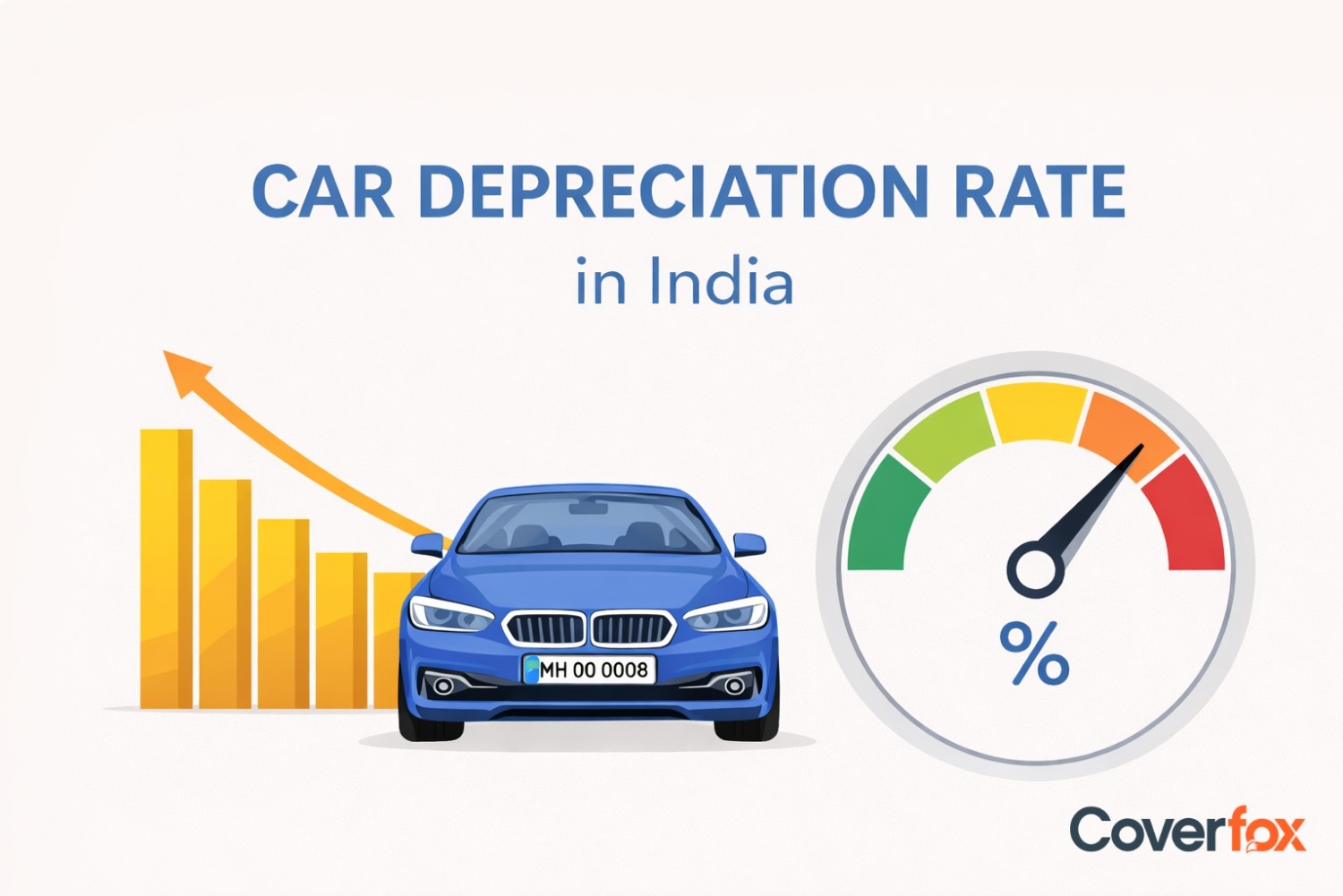
The monetary value of a vehicle decreases due to its age, usage, condition, and various driving conditions and trends in the local market. The car depreciation rate, or the rate at which vehicles depreciate, enables accurate insurance valuation, tax planning, and resale price estimation.
What is Vehicle Depreciation?
Vehicle depreciation is a systematic decrease in the value of a car from the date of purchase until disposal. Some of the reasons for the decrease can be attributed to physical wear and market forces. As a result, insurers calculate the Insured Declared Value (IDV) of a car by applying depreciation rates to its original price based on how old the vehicle is. The IDV also indicates the maximum that an insurer would have to pay for a total loss and/or theft of the vehicle.
How is the Vehicle Depreciation Rate Calculated?
Depreciation of vehicles, especially in the area of insurance, is determined by fixed age-based slabs as defined by the IRDAI (Insurance Regulatory and Development Authority of India). These are determined by how old the vehicle is, and each slab has a percentage of reduction in value that corresponds with the vehicle's age.
IRDAI Standard Depreciation Slabs
Here are the IRDAI standard depreciation slabs showing how a car’s value decreases with age, affecting insurance IDV and claim settlements.
| Age of Vehicle | Depreciation Rate (%) |
|---|---|
| Up to 6 months | 5% |
| 6 months – 1 year | 15% |
| 1–2 years | 20% |
| 2–3 years | 30% |
| 3–4 years | 40% |
| 4–5 years | 50% |
| 5–7 years | ₹13 lakh approx |
| Above 7 years | 60% (Negotiate) |
What is the Timeline of Car Value Depreciation?
Depreciation of a car in India begins immediately after it is registered and put to use. It is a common practice for a car to depreciate immediately when driven out of the dealership, even though it's new at that moment. When using an insurance company to determine the value of a vehicle under IRDAI guidelines, the first tier of IRDAI depreciation is less than six months. All vehicles depreciate on a percentage basis every six months, including new cars, after being driven.

Key Factors Affecting Car Value Over Time
Several determinants influence the depreciation of a car in India, such as
Age of Vehicle:
Mileage:
Condition and Maintenance:
Brand and Model Demand:
Fuel Type and Efficiency:
Economic Factors and Market Trends:
As the car gets older, it will lose more value than a newer model.
Generally, high miles will depreciate an automobile faster than low miles.
Well-maintained vehicles retain value comparatively better.
Established, reputable brands tend to depreciate less due to their strong resale markets.
Cars that run on alternative fuels or are more fuel-efficient are often able to keep their original value longer than gas-powered vehicles.
When consumer preferences change, they can also affect resale prices.
Impact of Car Depreciation Rate on Vehicle Owners
Car depreciation directly affects vehicle owners by influencing insurance claims, resale value, and loan or financing decisions.
1. Car Insurance Claims:
A decrease in value due to depreciation means that the amount of insurance paid for a total loss will be lower.
2. Resale Value:
If you have depreciated your car at a greater rate of depreciation, the resale value will be lower.
3. Loan and Finance Decisions:
Lenders may consider depreciation when valuing a car for financing.
Depreciation and Its Effect on Insurance Claims
In a comprehensive auto policy, the insurer will compensate the insured for an accident based on the payout amount, minus any deductions for depreciation. Depreciation is applied to replaced parts, like rubber, plastic, and stainless steel, based on how long the vehicle has been in service and what type of material it is made of. The sum insured under an auto policy is determined by the vehicle depreciation rate and income tax, which is established by the IRDAI depreciation slabs.
There are car insurance add-ons available for comprehensive car insurance policies, "Zero Depreciation" or "Bumper to Bumper", that eliminate the impact of depreciation on the amount paid by the insurer for replacement parts.
Vehicle Depreciation Under Income Tax
The Income Tax Act permits the deduction of depreciation on any business vehicle, including automobiles. Depreciation rate on a car as per income tax is calculated using the written-down value (WDV) method. For the 2025-26 fiscal year, the standard depreciation rate for a non-rental car is 15% of its WDV per year.
Tax Depreciation Example (WDV):
If a car is purchased for ₹10,00,000, its depreciation in the first year is ₹1,50,000 (15%). This declines over subsequent years as the WDV reduces.
How to Minimize Vehicle Depreciation Rate?
Depreciation cannot be eliminated, but certain approaches can help slow down value loss:
Maintain comprehensive service records.
Adhere to the manufacturer’s servicing schedules.
Avoid excessive mileage without necessity.
Protect the vehicle from damage (e.g., covered parking).
Choose cars with historically strong resale values based on market data.
Summary
The rate of depreciation on vehicles is an indication of the decrease in monetary value of a vehicle over time, based on usage and age, as well as the ever-changing marketplace. IRDAI has established standard depreciation slab rates that provide a uniform means of determining the insured declared value (IDV) for insurance purposes. The Income Tax Act provides different car depreciation rates for tax purposes. Using a car depreciation calculator can help vehicle owners estimate depreciation accurately. Therefore, knowledge of these rates will help in making informed decisions regarding financial planning for insurance, resale, and taxation purposes.
Explore More Articles:
How Depreciation Factor Impacts Car Insurance Claims?
How Zero-Depreciation Car Insurance Can Benefit You?
Frequently Asked Questions
What is the average depreciation rate for a new vehicle?
The average depreciation of a new automobile is estimated to be 15 to 20% (of its value) in the first year. By the end of the 5th year, total depreciation can be approximately 50% under the IRDAI depreciation.
Does third-party insurance cover depreciation?
Third-party insurance does not consider depreciation for liability coverage; depreciation is relevant in own-damage coverage calculations.
How does vehicle depreciation impact insurance claims?
Depreciation reduces the IDV, so the value of claim settlements for damage to the vehicle or for a total loss of the vehicle, unless someone purchases a policy with zero depreciation cover.
Is it better to buy a new or used car, considering depreciation?
Used vehicles usually provide more value because of all of the initial depreciation that has occurred already, especially if the vehicle is well-maintained and has lower mileage.
Disclaimer: The information provided in this article is for general informational and educational purposes only. Depreciation rates, insurance calculations, and tax provisions mentioned are based on publicly available guidelines and may change as per updates issued by the Insurance Regulatory and Development Authority of India (IRDAI) or amendments under the Income Tax Act. Insurance policy terms, conditions, inclusions, exclusions, and claim settlements vary across insurers. Readers are advised to verify details with their insurer, financial advisor, or tax consultant before making decisions related to insurance coverage, vehicle purchase, or taxation. This website does not provide tax or legal advice.