As an initiative to curb the rising pollution levels, the Indian Government has made it mandatory to obtain a PUC or Pollution Under Control Certificate for your vehicles, whether new or old.
This certificate is crucial to authenticate whether an Internal Combustion Engine (ICE) vehicle meets the required carbon emission level as prescribed by the Ministry of Road Transport and Highways (MoRTH). Just as you need to carry a driving licence and a car insurance policy with you, similarly, it is also necessary to carry a PUC certificate. If you are thinking of purchasing a new car, the guide below is helpful for explaining the basics and all you need to know about getting, renewing, and staying legal with your pollution certificate for a new car.
What is a PUC certificate?
Under the Central Motor Vehicles Act of 1988, a PUC (Pollution Under Control) Certificate is issued to all vehicles to check whether their emission levels are within the permissible limits. This certificate is obtained after inspection and verification are conducted at an authorized emission centre. The purpose of this is to control pollution levels, thereby minimizing environmental impact. Places where emission testing can be conducted:
RTO Offices
Fuel stations
Private testing centres

Why is a PUC certificate important?
There are multiple reasons why you need a PUC validity certificate for a new car or even an existing car. These include:
To follow the law
Helps keep your vehicle in check
To protect the environment
Having a valid PUC certificate means you are following the rules made under the Motor Vehicles Act. Without it, you could face fines or even jail.
Regular PUC tests help you know if your car’s pollution is within safe limits. This helps you fix problems before they get worse.
By keeping your vehicle’s emissions low, you help reduce air pollution and keep the environment clean.
Is a PUC Certificate Mandatory for Vehicle Insurance?
On 6th July, 2018, the Insurance Regulatory and Development Authority of India (IRDAI) issued a circular, conveying the directive of the Hon’ble Supreme Court to all General Insurance companies to ensure that the vehicle must have a valid PUC certificate at the time of motor insurance renewal. This instruction was later restated through another circular on 20 August 2020.
However, some media reports incorrectly stated that if a vehicle does not have a valid PUC certificate at the time of an accident, the insurance claim will not be paid. To clarify, the absence of a valid PUC certificate is not a valid reason for rejecting any claim under a motor insurance policy.
How long is a PUC certificate valid?
When it comes to PUC Certificate validity, it applies to both new and old cars.
For old cars
For new cars
The PUC certificate for older cars is valid for six months only, which means after the first year of buying the car, you need to get your car’s emissions tested every six months to get a new PUC certificate. Sometimes, if pollution levels are high, the certificate may be valid for less than six months and needs earlier renewal.
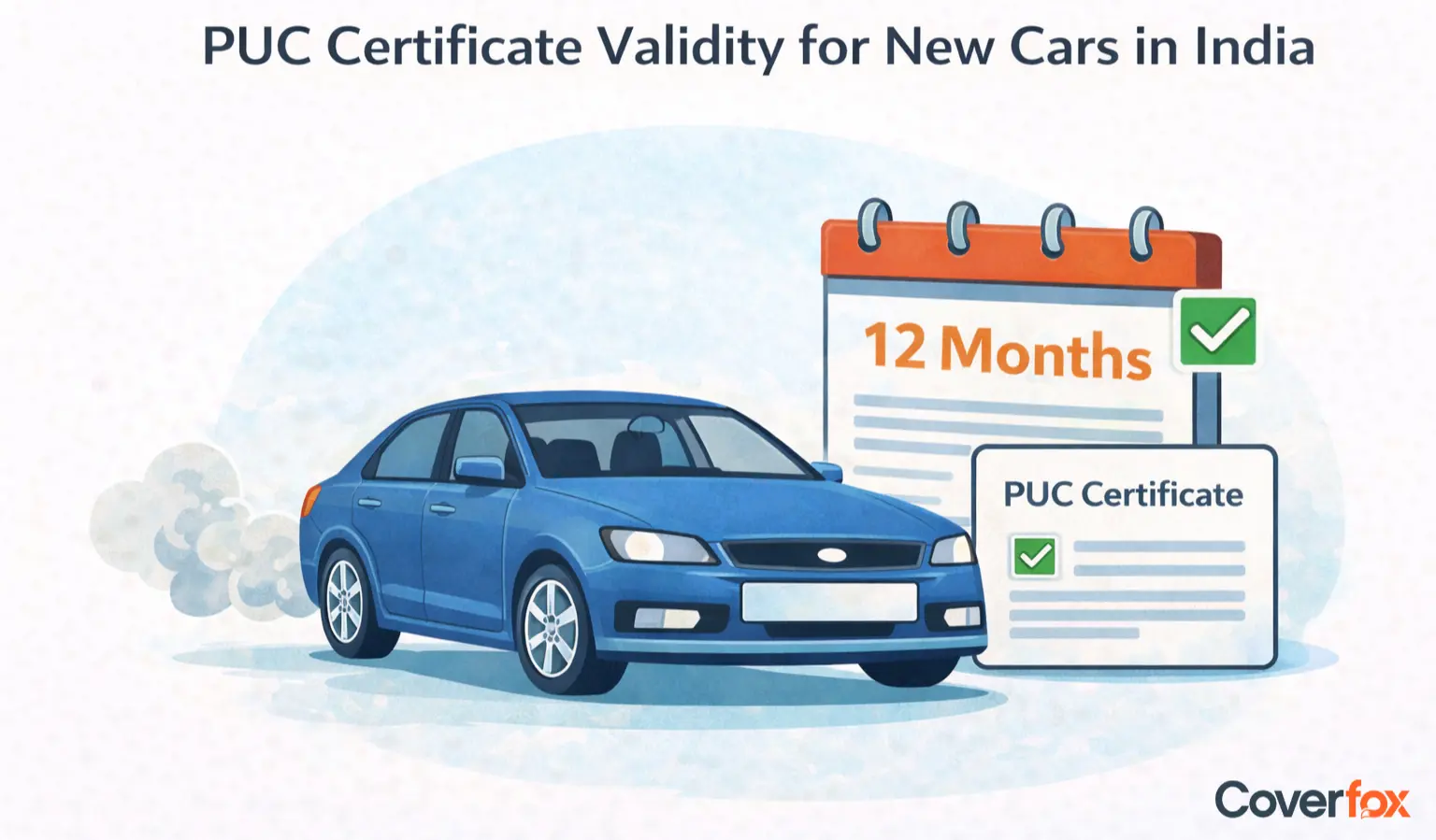
The pollution certificate for a new car is valid for one year from the date of issuance. Then, after a year, regardless of your vehicle type, you must get a new PUC certificate every six months.
What details are mentioned in a PUC certificate?
Here is the list of key details mentioned in your PUC certificate:
| Component | What It Means |
|---|---|
| Certificate Number | A unique number used to identify, verify, and track the emission certificate. |
| Car Details | Includes the engine number, chassis number, and vehicle registration number. |
| Emission Test Results | Displays pollution levels such as smoke density, hydrocarbons, and carbon monoxide recorded during the test. |
| Testing Centre Information | Details of the authorised centre where the vehicle emission test was conducted. |
| Owner Details (if needed) | Name and address of the vehicle owner, included when required. |
| Validity Dates | Shows the start date and expiry date of the emission certificate. |
Steps on How To Get Your PUC Certificate?
Follow these simple steps to obtain the new car Pollution Validity Certificate:
Take your car to an emission test centre, with these centres being at many fuel stations and in special approved labs with computers.
The expert at the centre will check your car’s exhaust for pollution levels. Each state has its own limits.
If your car passes, the expert will create your PUC certificate.
Pay the fee, usually between ₹60 and ₹100, and get your certificate.
If your car does not pass, you will get a rejection slip, and you must fix the problem and try again.
How to Download PUC Certificate Online?
Go to the Parivahan website (Ministry of Road Transport and Highways).
Click on "PUC Certificate".
Enter your vehicle’s registration number, the last 5 characters of the chassis number, and the code.
Click on "PUC Details" to check the certificate and expiry date.
Go ahead and download or print your PUC certificate.
What Kinds of Emission Tests Are Done for Cars?
Here are the different emission tests conducted to obtain a PUC for a new car:
| Type of Emission Test | What It Measures and Why It Matters |
|---|---|
| Carbon Monoxide (CO) | A colourless and odourless gas produced when fuel does not burn completely. High levels are dangerous to human health and contribute to air pollution. |
| Hydrocarbons (HC) | Organic gases released due to fuel evaporation and incomplete combustion. They contribute to smog formation and negatively impact health and the environment. |
| Nitrogen Oxides (NOx) | Gases formed during high-temperature combustion in engines. They cause air pollution and can lead to respiratory problems. |
| Non-Methane Hydrocarbons (NMHC) | A specific group of hydrocarbons used to measure smog-forming pollutants and assess a vehicle’s impact on air quality. |
| Evaporative Emissions (EVAP) | Fuel vapours that escape from the fuel system into the atmosphere. Controlling EVAP emissions is essential to reduce urban air pollution. |
What are the Permissible Vehicle Emission Limits in India?
1. For New Vehicles
| Vehicle Type | Carbon Monoxide (%) | Hydrocarbon (PPM) |
|---|---|---|
| BS4 / BS6 Petrol Vehicles | 0.3 | 200 |
| BS4 / BS6 Diesel Vehicles | 0.5 | 500 |
2. For Old Vehicles
| Vehicle Type | Carbon Monoxide (%) | Hydrocarbon (PPM) |
|---|---|---|
| Pre-BS II Vehicles | 3 | 1500 |
| Post-BS II Vehicles | 0.5 | 750 |
Disclaimer: Emission norms may vary by state and depend on vehicle condition, testing equipment, and updated government guidelines. Always check the latest PUC norms from your local RTO or certified emission testing centre.
What happens if you don’t have a valid PUC certificate?
As per Section 190(2) of the Central Motor Vehicles Act of 1988, it is mandatory to have a valid PUC certificate for your car. In case you are found without one, you can face the following consequences:
You may be fined ₹1,000 the first time, and ₹2,000 if you break the rule again. In some cases, you could even go to jail for up to 3 months.
There is a chance of your vehicle being seized by the authorities if you are found with a PUC certificate that is not valid.
You need a PUC certificate to renew your car insurance. Without it, your insurance may be delayed or refused.
Cars without a PUC certificate can make air pollution worse. When you keep your PUC certificate up to date, you help keep the air cleaner.
Conclusion
In all, owning a PUC for a new car is crucial, as it maintains legal obligations and reduces environmental impact. Do not forget to renew your certificate on time to avoid any kind of hassles later on, which could include fines, losing insurance, or even losing your vehicle itself.
A PUC certificate is just as important as your driving licence and car insurance policy. To purchase car insurance online seamlessly, head to Coverfox and choose from a wide range of policies, helping compare premiums, benefits and add-ons instantly!
Also Read:
Disclaimer: The information provided in this blog is for general awareness purposes only and is based on publicly available guidelines at the time of writing. Rules regarding PUC certificates, emission norms, fines, and insurance requirements may change as per government updates or state-specific regulations. Readers are advised to verify details with their local RTO, official government portals, or authorized emission testing centres before taking any action.
Frequently Asked Questions on New Car PUC
What does a PUC certificate mean for a vehicle?
A PUC (Pollution Under Control) certificate is issued to ensure your vehicle’s emissions are within the permissible limits as set by the Indian Government.
When should I renew my PUC certificate for a new car?
The new car pollution validity lasts for a year, so after that, it needs to be renewed every six months.
Where can I get my car’s PUC certificate?
You can get your PUC certification done at any authorised emission testing centres, including RTO offices, fuel stations, and private testing centres. Then, go ahead and download the certificate through the Parivahan portal.
What if I don’t have a valid PUC certificate?
In case you have an invalid pollution certificate for a car, you risk being fined, losing your insurance, or even having your vehicle seized. In some cases, it may even end up in imprisonment.
How can I check my PUC certificate’s validity?
You can enquire from the emission testing centre, or simply look at the PUC certificate for the expiry date mentioned.