MPFI and carburettor engines differ in fuel delivery, with MPFI using precise electronic injection while carburettors rely on mechanical mixing. Both have their pros and cons, where MPFI offers better efficiency and performance, while carburettors are simpler and easier to maintain. MPFI is now the standard in modern vehicles, as carburettor engines are no longer used due to stricter emission norms
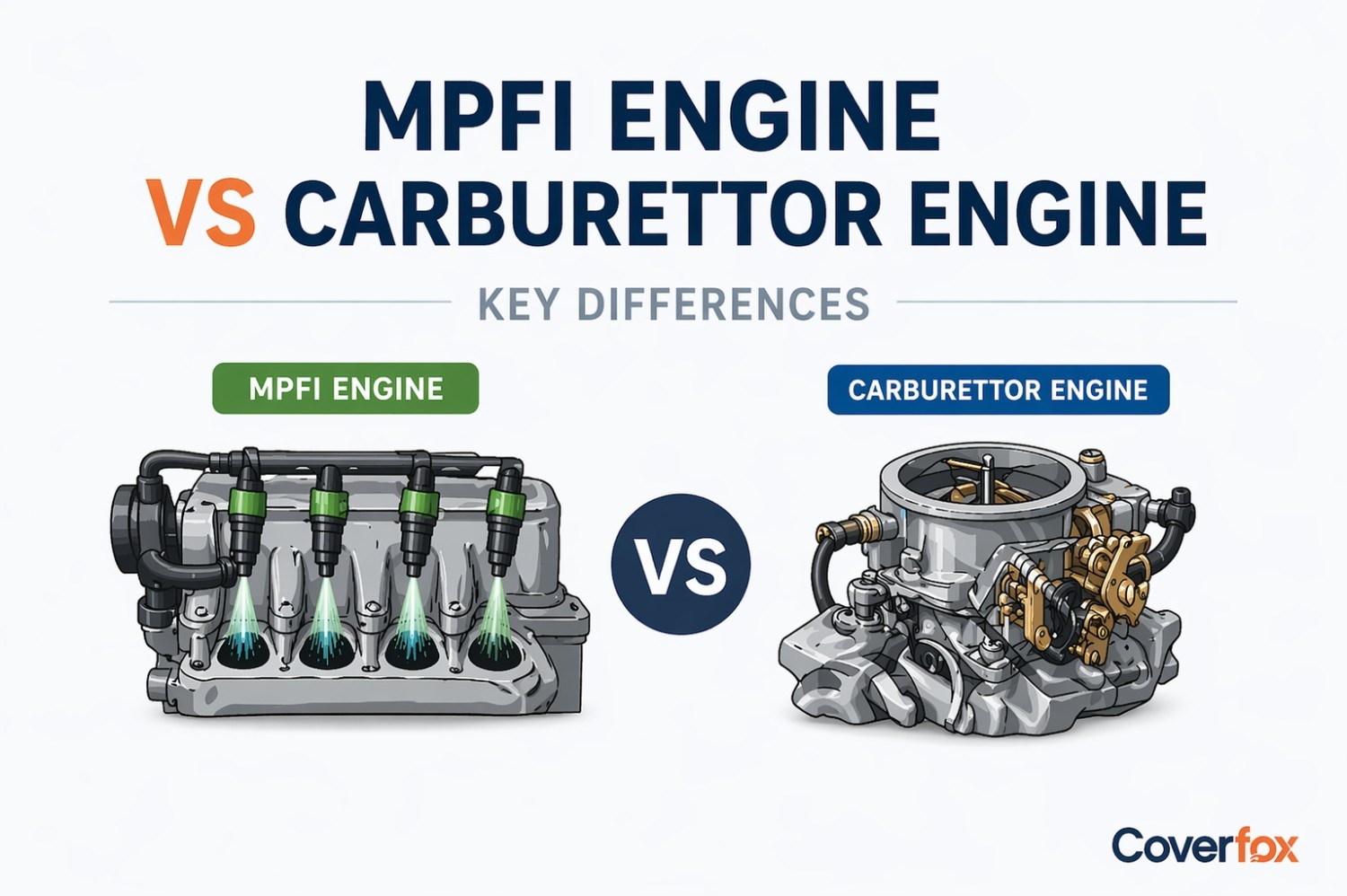
Over the years, constant progress has been made in the automobile industry. One such upgrade was from the traditional carburettor engines to the multi-point fuel injector engines. The new MPFI engines have revolutionised the combustion system of a car. Let us know more about the differences between MPFI and Carburettor engines, how each of them functions, and what their pros and cons are.
What is an MPFI Engine?
A Multi-Point Fuel Injection (MPFI) engine uses separate fuel injectors for each cylinder to deliver fuel accurately. It is controlled by an electronic control unit (ECU), which monitors various engine parameters to optimise the air-fuel mixture. This results in better fuel efficiency, improved performance, and lower emissions compared to traditional carburettor systems.
Fun fact: The concept of fuel injection was pioneered by Bosch, which played a key role in developing modern MPFI systems used in today’s cars.
Key Components of the MPFI Engine
Fuel Injectors: Spray fuel directly into each cylinder in controlled amounts
Fuel Pump: Delivers fuel from the tank to the injectors at high pressure
Electronic Control Unit (ECU): Acts as the brain, controlling fuel injection based on sensor data
Sensors: Monitor parameters like air intake, temperature, and engine load to assist the ECU
Fuel Rail: Distributes fuel evenly to all injectors
What is a Carburettor Engine?
A carburettor engine uses a mechanical device called a carburettor to mix air and fuel before it enters the engine cylinder. It operates based on air pressure differences and does not rely on electronic controls. This system was widely used in older vehicles and is known for its simple design and ease of maintenance, though it lacks precision compared to modern fuel injection systems.
Fun fact: Carburettors were the standard fuel system in cars for nearly a century before fuel injection systems gradually replaced them due to stricter emission norms.
Key Components of Carburettor Engine
Venturi: A narrow passage that increases air speed, helping draw fuel into the airflow
Float Chamber: Maintains a constant level of fuel to ensure a consistent supply
Throttle Valve: Controls the amount of air-fuel mixture entering the engine, regulating speed and power
Choke: Restricts airflow to enrich the fuel mixture during cold starts

What are the Key Differences Between MPFI vs Carburettor Engine?
MPFI and carburettor engines differ mainly in how they deliver fuel, impacting performance, efficiency, and emissions.
| Parameter | MPFI Engine | Carburettor Engine |
|---|---|---|
| Fuel Delivery | Uses electronic fuel injectors for precise delivery | Uses a mechanical carburettor to mix air and fuel |
| Control System | Controlled by the ECU and sensors | No electronic control, purely mechanical |
| Fuel Efficiency | Higher due to accurate fuel injection | Lower due to less precise mixing |
| Performance | Better throttle response and smoother performance | Slower response and less refined performance |
| Emissions | Lower emissions, meets modern norms | Higher emissions, less eco-friendly |
| Maintenance | More complex, requires skilled servicing | Simpler and easier to repair |
| Cold Start | Easier due to ECU adjustments | Requires choke for cold starts |
| Cost | Higher initial cost | Lower initial cost |
How Do MPFI and Carburettor Engines Differ in Fuel Delivery?
The key difference between MPFI and carburettor engines lies in how precisely fuel is mixed with air before combustion.
MPFI engines use multiple fuel injectors, one for each cylinder, to spray fuel into the intake port in controlled amounts. This process is managed by an Electronic Control Unit (ECU), which adjusts fuel delivery based on engine speed, load, and temperature, ensuring efficient and consistent combustion.
Carburettor engines rely on a mechanical carburettor that mixes air and fuel using airflow and pressure differences. The fuel flow depends on fixed settings, which can result in uneven mixing and lower efficiency. In simple terms, MPFI offers precise, electronically controlled fuel delivery, while carburettor engines use a basic mechanical method for mixing air and fuel.
Pros and Cons of MPFI Engines
| Pros | Cons |
|---|---|
| Better fuel efficiency | Higher initial cost |
| Smoother performance | Complex system |
| Lower emissions | Costly repairs |
| Easy cold start | Needs skilled servicing |
Pros and Cons of Carburettor Engines
| Pros | Cons |
|---|---|
| Simple design | Lower fuel efficiency |
| Low maintenance cost | Higher emissions |
| Easy to repair | Poor fuel-air precision |
| No electronics needed | Harder cold start |
Car Insurance for Your MPFI or Carburettor Engine
While both types of engines have their own sets of merits and demerits, car insurance does not cover engine damage (unless damaged in an accident). You should buy engine protection cover for your MPFI engine or Carburettor engine, so that you will be completely protected without any surprises.
To Conclude - Which One Should You Choose?
The choice between an MPFI and a carburettor engine depends on your priorities and usage.
If you prefer better fuel efficiency, smoother performance, and lower emissions, an MPFI engine is the better and more future-ready option.
If you value simplicity and lower maintenance, carburettor engines were once a practical choice, but they are no longer used in modern vehicles due to stricter emission norms.
Overall, MPFI engines are the standard in today’s vehicles, offering better efficiency, compliance, and performance for modern driving needs.
More Articles to Read:
Multi Point Fuel Injection (MPFI) in Vehicles
Engine Control Module (ECM) Failure: Signs, Diagnosis, Repair and Replacement Costs
What Is a Car Differential and How Does It Work?
Frequently Asked Questions
What type of fuel is required in an MPFI engine?
MPFI engines use standard petrol as fuel. Since fuel delivery is electronically controlled, they are designed to work efficiently with regular petrol, though some engines may perform better with higher-octane fuel depending on manufacturer specifications.
Are carburettor engines still used in modern vehicles?
No, carburettor engines are no longer used in modern cars due to stricter emission norms. Most manufacturers have shifted to fuel injection systems like MPFI to meet efficiency and environmental standards.
Which engine uses a carburettor?
Carburettors were commonly used in older petrol engines, especially in vehicles manufactured before the widespread adoption of fuel injection systems. Today, they are mostly found in older cars, small engines, or certain two-wheelers.
Which engine type offers better fuel efficiency: MPFI or carburettor?
MPFI engines offer better fuel efficiency because they deliver fuel precisely based on engine conditions. Carburettor engines, on the other hand, use a fixed mechanical system, which leads to less efficient fuel consumption.
Can a carburettor engine be converted into an MPFI engine?
While technically possible, converting a carburettor engine to MPFI is complex and expensive. It requires significant modifications, including installing an ECU, fuel injectors, sensors, and wiring, making it impractical in most cases.
Can a carburettor be better than fuel injection?
Carburettors are simpler and easier to repair, which can be an advantage in basic or low-cost applications. However, in terms of performance, efficiency, and emissions, fuel injection systems like MPFI are far superior.
What type of fuel does an MPFI engine require?
MPFI engines require petrol and are optimised for consistent fuel delivery using electronic controls. The system ensures better combustion compared to carburettor engines.
Do MPFI engines provide better performance than carburettor engines?
Yes, MPFI engines provide better performance due to precise fuel injection, improved throttle response, and more efficient combustion. This results in smoother driving and enhanced overall engine performance.