Paddle shifters are small levers mounted behind the steering wheel that let drivers change gears manually without a clutch pedal. Originally designed for Formula 1 race cars, paddle shifters have found their way into mainstream vehicles. Today, a family SUV or a sporty hatchback can offer the same gear-shifting thrill that was once exclusive to professional drivers on a racetrack.
So, whether someone is overtaking on a highway or struggling through traffic, paddle shifters add a layer of control and excitement that a regular automatic car cannot offer. This guide breaks down everything a driver needs to know, from how they work to which Indian cars carry paddle shifters.
What Are Paddle Shifters In A Car?
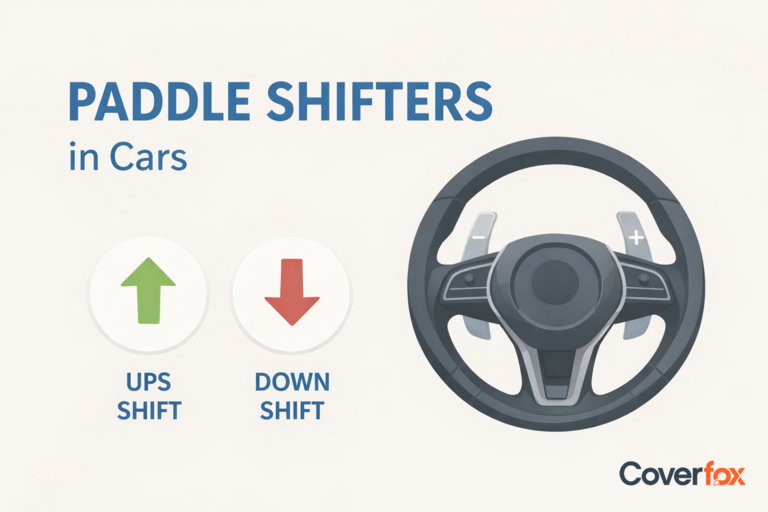
Paddle shifters in cars are two flat levers placed just behind the steering wheel, one on each side. The right paddle, marked +, moves the car up a gear. The left paddle, marked −, lowers it.
The best part? No clutch pedal. No gear stick. Just a quick finger pull, and the car responds instantly.
Unlike a full manual transmission, the driver does not have to manage the clutch. The car handles that automatically. This means the driver gets the control of a manual gearbox with the ease of an automatic car.
How Do Cars with Paddle Shifters Work?
Every time a driver pulls a paddle, a signal is sent to the car's Electronic Control Unit (ECU). The ECU then tells the transmission to shift either up or down within a fraction of a second.
The process is fast, smooth, and completely hands-on. In many cars, if the driver stops using the paddles for a few seconds, the car quietly switches back to full automatic mode on its own.
Types of Transmissions That Use Paddle Shifters
Paddle shifters are not tied to just one type of gearbox. They work across several transmission types:
Dual-Clutch Transmission (DCT):
Torque Converter Automatic (AT):
Automated Manual Transmission (AMT):
It is the fastest-shifting option. Common in performance-oriented cars such as the Volkswagen Virtus GT and the Hyundai i20 N Line.
This type is the most common one, and it is common in mainstream SUVs and sedans. Continuously Variable Transmission (CVT): By emulating gear transitions, it makes the driving experience more lively and sportier.
This option is the most affordable choice on the market and is available in the Tata Nexon and Maruti Baleno, which are entry-level Indian cars.

Best Paddle-Shift Cars in India (2026)
Here is a look at the top paddle-shifter cars available across different budgets in India:
| Car | Transmission | Segment | Approx. Price (Ex-showroom) |
|---|---|---|---|
| Maruti Suzuki Baleno AMT | AMT | Hatchback | ₹9.00 lakh onwards |
| Tata Nexon AMT | AMT | Entry SUV | ₹9.99 lakh onwards |
| Hyundai i20 N Line DCT | DCT | Sporty Hatchback | ₹13.45 lakh onwards |
| Volkswagen Virtus GT DSG | DSG (DCT) | Sedan | ₹15.96 lakh onwards |
| Skoda Kushaq DSG | DSG (DCT) | Compact SUV | ₹16.49 lakh onwards |
| Hyundai Creta 1.5 Turbo DCT | DCT | Mid-Size SUV | ₹17.99 lakh onwards |
| Kia Seltos 1.5 Turbo DCT | DCT | Mid-Size SUV | ₹18.99 lakh onwards |
| MG Hector DCT | DCT | Full-Size SUV | ₹19.99 lakh onwards |
| BMW 3 Series | 8-Speed AT | Premium Sedan | ₹57.90 lakh onwards |
| Mercedes-Benz C-Class | 9-Speed AT | Luxury Sedan | ₹61.00 lakh onwards |
Note: Prices are indicative and subject to change. Readers are advised to confirm current pricing with respective dealerships.
Why Are Paddle Shifters Important?
Paddle shifters make driving more fun. Nevertheless, they hold some serious practical value as well.
1. More effective control when overtaking:
Just before overtaking, if the driver downshifts, the driver gets the power instantly without the car reacting quickly.
2. Downhill roads can be safer:
Rather than just applying brakes on a slope, if the driver downshifts, speed can be controlled by engine braking, which is a very natural way.
3. Fuel is utilised wisely:
Paddle shifters help one be more economical with fuel consumption. With the driver wanting to keep the engine running at a good air/fuel mixture, the gearbox hunts the right gear more quickly, so the driver gets more mileage per litre.
4. Gear up for performance at all times:
Sharper responses to the throttle inputs and a very dynamic driving experience without any manual transmission whenever Sport Mode is combined with paddle shifters.
5. Meticulous Driving on Track Days:
For those who love not only performance driving but also track experiences, paddle shifters offer complete gear selection at every corner, something full automatic mode does not.
Practical Use and Recommendations
Paddle shifters work best in specific situations. Here is when to use them:
Highways: Pull the right paddle before a long overtake to build revs quickly.
Hill descents: Use the left paddle to downshift and let the engine slow the car naturally.
Spirited driving: Keep the car in the right gear through corners for a more engaging drive.
What to avoid: do not use paddles constantly in city traffic. Repeated manual shifts in bumper-to-bumper conditions add no benefit and can actually increase fuel consumption.
The Future of Paddle Shifters in India
The direction is clear. Automatic cars are taking over, and paddle shifters are becoming part of that growth story.
In India, manufacturers are already responding. Paddle shifters are now appearing in entry-level variants, not just premium ones. As buyers become more aware of driving dynamics, this feature will shift from a luxury add-on to a standard expectation. India's automatic transmission market has recorded a compound annual growth rate (CAGR) of 19.61% between 2020 and 2024, one of the strongest growth trajectories in the automotive sector. That growth is not slowing down either. CRISIL, one of India's most respected analytics firms, projects that the share of automatic transmissions in new passenger vehicle sales will rise to 40–45% by fiscal year 2028.
Several forces are driving this shift simultaneously. Rising disposable incomes, worsening urban traffic conditions, and a younger buyer demographic that values convenience and technology are all pushing demand upward.
The manufacturers, too, are coming up with ideas to match customers' enthusiasm. For instance, paddle shifters, which were previously the preserve of very high-end or premium models, are now included in even the entry-level models of the most popular hatchbacks and compact SUVs. Maruti Suzuki, Tata Motors, and Hyundai are some of the companies that have made their products feature this widely so that first-time car buyers can also have access to this feature.
What About the Paddles in EVs, Plug-in Hybrids and Regular Hybrids?
In electric and hybrid cars, paddle shifters are used for something else altogether. In these cars, the suspension of a conventional gearbox has been done away with, and hence the paddles are not only for gear changing; they also allow one to control regenerative braking, which recovers energy during braking and charges the battery simultaneously.
The left paddle increases the braking effect, thereby slowing the car. At the same time, the battery is getting recharged. On the other hand, the right paddle does the opposite, allowing the car to move more freely or coast with reduced resistance. Some EVs available in India, including the Tata Nexon EV and MG ZS EV, offer multiple regenerative braking levels, giving the driver genuine control over both energy recovery and driving feel.
In hybrid vehicles, the function varies by model. Some like the Toyota Camry Hybrid, which blends gear selection with regenerative braking control via the same paddles. Others manage regeneration automatically, leaving the paddles purely for gear changes.
For Indian EV buyers, this feature carries real practical value. Using regenerative braking effectively through the paddles can noticeably extend range on a single charge, which remains a top priority for most EV buyers in the country.
Bottom Line
Paddle shifters bring a perfect mix of control, comfort, and performance to modern cars, making driving more engaging across city roads and highways. As more Indian cars adopt this feature, it is becoming a standard part of automatic driving. However, like any advanced component, proper maintenance and timely servicing are important for long-term reliability. It’s also wise to protect your vehicle with a good car insurance poicy to cover unexpected repairs and ensure complete peace of mind.
Related Articles:
DCT vs CVT : Which Transmission Is Better for Your Car?
Cruise Control and Adaptive Cruise Control in a Car
What is a Propeller Shaft in Cars?
Frequently Asked Questions
1. Which Indian car has a paddle shifter?
Several popular models in India feature paddle shifters, including the Tata Nexon AMT, Hyundai i20 N Line DCT, Kia Seltos Turbo DCT, Volkswagen Virtus GT, and the MG Hector, among others.
2. Are paddle shifters considered automatic or manual?
Paddle shifters are found on automatic or semi-automatic vehicles. While they allow manual gear selection, there is no clutch pedal, so the car is still classified as an automatic.
3. What is the purpose of paddle shifters in a car?
They give the driver direct control over gear changes without a clutch. This improves overtaking performance, enables engine braking on descents, and makes driving more engaging overall.
4. Which car or SUV is equipped with paddle shifters?
A wide range of vehicles offer this feature, from the Tata Nexon and Kia Seltos to the Hyundai Creta, Volkswagen Taigun, Skoda Kushaq, BMW X1, and Mercedes-Benz GLC.
5. Which 3 Series has paddle shifters?
Every BMW 3 Series variant sold in India, including the 320Ld, 330i, and M340i, comes with paddle shifters as standard, paired with an 8-speed Steptronic automatic transmission.
6. Which is the cheapest car with paddle shifters?
As of 2025, the Tata Nexon AMT and Maruti Suzuki Baleno AMT are among the most affordable options, with prices starting around ₹9–10 lakh (ex-showroom).
7. When should I use paddle shifters?
Use paddle shifters during highway overtakes, steep downhill drives, or whenever you need more direct control over acceleration and engine response. Avoid constantly using them in city traffic for the best efficiency.
Disclaimer: The information provided in this article is for general informational and educational purposes only. Vehicle features, specifications, and prices mentioned are indicative and may vary based on location, variant, and manufacturer updates. Readers are advised to verify details with authorized dealerships or official brand sources before making any purchase decisions. This content does not constitute financial, automotive, or insurance advice. For vehicle insurance-related information, coverage, and policy terms, please refer to the respective insurer’s policy documents or consult a certified insurance advisor.