If you bought the car insurance policy from Coverfox, contact us on help@coverfox.com or through 022 4897 1018 on call. If the policy purchase was done directly through an insurer, contact the respective support team. In case the support team do not resolve the issue, you can further escalate the issue with the grievance officer, insurance ombudsman or to consumer court.
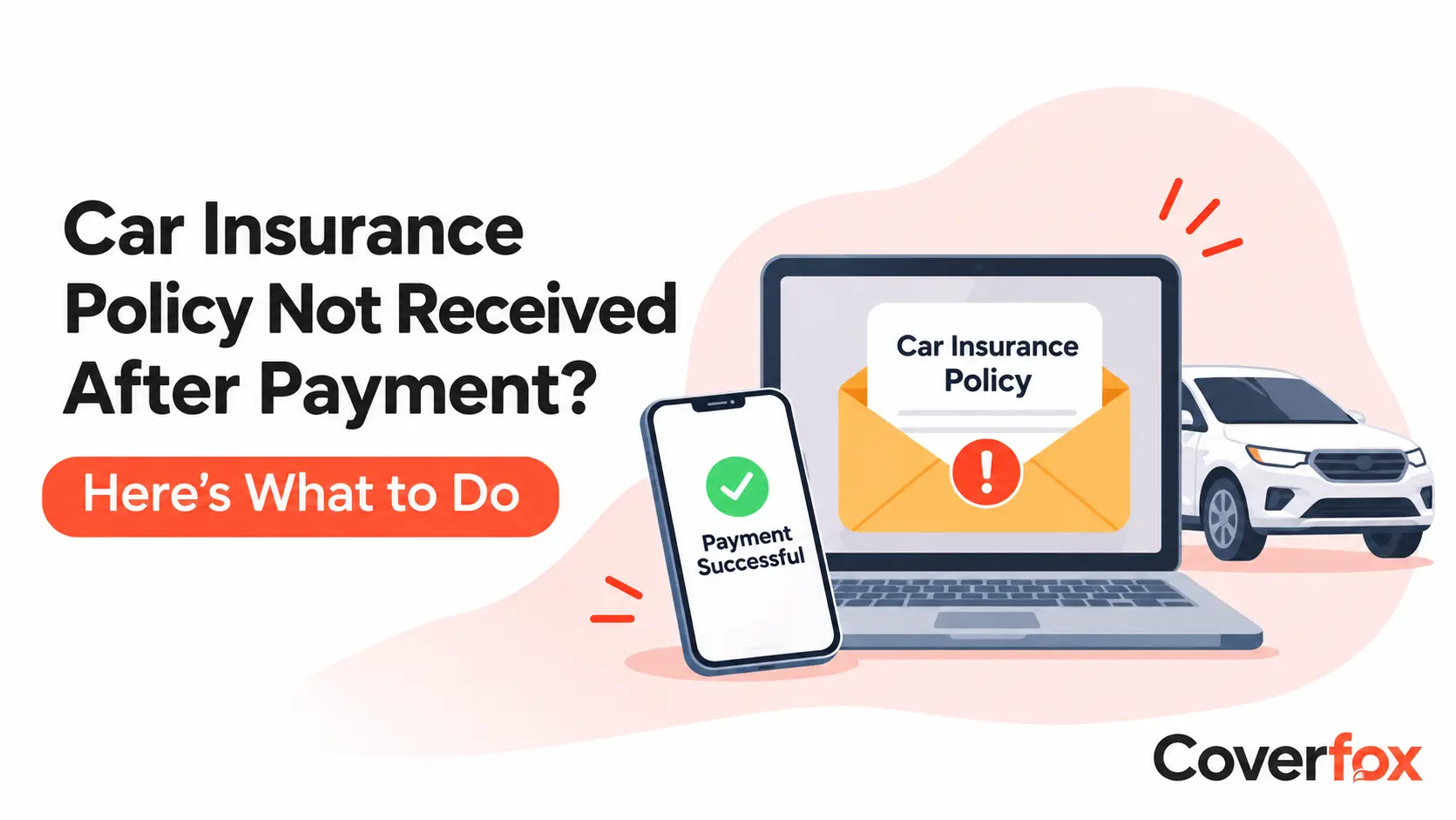
Are you worried that you did not receive your car insurance policy after payment? Do not panic; this can happen sometimes due to reasons like payment verification delay, the policy being issued but not emailed, an incorrect email or a technical issue. Read this guide to understand why you did not receive the car insurance policy, and what you can do in such situations.
Why Have You Not Received Your Car Insurance Policy After Payment?
If you didn’t receive your car insurance policy immediately after payment, it does not necessarily mean that the insurer didn’t issue your policy. Here are the usual places it gets stuck, and what each one looks like from your side.
| Cause | What you'll notice | Who can fix it |
|---|---|---|
| Payment confirmation pending | Bank shows “pending” or “processing”; no receipt | Your bank, then the payment gateway |
| Cheque or offline payment still clearing | Payment made, money not yet cleared | Wait, or ask the intermediary |
| Premium received, issuance incomplete | Receipt exists, no policy number | The insurer |
| Vehicle inspection pending | A request to upload photos or a video, or book a surveyor | You, then the insurer |
| Details don't match | Insurer asks for your RC, previous policy or ownership proof | You, then the insurer |
| Wrong email or mobile number | A typo on the confirmation page | Platform or insurer support |
| Email filtered | Policy shows in your account, not your inbox | You |
| Technical error | The page froze or threw an error after payment | Platform or insurer |
| Paid through an intermediary | Receipt from an aggregator, broker, agent or dealer; nothing from the insurer | The intermediary, then the insurer |
The payment rule: Under Section 64VB of the Insurance Act, 1938, an insurer takes on risk only after it receives the premium. So, until the transaction is verified successfully, the insurer generally won't issue your policy.
The inspection step: If your last policy expired, even by a day, most insurers want to see the car first. Until they approve your photos or video, no policy comes out. The inspection link usually arrives by SMS or email after payment, and people miss it.
Bought through a car dealer? If the policy is not issued, you can reach to the dealer to know more details about why the car insurance has not been issued yet.
What Should You Do If Your Car Insurance Policy Is Not Received After Payment?
Once you understand the problem, now comes the solution.
Check Your Payment and Policy Status
Open your bank or UPI app: Find the transaction. Is it successful, pending or failed?
Screenshot it: Capture the transaction ID (the UTR), the amount, the date and the time.
Search your email: Look in the inbox, spam, promotions and trash. Try the insurer's name, the word “policy” and the name of the website you bought from.
Check your SMS: Some insurers send a download link by text.
Read the email address on your confirmation page: One wrong letter and the policy went to someone else. If that's what happened, tell support straight away.
Log in where you bought: If the payment went through, you can also find your policy on the insurer's website or the Coverfox dashboard.
Check Parivahan: Parivahan shows insurance validity, but it updates after issuance and can lag, so a blank there proves nothing.
Contact the Insurer or Intermediary
Policy Purchased Directly from the Insurer: Contact the insurer’s support team. You can find this information on their “Contact Us” Page.
Policy Bought from Coverfox: Contact our support team through email on help@coverfox.com or give us a call on 022 4897 1018.
For more details to contact the support team of Coverfox, you can visit here.
One warning: Use only the phone numbers and email addresses printed on the insurer's or platform's own website. Fake customer-care numbers are a known scam, and no genuine agent needs your OTP, card PIN or CVV to release a policy.
What If Your Payment Was Deducted but the Policy Is Still Not Issued?
Find out if the debit is final: A “pending” or “failed” status with money gone from your account usually reverses on its own. Banks commonly take 3 to 7 business days. RBI's rule for failed transactions is five working days depending on payment method and type of transaction, after which the bank owes you ₹100 per day of delay. If the bank is late, take it up with the bank.
Ask for a premium receipt: If the money reached the insurer or platform, they can give you a receipt number even when the policy is stuck.
Don't pay again yet: A second payment can leave you with two policies and a refund to chase. Wait for written confirmation that the first payment failed or will be returned.
Sort out your cover dates: Old policy still running? You're covered until it ends, so keep calm. Expired, or expiring today? Ask the insurer to confirm in writing the date and time your new cover starts.
Give support time to resolve: If the support is not able to resolve your issue after adequate time, move to the escalation steps below.
Keep a log: Date, time, name, ticket number, keep everything recorded.

How Can You Escalate a Complaint if Your Car Insurance Policy Is Not Issued?
Use this route only after normal customer support has failed. Go in order. You should first contact the insurer regarding the complaint, and if the issue still persists, only then you can reach out to the Insurance Ombudsman.
There are five steps, starting with Coverfox's own grievance team and ending with the Consumer Commission.
Step 1: Send a formal complaint to Coverfox or the Insurer
Write to grievance.it@coverfox.com regarding the pertaining issue.
In the body, give your name, registered mobile number, vehicle number, insurer, proposal number, transaction ID, payment date, amount and every support ticket number you have so far. Then say what you want in one line: the policy, or a refund.
If this doesn't resolve your issue, move to step 2.
Step 2: Complain to the insurer's Grievance Redressal Officer
The insurer is the company that issues your policy, so it carries the obligation to deliver it or return your money.
Write to the insurer's Grievance Redressal Officer (GRO) as well. The address is on the insurer's website under “Grievance Redressal”. The 30-day wait before you can approach the Ombudsman counts from the day you complain to the insurer.
Insurers are generally expected to resolve complaints in about 15 days. Save the reference number they give you.
Step 3: Escalate through IRDAI's Bima Bharosa portal
Bima Bharosa is IRDAI's complaint portal, formerly called IGMS. Use it when the insurer couldn’t resolve your problem.
Go to bimabharosa.irdai.gov.in, register with your mobile number and email, and fill in the complaint form. Name the insurer, describe the problem in a few lines, and upload your documents. You'll get a token number. Use it to track the complaint.
IRDAI forwards your complaint to the insurer and follows it until it closes.
Prefer to talk? Call 155255 or 1800 4254 732. You can also email complaints@irdai.gov.in.
Step 4: Take it to the Insurance Ombudsman
The Insurance Ombudsman settles disputes between policyholders and insurers. Its scope under the Insurance Ombudsman Rules, 2017 includes non-issuance of an insurance document after the premium has been received. That's your case.
You can go to the Ombudsman if:
You have already complained to the insurer, and
The insurer didn't reply within 30 days, or you're not satisfied with its reply, and
You file within one year of the insurer's reply, or of the 30 days running out.
Apply through the Bima Bharosa portal, by email, or by post to the Ombudsman office for your area. Attach a copy of your complaint to the insurer, its response, if any, the premium receipt and your payment proof.
The Ombudsman first tries to get both sides to agree on a settlement. If that fails, it issues an award. An award you accept is binding on the insurer.
Step 5: Approach the consumer helpline or consumer commission
If the Ombudsman route doesn't work for you, call the National Consumer Helpline on 1915. You can also file a case with the District Consumer Disputes Redressal Commission, and the e-Daakhil portal lets you do that online.
Conclusion
A car insurance policy not received after payment usually means one of two things. Either the policy exists and didn't reach you, or it was never issued. Check your bank statement, your spam folder and the portal where you bought it. Quote your transaction ID. Ask for every answer in writing. Bought from Coverfox? Contact Coverfox support with your proposal and vehicle numbers, and call the insurer in parallel.
Frequently Asked Questions
How long does it take to receive a car insurance policy after payment?
For most online purchases, minutes. Inspections and mismatched details take longer, because the insurer has to approve them first.
Should I pay again if my car insurance premium has been deducted but I have not received the policy?
No. First find out whether the original payment succeeded and whether a policy exists. A second payment can leave you with two policies and a refund to chase. Pay again only after the insurer or platform tells you in writing that the first payment failed or will be returned.
Can I drive my car if I have paid for insurance but not received the policy?
Only if you're sure you have valid cover. Don't assume the new one is live just because you paid. Under Section 64VB of the Insurance Act, cover depends on the insurer receiving the premium, and a third-party car policy is mandatory for any car on a public road.
Will I get a refund if my car insurance policy is not issued?
If your premium has been deducted but the car insurance policy is not issued, you can request a refund. Failed transactions are usually reversed automatically, while payments received by the insurer may require a refund request.