Rejected, denied, and closed-without-payment are three different outcomes, and each one opens up a different next step for you.
Rejections usually come down to fixable paperwork; denials are a considered refusal on merit; closures without payment depend entirely on the reason behind them.
If a claim isn't paid, you can raise a grievance to the insurer first, then escalate to IRDAI's Bima Bharosa portal, and finally to the Insurance Ombudsman if the dispute stays unresolved.
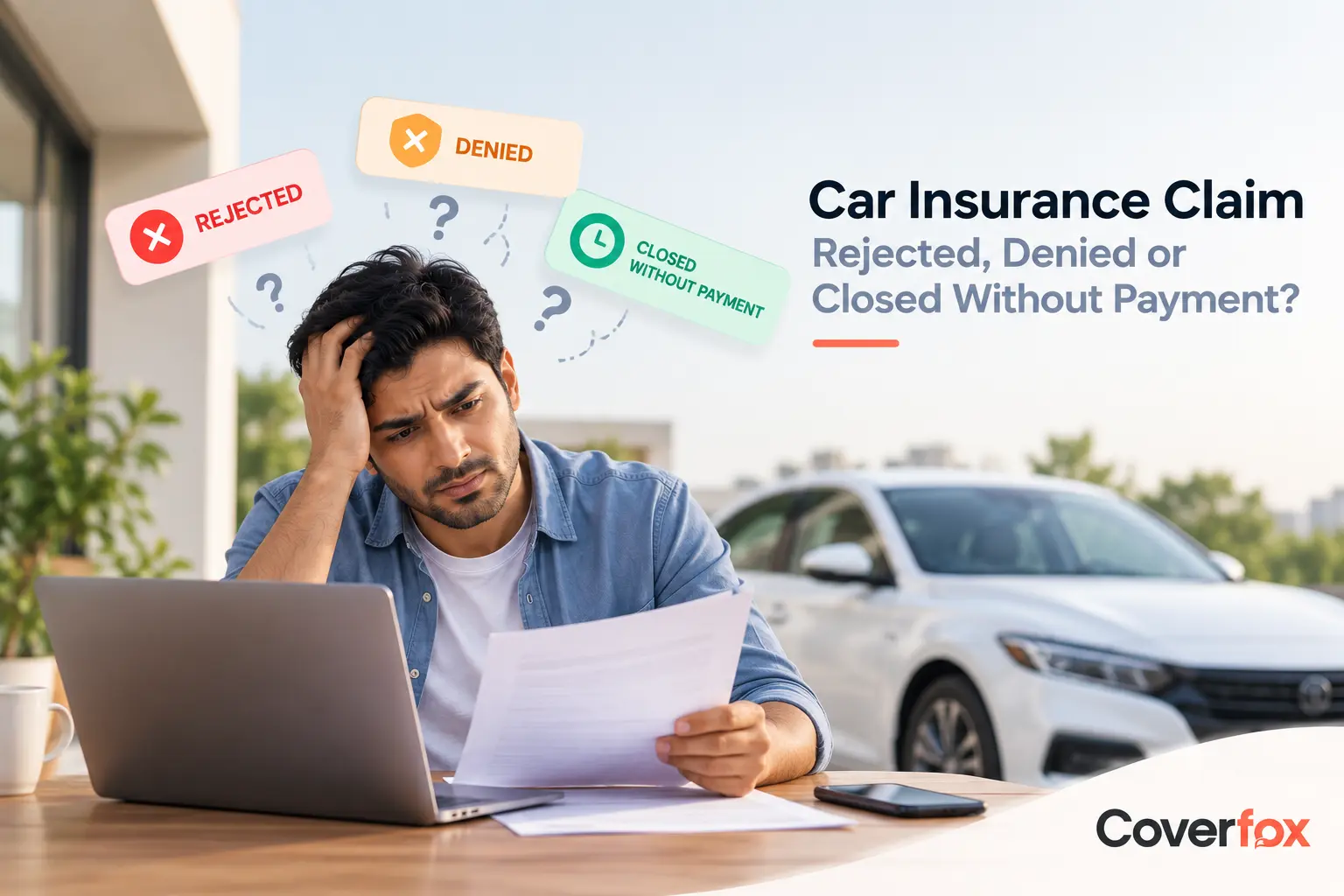
Your claim status has changed, and the word next to it is "denied," "rejected," or "closed without payment." None of those three words means the same thing, even though they get used interchangeably in everyday conversation. The label your insurer applies decides whether you can fix the issue and resubmit, appeal the decision, or simply accept it. Here's what each term actually means under Indian motor insurance practice, and the exact steps to take once you see it on your claim.
Denied vs Rejected vs Closed Without Payment: A Quick Comparison
| Status | What's really happening | Your next move |
|---|---|---|
| Rejected | A procedural or documentation gap stopped processing | Fix the gap and resubmit |
| Denied/repudiated | Insurer reviewed the facts and refused coverage on merit | Appeal with evidence, or escalate |
| Closed without payment | File was completed, but nothing was payable | Depends on the closure reason |
What Does a Rejected Car Insurance Claim Mean?
A car insurance claim rejection means the insurer could not process the claim because something in the paperwork, the eligibility check, or the reporting timeline fell short of what the policy requires. The exact meaning depends on the insurer's claim process and the reason stated in the rejection communication
Common Reasons a Car Insurance Claim May Be Rejected
Incomplete documentation: RC copy, driving licence, FIR, or repair invoice missing from the claim file.
Mismatched details: The vehicle's registration number, engine number, or policy number doesn't match what's on the insurer's records.
Late intimation: The accident was reported outside the notification window mentioned in the policy.
Survey not completed: The surveyor couldn't inspect the vehicle before repairs began.
Duplicate claim: The same incident was already claimed under another policy or a different claim head.
What Does a Denied or Repudiated Car Insurance Claim Mean?
A denied or repudiated car insurance claim means the insurer has decided not to pay the claim because, after assessing the facts of the loss and the applicable policy terms and conditions, it has determined that the claim is not payable. The decision may relate to an exclusion, breach of policy conditions, non-disclosure or misrepresentation of relevant information, lack of applicable coverage, policy validity issues, suspected fraud, or the insurer's assessment of the cause or extent of the damage.
Common Reasons for Denial or Repudiation
Policy exclusion: The loss falls under an event the policy specifically leaves out, such as mechanical or electrical breakdown.
Lapsed policy: The accident happened after the policy expired or before a renewal payment was processed.
Misrepresentation at purchase: Vehicle use, ownership, or prior damage history was stated incorrectly on the proposal form.
Breach of policy condition: Driving without a valid licence, under the influence, or using a private vehicle for commercial purposes.
Wrong cover for the loss: A third-party-only car policy can't pay for own-damage repairs; the two are different products.
If you think the insurer has misread the facts or overlooked evidence, a denial can still be challenged. Write to the insurer's Grievance Redressal Officer with your version of events and any supporting proof, and escalate through IRDAI's Bima Bharosa portal if the response doesn't satisfy you.
What Does "Closed Without Payment" Mean in Car Insurance?
Closed without payment is an outcome rather than a single reason for denial. The claim may have been closed because it was withdrawn, documents were not submitted, no payable loss was established, or the assessed amount was not payable. Insurers use it when the case reaches a natural end point without a payable outcome, sometimes because of something you did, sometimes because the numbers simply didn't add up to a payout.
Why Can a Car Insurance Claim Be Closed Without Payment?
Claim withdrawn: You informed the insurer you no longer wanted to pursue it.
No response from the policyholder: Requested documents went unanswered past the follow-up period.
No payable loss found: The surveyor inspected the vehicle and found nothing chargeable under the terms of the policy.
Cost under the deductible: The repair estimate, once depreciation and the voluntary excess were applied, fell below the payable threshold.
Wrong documents filed: Papers submitted didn't correspond to the type of claim being made.
Can a Closed-Without-Payment Car Insurance Claim Be Reopened?
Sometimes, and it depends entirely on the reason for closure.
| Reason for closure | Can you reopen it? |
|---|---|
| Missing documents | Yes, submit them and request reassessment |
| Claim withdrawn by you | Yes, if you're still within the intimation window |
| Repair cost below deductible | Rarely; ask the insurer to show the calculation instead |
| No payable loss found by surveyor | Limited; request a copy of the survey report first |

What to Do If Your Car Insurance Claim Is Not Paid
Get the reason in writing: Ask the insurer to state the exact clause or ground behind the decision, not just a one-line status update.
Match it against your policy wording: Pull out your policy document and check whether the cited exclusion or condition genuinely applies to your situation.
Raise a formal grievance: Email the insurer's Grievance Redressal Officer with your claim number, the reason given, and your supporting documents.
Track the response window: Under IRDAI's current grievance-redressal framework, an insurer should resolve a complaint within 15 days of receiving it. See IRDAI's Master Circular on Protection of Policyholders' Interests, 2024 and the IRDAI grievance-redressal guidance.
Escalate to IRDAI: If the insurer stays silent or the reply doesn't hold up, register a complaint through the Bima Bharosa portal.
Approach the Insurance Ombudsman: For disputes that remain unresolved after 30 days of first writing to the insurer, or if the insurer rejects your complaint or gives an unsatisfactory response, you can approach the Insurance Ombudsman. The forum is free to use, and awards are binding on insurers, subject to a claim-value limit of ₹30 lakh.
Pro Tip: If you have bought your car insurance policy from Coverfox, you can contact help@coverfox.com or call 022 4897 1018 for any grievances or help towards your car insurance claim.
What Documents Should You Keep When Disputing a Car Insurance Claim?
| Document | Why it matters |
|---|---|
| Policy copy and schedule | Confirms your coverage, exclusions, and sum insured |
| Claim intimation proof | Shows exactly when you first reported the loss |
| Rejection, denial or closure letter | States the insurer's exact reason in writing |
| Repair estimate and final invoice | Establishes the actual cost of the loss |
| Survey report, if one was issued | The insurer's own assessment of the damage |
| Email and call correspondence | Proof of every follow-up and response, or lack of one |
| FIR or police report, where applicable | Required for theft claims and accidents involving third-party injury |
How to Avoid Problems With a Car Insurance Claim
Inform your insurer immediately: Report the incident within the window your policy specifies, before repairs start.
Keep policy details current: Address, vehicle use, and any modifications should match what's on record.
Renew before expiry: A lapsed policy at the moment of an accident is one of the most avoidable reasons for denial.
Preserve evidence early: Photograph the damage, keep the repair shop's first estimate, and jot down the sequence of events while it's fresh.
Re-read your exclusions at renewal: Cover terms shift from year to year, so know what's left out before you ever need to claim.
Frequently Asked Questions
Is a rejected claim the same as a denied or repudiated claim?
Not quite. Rejection points to a paperwork or procedural gap that can often be corrected. Denial and repudiation are a considered refusal on the merits: the insurer has reviewed the facts and decided the loss isn't covered.
Can a closed-without-payment car insurance claim be reopened?
It depends on why it closed. Claims shut for missing documents or a withdrawal request can often be reopened once you submit what's pending. Claims closed because the repair cost fell below your deductible leave little room to reopen, though you can still ask the insurer to show how that figure was calculated.
Why was my car insurance claim not paid even though my car was damaged?
Visible damage alone doesn't guarantee a payout; the cause, the timing, and the paperwork behind it matter just as much. A lapsed policy, an excluded cause of loss, or a repair estimate that lands under your deductible can all leave a genuine accident with no payment.
Can I approach IRDAI if my car insurance claim is not resolved?
Yes. If your insurer doesn't respond within 15 days, or the response leaves your dispute unresolved, you can register a complaint on IRDAI's Bima Bharosa portal, which tracks the case against the insurer directly.
Will a Rejected or Denied Claim Affect My No Claim Bonus?
A rejected or denied claim may still affect your No Claim Bonus (NCB), depending on your insurer’s policy terms and how the claim is recorded and processed. NCB is generally linked to having no claim during the preceding policy period, but the treatment of rejected, denied, or closed-without-payment claims can vary. Check your policy wording or confirm the impact with your insurer before renewal.
Disclaimer: The information on this page is for general informational purposes only and should not be considered legal, financial, or insurance advice. Claim decisions, coverage, exclusions, and grievance procedures may vary depending on your insurer, policy terms, and the circumstances of the claim. Please refer to your policy documents and contact your insurer for claim-specific guidance.