An adapted vehicle is a motor vehicle that has been permanently modified to meet the mobility needs of a person with a physical disability through features such as hand controls, wheelchair ramps, lifts, or specialised seating. Under the Motor Vehicles Act, 1988, adapted vehicles have a separate legal classification, and permanent adaptations require approval from the Regional Transport Office (RTO) before being recorded in the vehicle's Registration Certificate (RC). These modifications should also be disclosed to the insurer so the insurance policy accurately reflects the adapted vehicle and helps minimise complications during claim settlement.
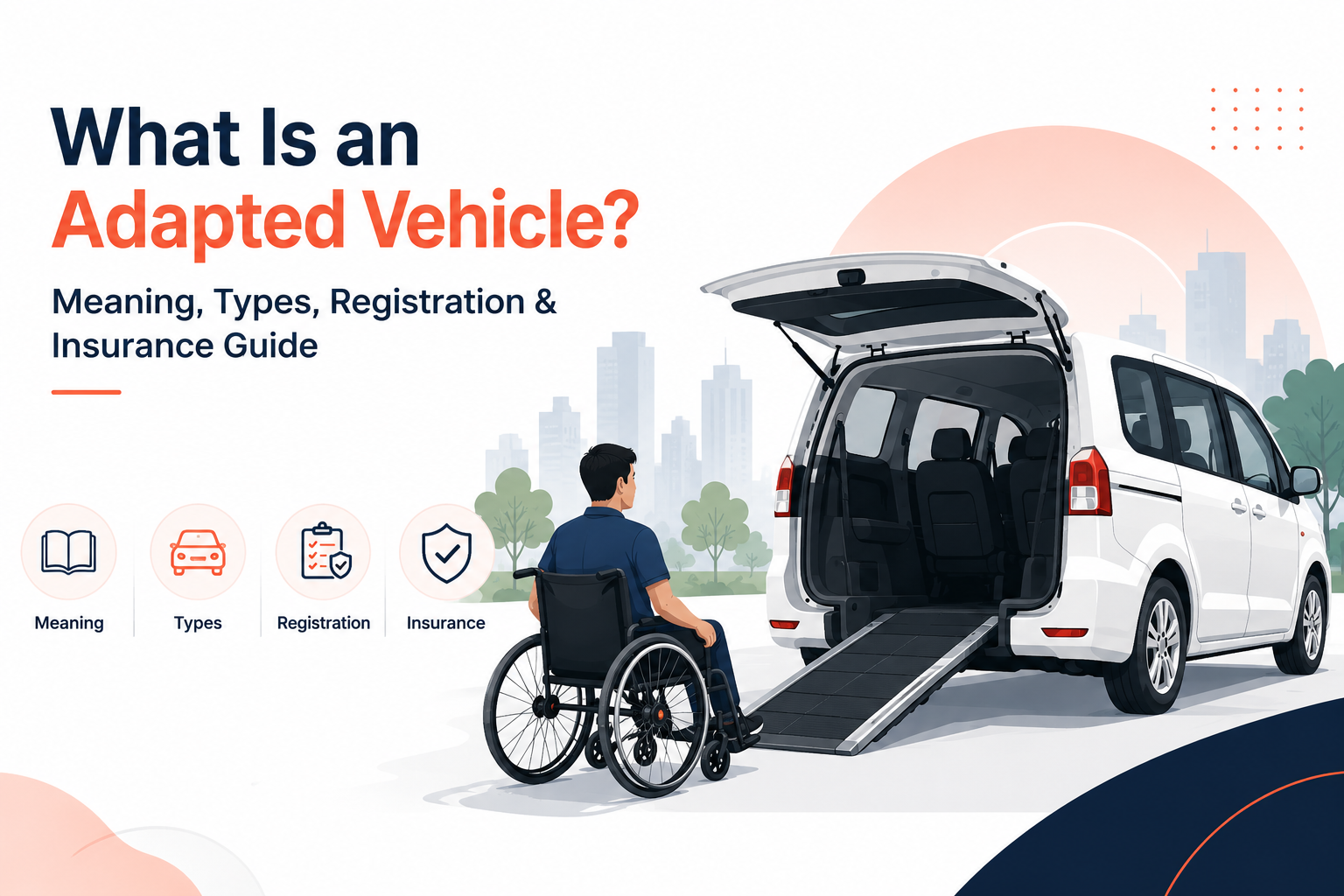
If you are someone who’s looking to buy a vehicle with special accessibility features, you would probably come across “Adapted Vehicles”. This is not just a buzzword; it appears on RTO documents, registration forms, GST portals, and also in car insurance paperwork. The term "adapted vehicle" has largely replaced the older term "invalid carriage" in Indian transport laws and official documents. If you're looking for what an adapted vehicle is, this guide explains everything in simple terms, including its different types, registration requirements, and how insurance works after a vehicle has been adapted.
What is an adapted vehicle?
An adapted vehicle is a motor vehicle that has been permanently altered to meet the mobility needs of a person with a physical disability. In simple terms, an adapted vehicle means a standard vehicle fitted with approved accessibility features or driving controls that help a person drive or travel safely. Unlike a modified vehicle, which may be altered for performance, styling, or comfort, an adapted vehicle is recognised under transport laws because its changes are made for accessibility and must meet specific legal and RTO requirements.
As per Section 2(1) of the Motor Vehicles Act, 1988:
"Adapted vehicle means a motor vehicle either specially designed and constructed, or to which alterations have been made under sub-section (2) of section 52, for the use of a person suffering from any physical defect or disability, and used solely by or for such person."
Why Are Adapted Vehicles Used?
Adapted vehicles help people with physical disabilities travel more safely, comfortably, and independently without relying on others for everyday transportation. Here are the benefits:
Independent mobility: Adaptations such as hand controls or wheelchair access allow many people to drive or travel on their own, giving them greater freedom in their daily lives.
Better accessibility: Features like ramps, lifts, swivel seats, and lowered floors make getting into and out of the vehicle much easier for both drivers and passengers.
Daily commuting: An adapted vehicle makes routine travel, whether it's going to work, shopping, or running errands, far more convenient and less dependent on family members or caregivers.
Work and education: Makes it easier to commute independently to workplaces, schools, colleges, and training centres, reducing transportation barriers and improving access to employment and education.
Medical visits: Regular hospital appointments, rehabilitation sessions, physiotherapy, and follow-up consultations become easier to manage with a vehicle adapted to individual needs.
Improved safety: Accessibility equipment and specialised driving controls are designed to help users operate the vehicle safely while reducing physical strain during travel.
Greater confidence while driving: Being able to drive a vehicle suited to one's physical needs gives many individuals the confidence to travel independently and participate more actively in everyday life.

Who Can Use an Adapted Vehicle?
Adapted vehicles are meant for individuals with mobility or physical conditions that make it difficult to drive or travel in a standard vehicle. Depending on the requirement, they can be used by:
Locomotor disabilities: Individuals with limited movement in their arms, legs, or joints need specialised driving controls or accessibility features.
Amputees: Drivers or passengers with limb loss require hand-operated controls, pedal modifications, or other vehicle adaptations to travel safely.
Wheelchair users: Vehicles fitted with ramps, lifts, lowered floors, or wheelchair restraint systems make entering, exiting, and travelling much easier.
Senior citizens: Some older adults with age-related mobility limitations benefit from adaptations such as swivel seats, grab handles, or easier access features, where appropriate.
Temporary injuries: Those recovering from surgeries, fractures, or accidents use adapted vehicles for a limited period until mobility improves.
Medical conditions affecting mobility: Conditions such as muscular dystrophy, cerebral palsy, multiple sclerosis, spinal cord injuries, or similar disorders require permanent or customised vehicle adaptations to support safe and comfortable travel.
Types of Adapted Vehicle Modifications
Different adaptations address different mobility requirements. Some help a person operate the vehicle independently, while others make entering, exiting, or travelling in the vehicle more comfortable.
| Type | Common Adaptations |
|---|---|
| Hand Controls | Hand accelerator, hand brake, hand-operated clutch |
| Steering Wheel Modifications | Steering knob (spinner knob), specialised steering grips |
| Pedal Modifications | Left-foot accelerator, pedal extensions, adjustable pedals |
| Wheelchair Access Modifications | Ramps, powered lifts, lowered floors |
| Seating Modifications | Swivel seats, powered seats |
| Automatic Transmission | Automatic gearbox replacing manual clutch operation |
| Secondary Controls | Indicator extensions, wiper controls, lighting controls, horn relocation |
Hand Controls
Hand controls replace or supplement the standard foot-operated pedals, allowing the vehicle to be driven using the hands instead of the legs. They are commonly used by drivers with limited or no movement in their lower limbs.
Hand accelerator: Lets the driver increase speed using a lever or push-pull mechanism.
Hand brake control: Enables braking without using the brake pedal while maintaining good control of the vehicle.
Hand-operated clutch: Available in manual vehicles, this system allows clutch operation through a lever or electronic mechanism, although many drivers prefer automatic transmissions instead.
Steering Wheel Modifications
Maintaining full control of the steering wheel can be difficult if a driver has the use of only one hand or reduced grip strength. Simple steering aids can make everyday driving much easier.
Steering knob (spinner knob): A rotating knob attached to the steering wheel that allows it to be turned with one hand, especially useful while parking or making sharp turns.
Specialised steering grips: Some drivers use customised grips or steering aids that provide better support and control based on their individual needs.
Pedal Modifications
Not every adaptation removes the pedals altogether. In many cases, the accelerator, brake, or clutch pedals are repositioned or redesigned to suit the driver's physical condition. Left-foot accelerators, pedal extensions, and adjustable pedal systems are among the most common solutions prescribed after a mobility assessment.
Wheelchair Access Modifications
For wheelchair users, entering and exiting a standard vehicle can be the biggest challenge. Accessibility equipment removes that barrier and allows safer transfers.
Ramps: Foldable or retractable ramps provide wheelchair access without heavy lifting.
Powered lifts: Electrically operated lifts raise and lower a wheelchair into the vehicle, making them particularly useful for larger vehicles such as vans.
Seating Modifications
A standard seat may not offer enough support or flexibility for every passenger or driver. Adapted seating can reduce physical strain during every journey.
Swivel seats: Rotate towards the door, making it easier to get in and out of the vehicle.
Powered seats: Move electronically to adjust height, position, or angle, helping users find a comfortable and accessible seating position with minimal effort.
Automatic Transmission Conversion
Many adapted vehicles are equipped with automatic transmissions because they remove the need to operate a clutch pedal and reduce the number of driving actions that have to be performed at the same time. This allows drivers to focus on steering, braking, and monitoring traffic instead of coordinating clutch and gear changes. For this reason, automatic cars are often recommended during driving assessments for people with mobility impairments.
Secondary Controls
Small changes to everyday controls can make a significant difference behind the wheel. These adaptations keep essential functions within easy reach without forcing the driver to stretch or remove a hand from the steering wheel.
Common examples include:
Indicator extensions for easier signalling.
Wiper control extensions that require less hand movement.
Lighting control extensions for operating headlights and other switches more comfortably.
Horn and auxiliary switch relocations where needed to suit the driver's reach and mobility.
Difference Between an Adapted Vehicle and a Modified Vehicle
| Aspect | Adapted Vehicle | Modified Vehicle |
|---|---|---|
| Purpose | To improve accessibility for a person with a physical disability. | To improve performance, appearance, comfort, or utility. |
| Who uses it | People with physical disabilities or mobility limitations. | Any vehicle owner. |
| Approval | RTO approval and RC update may be required for permanent adaptations. | Depends on the type of modification. |
| Insurance | Adaptations should be declared to the insurer. | Relevant modifications should also be disclosed to the insurer. |
| Examples | Hand controls, wheelchair ramps, swivel seats, steering knobs. | Alloy wheels, body kits, performance exhausts, infotainment systems. |
Note: Every adapted vehicle is a modified vehicle, but not every modified vehicle is an adapted vehicle under the Motor Vehicles Act, 1988.
Is RTO Approval Required for an Adapted Vehicle?
Yes. If a vehicle has been permanently adapted by altering its original structure or driving controls, the changes must comply with the Motor Vehicles Act, 1988 and the Central Motor Vehicles Rules, 1989. After the adaptation, the vehicle is inspected by the Registering Authority, and once approved, an endorsement is made in the Registration Certificate (RC) to record it as an adapted vehicle.
Updating the Registration Certificate (RC) is essential to maintain legal compliance. It helps ensure the vehicle remains legally compliant and can also prevent issues during insurance claims, ownership transfer, or future inspections.
Note: While the legal framework is the same across India, the documents required, inspection process, and application procedure may vary from one state to another. Before making any permanent adaptation, check the latest requirements with your local RTO.
How Does the RTO Approval Process for Adaptive Vehicles Work?
Although the exact procedure varies across states, the process follows these steps:
The vehicle is adapted using approved accessibility equipment.
The required documents, including the retrofitment or modification certificate, are submitted to the RTO.
The Registering Authority inspects the vehicle to verify that the adaptations comply with the applicable rules.
Once approved, the changes are recorded in the vehicle's Registration Certificate (RC), officially recognising it as an adapted vehicle.
Documents Required to Register an Adapted Vehicle
The exact documents may vary across states and the type of adaptation. However, the following are commonly required by RTOs during the registration or endorsement process.
| Document | Purpose | Examples |
|---|---|---|
| Medical certificate | Confirms the applicant's physical disability or mobility condition, where applicable. | Disability certificate or medical certificate issued by a competent medical authority. |
| Identity proof | Verifies the applicant's identity. | Aadhaar Card, PAN Card, Passport, Voter ID. |
| Address proof | Confirms the applicant's residential address. | Aadhaar Card, Passport, Utility Bill, Driving Licence. |
| Vehicle documents | Establishes ownership and vehicle details. | Registration Certificate (RC), invoice, insurance certificate, Form 20/21/22 (for new vehicles, where applicable). |
| Retrofitment certificate | Confirms that the adaptation has been carried out as per prescribed standards. | Retrofitment or installation certificate issued by the vehicle manufacturer or authorised modifier. |
| Manufacturer's approval (if applicable) | Required for certain adaptations affecting the vehicle's original specifications. | No Objection Certificate (NOC) or approval from the vehicle manufacturer, where prescribed. |
Note: The documents required can differ depending on your state's RTO and the type of vehicle adaptation. It's advisable to verify the latest requirements with your local RTO before applying.
Can You Get Car Insurance for an Adapted Vehicle?
Yes, an adapted vehicle can be insured. When purchasing or renewing your comprehensive car insurance policy, you should disclose any permanent accessibility-related modifications, such as hand controls, wheelchair ramps, lifts, or specialised seating. Depending on the nature of the adaptation, the insurer may ask for photographs, supporting documents, or inspect the vehicle before recording the changes through a policy endorsement.
Why is disclosure of adaptation important in car insurance?
Informing your insurer ensures the policy accurately reflects the vehicle's specifications. If permanent adaptations are not disclosed, it could create complications during claim assessment, especially if the modified components are damaged. Keeping both the Registration Certificate (RC) and the insurance policy updated helps avoid unnecessary disputes at the time of a claim.
Insurance Tip: Cosmetic accessories and accessibility adaptations are treated differently. Always disclose permanent accessibility-related modifications when purchasing or renewing your policy.
Example
Raj installs a permanently fitted wheelchair lift worth ₹2 lakh in his car but does not inform his insurer when renewing the policy. A few months later, the lift is damaged in an accident. During claim assessment, the insurer discovers that the policy does not mention the accessibility modification and requests additional documents before processing the claim. Had the adaptation been declared when the policy was renewed, the vehicle's details would already have matched the policy records, making the assessment process smoother.
Does Vehicle Modification Affect Insurance Premium?
Yes, it can. Whether your insurance premium changes depends on what has been modified, how much the modification costs, and whether it affects the vehicle's value or risk profile.
Changes to the Vehicle's Value
Accessibility equipment such as wheelchair lifts, powered seats, or specialised driving controls can increase the overall value of the vehicle. Since insurers consider the vehicle's value while calculating the Insured Declared Value (IDV), expensive adaptations may result in a higher premium.
Risk Assessment
Insurers also assess whether the modification changes the vehicle's risk. Adaptations that improve accessibility without affecting the vehicle's safety are evaluated differently from performance-related modifications, which may increase risk.
Always Declare Modifications
If you have made permanent adaptations, inform your insurer before the policy is issued or renewed. Undeclared modifications may affect claim settlement if the insurer discovers that the vehicle no longer matches the details provided in the policy.
Things to Check Before Buying or Modifying an Adapted Vehicle
Before purchasing or adapting a vehicle, consider the following points to avoid legal, safety, and insurance-related issues later.
RTO approval: Ensure the proposed adaptation complies with applicable RTO requirements and can be endorsed in the Registration Certificate (RC).
Certified installer: Choose a qualified manufacturer or authorised retrofitment agency to carry out the modifications.
Compatible controls: The adapted controls should suit the driver's mobility needs and remain safe and easy to operate.
Inform your insurer: Declare all permanent modifications so they can be recorded in your insurance policy.
Warranty implications: Check whether the adaptation affects the vehicle manufacturer's warranty and whether the installer provides a warranty on the fitted equipment.
Servicing and maintenance: Confirm that the adapted components can be serviced easily and that replacement parts are readily available.
Resale value: Adapted vehicles may appeal to a smaller group of buyers, so consider how the modifications could affect the vehicle's resale value.
Challenges of Owning an Adapted Vehicle
Adapted vehicles also come with challenges:
Higher costs: Accessibility adaptations can significantly increase the overall cost of ownership depending on the type of equipment installed. Powered lifts, specialised seating, and electronic driving controls are more expensive than basic mechanical adaptations.
Maintenance: Specialised components may require trained technicians and specific spare parts.
RTO approval: Certain adaptations must be approved and recorded by the RTO.
Insurance disclosure: Permanent modifications should always be declared to the insurer.
Limited availability: Some adaptations are available only for selected vehicle models.
Resale value: Selling an adapted vehicle may take longer because it caters to specific mobility needs
Document management: Keep invoices, retrofitment certificates, photographs of the modifications, and RTO approval documents safely. These records will be required while updating your insurance policy, selling the vehicle, or during claim settlement
Conclusion
Adapted vehicles make driving and travelling more accessible for people with physical disabilities, but the modifications should also be reflected in the vehicle's legal and insurance records. If you permanently adapt a vehicle, obtain the necessary RTO approval, update the Registration Certificate (RC), and inform your insurer about the changes. Keeping these records up to date helps ensure the vehicle remains legally compliant and reduces the likelihood of complications during ownership transfer or insurance claims.
Frequently Asked Questions
What does an adapted vehicle mean?
An adapted vehicle means a vehicle that has been modified with approved accessibility features to help a person with a physical disability drive or travel safely. Under the Motor Vehicles Act, 1988, it has a specific legal definition.
Is an adapted vehicle legal in India?
Yes. Adapted vehicles are legal in India, provided the modifications comply with the Motor Vehicles Act, 1988, and the Central Motor Vehicles Rules, 1989. Certain permanent adaptations also require approval and endorsement by the Regional Transport Office (RTO).
Does an adapted vehicle require RTO approval?
Yes, permanent adaptations that alter the vehicle's original construction or driving controls require approval from the RTO. Once approved, the changes are recorded in the vehicle's Registration Certificate (RC).
Can adapted vehicles be insured?
Yes. Adapted vehicles can be covered under a car insurance policy. However, permanent accessibility-related modifications should be disclosed to the insurer so they can be recorded in the policy.
Can any car become an adapted vehicle?
Many cars can be adapted, but not every vehicle is suitable for every type of modification. The feasibility depends on the vehicle's design, the required adaptation, and applicable legal requirements.
Do adapted vehicles cost more?
Yes, adapted vehicles often cost more than standard vehicles because of the additional equipment, installation charges, and specialised components required for accessibility.
Can automatic cars be adapted?
Yes. Automatic cars are commonly adapted because they eliminate the need for clutch operation, making them easier to drive for many people with mobility limitations.
Can adapted vehicles be sold?
Yes. An adapted vehicle can be sold like any other vehicle. However, the buyer should be informed about the modifications, and the transfer should be completed according to the applicable RTO procedures.
Are adapted vehicles eligible for GST concessions?
Yes, eligible persons with benchmark disabilities may claim GST concessions on adapted vehicles, subject to the conditions and certification prescribed by the Government of India.
Can I drive an adapted vehicle with a regular driving licence?
You can drive an adapted vehicle only if your driving licence authorises you to do so. Depending on your disability and the vehicle adaptation, the licensing authority may issue a licence with suitable endorsements after the required driving assessment.
Can I install adaptations after buying a car?
Yes. A vehicle can be adapted after purchase, provided the modifications comply with the Motor Vehicles Act and applicable RTO requirements. Permanent alterations may need approval and an update to the Registration Certificate (RC).