Battery as a Service (BaaS) lets you buy an electric vehicle without purchasing the battery upfront, reducing the initial cost while paying separately through a subscription or per-kilometre model. Whether it's the right choice depends on your driving habits, long-term ownership plans, and how BaaS affects your overall running costs and insurance.
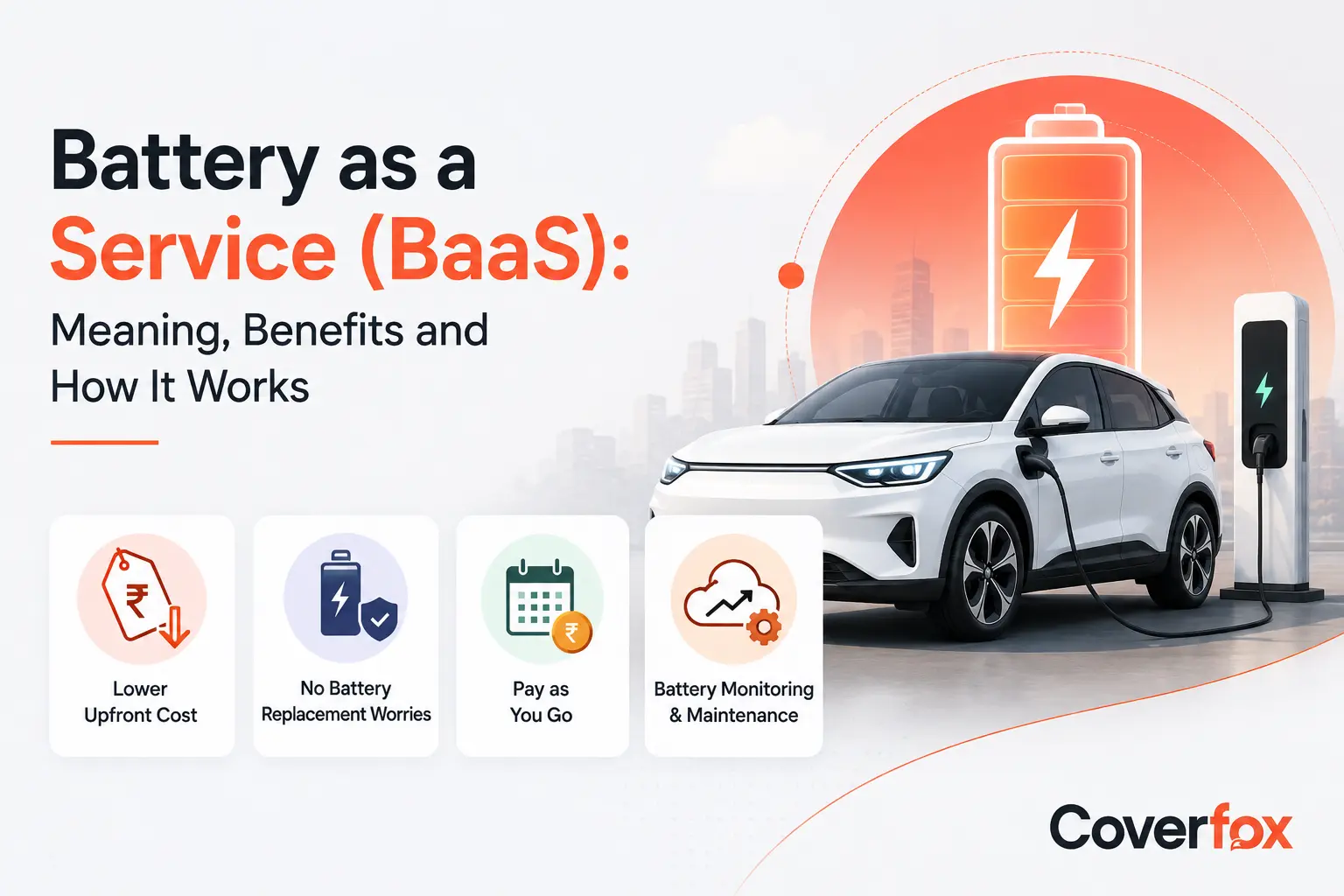
Electric vehicle prices in India carry one hidden weight: the battery, which can account for a hefty portion of what you pay at the showroom. Battery as a Service (BaaS) splits that cost out entirely, letting you buy the car and rent the battery separately. This guide breaks down what BaaS actually means, how it works, and whether it fits your driving habits, with real examples from EVs already selling in India under this model.
What is Battery as a Service (BaaS)?
BaaS is a purchase model where you buy an electric vehicle without its battery pack, then pay a separate subscription or per-kilometre fee to use the battery, rather than owning it outright.
Why was BaaS introduced?
Battery packs make up 35-50% of an EV's total cost in most cases, pricing many buyers out of the market entirely.
Decoupling the battery from the vehicle lets manufacturers advertise a lower entry price without changing the car itself.
It shifts battery degradation and replacement risk away from the buyer and onto the company leasing it out.
Example: Tata's Tiago EV facelift is priced at ₹6.99 lakh (ex-showroom) with the battery included. Under Tata's BaaS scheme, the same car starts at ₹4.69 lakh, with the battery rented separately at a per-kilometre rate. You save ₹2.3 lakh upfront and pay only for the charge you actually use.
How Does Battery as a Service Work?
For an EV, BaaS works as follows:
Buying the EV Without the Battery
The manufacturer sells you the vehicle body, motor, and electronics at a reduced price. The battery pack stays out of this transaction entirely and is priced or subscribed to separately.
Paying a Subscription
Depending on the manufacturer, you either pay a fixed monthly fee or a per-kilometre rate. Tata's BaaS scheme on the Tiago.ev and Punch.ev, for instance, charges around ₹2.6 per kilometre driven, billed based on actual usage rather than a flat monthly number.
Battery Replacement or Swapping
If the battery degrades below a usable threshold or fails, the provider replaces or repairs it, at no extra cost to you beyond the subscription in most agreements. Some two-wheeler BaaS models, like those from Ola Electric and Hero's VIDA, go a step further and let you swap a depleted battery for a charged one at a station rather than waiting to charge.
Battery Monitoring and Maintenance
Providers track battery health remotely, flag degradation early, and schedule maintenance or replacement before it becomes your problem. This is one part of ownership you're fully insulated from under BaaS.
Why is Battery as a Service Becoming Popular?
Battery as a Service is gaining popularity due to the following reasons:
Lower upfront vehicle cost: Removing the priciest single component from the sale price makes EVs accessible to buyers who'd otherwise stick with petrol or diesel.
EV affordability: BaaS narrows the price gap between an EV and its combustion-engine equivalent, sometimes closing it almost entirely at the point of purchase.
Faster adoption: Lower entry prices tend to pull hesitant first-time EV buyers off the fence faster than incentives or awareness campaigns alone.
Reduced ownership risk: Battery degradation, the single biggest long-term worry with EVs, becomes the provider's problem rather than yours.
Convenience: No need to worry about battery-related expenses or how battery health could affect the vehicle's long-term value.
Benefits of Battery as a Service
Lower purchase cost: Often ₹2-5.5 lakh less upfront, depending on the model and battery size.
Predictable monthly expenses: Per-kilometre or fixed subscription billing makes budgeting for running costs more straightforward than an unplanned replacement bill years down the line.
Access to newer battery technology: Some providers upgrade battery packs across their fleet over time, meaning your subscription could eventually connect you to a better battery than the one you started with.
Reduced battery degradation worries: Since you don't own the pack, its capacity fade over years of use isn't a resale or replacement headache for you.
Limitations of Battery as a Service
Monthly subscription costs: Over several years, per-kilometre or monthly fees can add up to more than what a replacement battery would have cost outright.
Dependency on provider network: If the company offering the subscription shuts down or exits the market, you're left with a vehicle and no clear path to a battery.
Battery ownership limitations: You can't sell, modify, or transfer the battery independently, since you never actually own it.
Availability in limited models: BaaS isn't offered across every EV in the market; it's currently limited to specific models from a handful of manufacturers.
Long-term cost considerations: For buyers planning to keep a vehicle for five-plus years, buying the battery outright often works out cheaper than a subscription over that period.
Battery as a Service vs Buying the Battery
| Factor | Battery as a Service (BaaS) | Buying the Battery |
|---|---|---|
| Initial vehicle cost | Lower, battery cost excluded | Higher, battery included in price |
| Monthly expenses | Ongoing subscription or per-km fee | None beyond regular charging costs |
| Ownership | Battery remains with the provider | You own the battery outright |
| Maintenance | Handled by the provider | Your responsibility, under warranty terms |
| Flexibility | Can suit shorter ownership periods | Better suited to long-term ownership |
| Resale implications | Vehicle resale value may need separate battery arrangement for the new owner | Battery health directly affects resale value |
Which Electric Vehicles in India Offer Battery as a Service?
As of mid-2026, BaaS has moved from a niche pilot to a genuine option across several mainstream EVs:
| Manufacturer | Model(s) with BaaS | Notes |
|---|---|---|
| Tata Motors | Tiago.ev, Punch.ev | Battery rented at a per-kilometre rate; both facelifted models offer the scheme |
| MG Motor (JSW MG) | Windsor EV, Comet EV | MG was among the first mainstream carmakers to introduce BaaS in India |
| Maruti Suzuki | e Vitara | BaaS introduced alongside the standard purchase option |
| Kia | Syros EV, Carens Clavis EV | Kia's Carens Clavis is currently the only MPV in India sold with a BaaS option |
Two-wheeler brands including Ola Electric, Ather Energy, TVS Motor, Hero MotoCorp (VIDA), and Honda have introduced their own BaaS or swappable-battery subscription plans as well, though the terms and pricing differ from the four-wheeler schemes above.
Availability changes often. Manufacturers add, modify, or discontinue BaaS schemes with little notice, so confirm current terms directly with the dealership before assuming a model still offers it.

Does Battery as a Service Affect EV Insurance?
Who Insures the Battery?
This depends entirely on the ownership structure. If the battery is leased, the leasing company insures it separately under its own commercial policy in most cases. If you own the vehicle outright without a BaaS arrangement, the battery is covered as part of your standard electric car insurance policy, since it's treated as a core vehicle component.
Does the Subscription Affect Insurance?
Yes, in one important way: your policy needs to reflect what you actually own. Insuring a vehicle's Insured Declared Value (IDV) as if it includes the battery, when the battery is leased, can lead to an inflated premium or a mismatch at claim time. Always disclose the BaaS arrangement to your insurer when buying or renewing car insurance on a BaaS vehicle.
What Happens if a Leased Battery is Damaged?
This is where BaaS agreements diverge sharply. Some providers bundle battery damage cover into the subscription fee itself. Others expect you to carry a separate policy or rider covering the leased battery, with liability spelt out in the leasing contract rather than your vehicle policy. Reading the BaaS agreement's fine print before signing matters as much as reading the insurance policy itself.
Should You Choose Comprehensive EV Insurance?
For any EV, BaaS or not, comprehensive car insurance remains the safer route over a third-party-only policy, given how expensive EV components are to repair or replace. On a BaaS vehicle specifically, confirm exactly what your comprehensive policy excludes, since a leased battery may already be covered under the provider's own insurance, and paying for overlapping cover wastes money.
Is Battery as a Service Right for You?
The answer is not a simple yes or a no; it depends on your requirements:
Daily City Commuters
Short, predictable daily distances make per-kilometre BaaS billing easy to estimate, and lower upfront cost matters more when the car is doing routine errands rather than long hauls.
High-Mileage Drivers
Per-kilometre subscription fees add up fast for drivers logging heavy monthly distances. Running the numbers against outright battery ownership before committing is worth the ten minutes it takes.
Fleet Owners
Predictable per-vehicle costs and someone else managing battery health across an entire fleet can simplify operations considerably, which is part of why commercial and fleet BaaS adoption has moved faster than individual consumer uptake.
First-Time EV Buyers
A lower entry price and zero battery-replacement anxiety make BaaS a genuinely useful way to trial EV ownership without the biggest long-term unknown hanging over the decision.
Budget-Conscious Buyers
If the upfront ₹2-5.5 lakh saving is what makes an EV purchase possible at all right now, BaaS solves an immediate affordability problem, even if it isn't the cheapest path over a five-year ownership horizon.
Common Misconceptions About Battery as a Service
You Never Own the Vehicle
False. BaaS separates battery ownership from vehicle ownership. You own the car outright; only the battery remains with the provider.
Battery Subscription Is Always Cheaper
Not necessarily. Over several years of ownership, subscription fees can exceed what buying the battery outright would have cost, particularly for high-mileage drivers.
Every EV Supports BaaS
Incorrect. BaaS is available only on specific models from select manufacturers, currently Tata, MG, Maruti Suzuki, and Kia among mainstream carmakers, not across the entire EV lineup in India.
Battery Swapping and BaaS Are the Same Thing
They're related but distinct. BaaS refers to the ownership and payment structure, not owning the battery, paying for its use instead. Battery swapping is a physical process, exchanging a depleted battery for a charged one at a station, which some but not all BaaS providers offer as part of their service.
Final Thoughts
Battery as a Service solves a real, specific problem: the high upfront cost that keeps EVs out of reach for many Indian buyers. It isn't automatically the cheaper option over the long run, and it isn't available on every model, but for city commuters, first-time EV buyers, and fleet operators managing multiple vehicles, it removes genuine friction from EV ownership. Whether it makes sense for you comes down to how far you drive, how long you plan to keep the vehicle, and whether the upfront saving matters more than the long-term math.
Frequently Asked Questions
What is Battery as a Service (BaaS)?
BaaS is a model where you buy an electric vehicle without its battery and pay a separate subscription or per-kilometre fee to use the battery instead of owning it.
Is Battery as a Service available in India?
Yes. As of 2026, Tata Motors, MG Motor, Maruti Suzuki, and Kia offer BaaS on select EV models, alongside multiple two-wheeler brands including Ola Electric, Ather, TVS, Hero MotoCorp, and Honda.
How is BaaS different from battery swapping?
BaaS is a financial and ownership structure, the battery is leased, not owned. Battery swapping is a physical process of exchanging a depleted battery for a charged one, which some BaaS providers use but which can also exist independently of any subscription model.
Is Battery as a Service cheaper than buying the battery?
It lowers the upfront cost significantly in most cases. Over a longer ownership period, particularly for high-mileage drivers, buying the battery outright can work out cheaper than ongoing subscription fees.
Who owns the battery in a BaaS model?
The manufacturer or a third-party provider retains ownership of the battery. You own the vehicle itself but pay to use the battery through a subscription or per-kilometre fee.
Does EV insurance cover leased batteries?
It depends on the specific BaaS agreement. Some providers insure the leased battery themselves; in other cases, you may need a separate policy or rider. Always confirm this with both your insurer and the BaaS provider before assuming coverage.
Can I buy the battery later?
This depends entirely on the manufacturer's terms. Some BaaS schemes allow buyers to switch to full ownership after a certain period; others don't offer this option at all. Check the specific agreement before signing.
Which EVs in India offer Battery as a Service?
Tata Tiago.EV and Punch.EV, MG Windsor EV and Comet EV, Maruti Suzuki e Vitara, and Kia Syros EV and Carens Clavis EV all offer BaaS as of mid-2026, alongside select two-wheeler models from Ola, Ather, TVS, Hero, and Honda.