Tesla is known for its software-first approach, industry-leading EV efficiency, advanced driver-assistance technologies, and premium electric vehicles that focus on performance and innovation. BYD has emerged as the world's largest EV manufacturer by sales volume, offering a diverse lineup of affordable and premium electric vehicles powered by its highly regarded Blade Battery technology. Both brands are shaping the future of electric mobility through continuous innovation, long-range EVs, advanced battery systems, and a growing global presence in the rapidly expanding EV market.
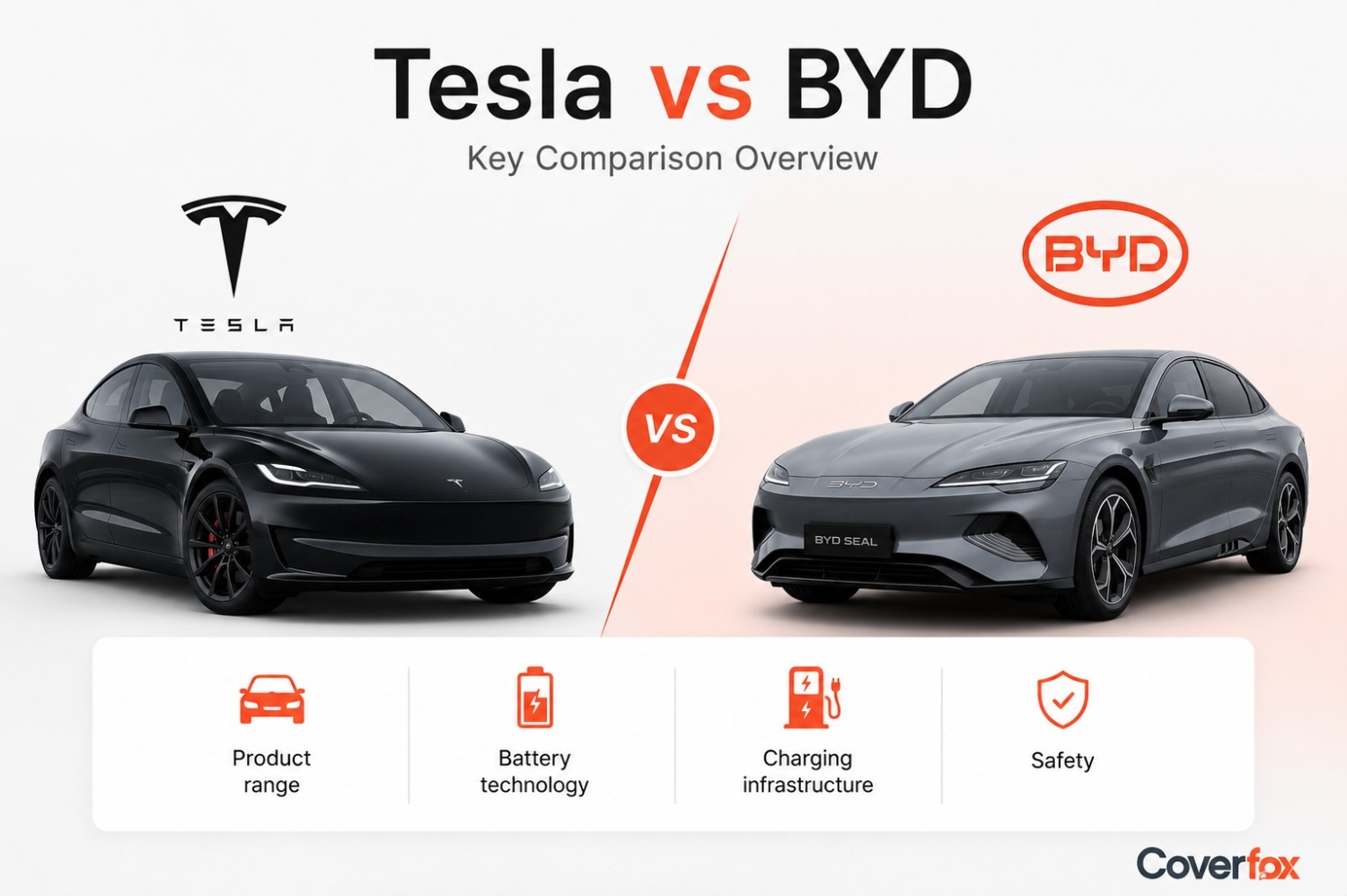
Tesla and BYD are unofficially the behemoths of EVs in the world. Tesla, the king of EVs, has remained dominant in the EV market, but on the other hand, BYD has also stepped into this industry and is prominently making its name, especially in the Asian markets. With the rise of EVs in India, the question arises: which EV should you choose? Tesla or BYD? Well, if you are confused about the same, do not worry; we have got you covered with this comprehensive guide for Tesla vs BYD EVs
Tesla vs BYD at a Glance
Here is a quick overview to get a gist of the differences between Tesla and BYD:
| Parameter | Tesla EVs | BYD EVs |
|---|---|---|
| Core Strategy | Pure-electric vehicles only | Battery EVs and plug-in hybrid EVs |
| Best-Selling EV | Model Y | Seagull (Dolphin Mini in some markets) |
| Typical Real-World Range | 450–600 km on mainstream models | 300–570 km on mainstream models |
| Battery Chemistry | Primarily LFP and NMC batteries sourced from multiple suppliers | Primarily in-house Blade LFP batteries |
| Energy Efficiency | Among the most efficient EVs globally (typically 12–15 kWh/100 km) | Typically 13–17 kWh/100 km depending on model |
| Fast-Charging Speed | Up to 250 kW on Tesla Superchargers | Generally 80–230 kW depending on model |
| Software Updates | Frequent over-the-air updates adding new features | OTA updates available, but less extensive |
| Driver Assistance | FSD and Autopilot ecosystem | God’s Eye ADAS and DiPilot systems |
| Vehicle Architecture | Highly software-defined vehicles | Strong focus on hardware integration and cost efficiency |
| Manufacturing Approach | Gigacasting, simplified production, fewer parts | Vertical integration from battery cells to semiconductors |
| Battery Production | Produces battery packs but sources many cells externally | Produces batteries, cells, motors, chips, and vehicles in-house |
| Vehicle Portfolio | Sedan, SUV, pickup truck | Hatchback, sedan, SUV, MPV, luxury EV, off-roader |
| Expected Entry-Level EV Price in India | ₹25–30 lakh (estimated) | ₹10–15 lakh (based on global entry-level models; not currently sold in India) |
| Premium EV Presence | Strong | Growing but smaller than Tesla |
| Main Competitive Edge | Efficiency, software, charging ecosystem | Affordability, battery technology, manufacturing scale |
Tesla vs BYD Vehicle Lineup Comparison
Here are the major vehicle lineups covered for different segments for Tesla vs BYD:
| Category | Tesla | BYD |
|---|---|---|
| Number of Mainstream Models | 5 major models | 20+ EV models globally |
| Entry-Level EV | Model 3 | Seagull, Dolphin |
| Compact Hatchback | Not offered | Seagull, Dolphin |
| Sedan Segment | Model 3, Model S | Qin, Seal, Han |
| SUV Segment | Model Y, Model X | Atto 3, Song, Sealion, Tang, Yuan |
| MPV Segment | Not offered | D9, M9 |
| Pickup Truck | Cybertruck | Shark Plug-in Hybrid Pickup |
| Luxury Sedan | Model S | Han, Yangwang U7 |
| Luxury SUV | Model X | Yangwang U8 |
| Performance EVs | Model 3 Performance, Model S Plaid, Model X Plaid | Seal Performance, Yangwang U9 |
| Off-Road Vehicles | Cybertruck (limited off-road focus) | Yangwang U8 with dedicated off-road capabilities |
| Plug-in Hybrid Models | Not offered | Extensive PHEV lineup across multiple segments |
| Commercial Vehicles | Limited | Electric buses, trucks, vans, and fleet vehicles |
| India Portfolio | Expected Model 3 and Model Y initially | Atto 3, Seal, Sealion 7 |
| Primary Target Audience | Premium EV buyers, technology enthusiasts | Mass-market buyers, families, premium buyers, and luxury customers |
| Vehicle Range Coverage | Mid-premium to luxury | Entry-level to ultra-luxury |
Design and Interior Experience
Both Tesla and BYD offer modern EV interiors, but they take very different approaches to design, technology, and user experience.
Tesla:
Tesla follows a minimalist design philosophy, with most controls integrated into a large central touchscreen and very few physical buttons. The cabins are clean, futuristic, and software-focused, appealing to buyers who prefer a technology-first driving experience. Features such as panoramic glass roofs, over-the-air updates, and advanced infotainment systems further enhance the premium feel.
BYD:
BYD adopts a more conventional yet premium approach, combining large touchscreens with physical controls for essential functions. Its interiors often feature higher levels of visual detailing, softer materials, ambient lighting, and comfort-focused elements that cater to family-oriented buyers. BYD's rotating touchscreen and feature-rich cabins offer a blend of modern technology and everyday practicality.
Performance and Driving Experience
Tesla and BYD deliver impressive electric performance, but their vehicles are tuned for different driving priorities and customer expectations.
Tesla:
Tesla vehicles are known for their rapid acceleration, precise handling, and class-leading power delivery. Models such as the Model 3 Performance and Model S Plaid offer sports-car-like performance, while the low centre of gravity from the battery pack enhances stability and cornering. Tesla also places a strong emphasis on driving dynamics and efficiency.
BYD:
BYD focuses on delivering a balanced driving experience that prioritises comfort, efficiency, and everyday usability. While performance-oriented models such as the Seal Performance offer strong acceleration, most BYD vehicles are tuned for smooth ride quality and practical urban driving. This approach makes them particularly appealing to families and daily commuters seeking a comfortable EV experience.

Tesla vs BYD: Which EV Battery Technology Is Better?
Best for Range & Efficiency: Tesla
Best for Safety: BYD
Best for Fast Charging: Tesla
Best for Durability: BYD
Best for Innovation: Tesla
Best Value for Money: BYD
Tesla's battery technology is designed to maximise energy efficiency, helping its EVs travel more kilometres on a single charge.
BYD's Blade Battery is widely recognised for its exceptional safety standards and resistance to overheating.
Tesla's battery ecosystem supports some of the fastest charging speeds available in mainstream EVs
The Blade Battery is known for its long lifespan and ability to withstand demanding operating conditions.
Tesla continues to push battery innovation through advanced battery management systems and next-generation cell technologies.
BYD's in-house battery production helps reduce costs, making its EVs more affordable without compromising reliability.
Verdict: Tesla leads in efficiency, performance, and charging technology, while BYD excels in safety, durability, and affordability. The better choice ultimately depends on what matters most to the buyer.
Which EV Has the Better Range?
Range is one of the most important factors for EV buyers, and both Tesla and BYD offer models capable of covering long distances on a single charge. However, Tesla generally holds an advantage in terms of driving efficiency and real-world range.
Longest Range EV: Tesla
Best Range Efficiency: Tesla
Best Value-for-Range: BYD
Best Range for Daily Use: BYD
Tesla's flagship models can deliver over 600 km of range on a single charge, making them some of the longest-range EVs available globally.
Tesla vehicles are known for extracting more kilometres from each kilowatt-hour of battery capacity, helping maximise range without requiring larger batteries.
BYD offers competitive driving ranges across multiple price segments, giving buyers strong range figures at a lower price point.
Most BYD EVs provide more than enough range for urban commuting and long-distance travel, making them practical for everyday use.
Verdict: Tesla currently leads in overall range and efficiency, while BYD delivers impressive range at a more accessible price. For buyers seeking the maximum distance per charge, Tesla has the edge, whereas BYD offers a better balance of range and affordability.
Technology and Safety Features
Technology and safety play a crucial role in the appeal of both Tesla and BYD vehicles. While Tesla is known for its software-driven ecosystem and advanced driver-assistance systems, BYD focuses on delivering comprehensive safety features and practical technology across its lineup.
Tesla:
Tesla has built its reputation around innovation, offering features such as over-the-air software updates, a highly intuitive infotainment system, and advanced driver-assistance technologies like Autopilot and Full Self-Driving (FSD). The company's software-first approach allows vehicles to gain new features and improvements long after purchase.
BYD:
BYD combines modern connectivity features with a strong emphasis on safety. Its vehicles come equipped with advanced driver-assistance systems, multiple active and passive safety technologies, and the highly regarded Blade Battery, which is designed to improve safety and durability. BYD also offers feature-rich cabins that cater to both convenience and everyday usability.
Verdict: Tesla has an advantage in software innovation and autonomous driving technology, while BYD excels in battery safety, practical features, and delivering strong technology offerings at a more accessible price point.
Pricing and Value for Money
Pricing is one of the clearest differences between Tesla and BYD, with each brand targeting a different segment of EV buyers.
Tesla:
Tesla's global lineup typically starts at around ₹25–30 lakh (estimated for India) and extends well beyond ₹70 lakh for premium models. Vehicles such as the Model 3 and Model Y focus on technology, efficiency, and performance, making Tesla a premium choice for buyers willing to pay more for advanced software and driving dynamics.
BYD:
BYD offers a much wider pricing spectrum, with entry-level global EVs such as the Seagull priced below ₹10 lakh (converted from Chinese pricing), while premium models can exceed ₹40–50 lakh. In India, models such as the Atto 3, Seal, and Sealion 7 are positioned between approximately ₹25 lakh and ₹55 lakh, providing strong range, features, and battery technology for the price.
Verdict: Tesla generally offers better software, efficiency, and brand appeal, but comes at a premium. BYD delivers more features, competitive range, and advanced battery technology at a lower cost, making it the stronger value-for-money proposition for most EV buyers. For buyers seeking the most affordable route into EV ownership, BYD has a clear advantage, while Tesla caters to those prioritising technology and performance over purchase price.
Tesla vs BYD: Which Brand Should You Choose?
So here is the final verdict:
Choose Tesla if you prioritise cutting-edge technology, class-leading efficiency, advanced software features, and strong driving performance. Tesla's vehicles are designed for buyers who want a premium EV experience with industry-leading connectivity and innovation.
Choose BYD if you are looking for better value for money, a wider range of vehicle options, proven battery technology, and a feature-rich ownership experience. BYD's diverse lineup and competitive pricing make it an attractive choice for both first-time EV buyers and families.
Ultimately, neither brand is universally better. Tesla excels in software, performance, and efficiency, while BYD stands out for affordability, battery innovation, and product variety. The right choice depends on your budget, driving needs, and the features that matter most to you, including car insurance considerations.
Related Articles:
Tesla Model Y vs BYD Sealion 7 - Range, Price & Features
Electric Car vs Petrol Car: Which Is Best for You?
Frequently Asked Questions
Is BYD bigger than Tesla?
Yes, BYD is currently larger than Tesla in terms of overall vehicle sales volume. BYD sells both battery electric vehicles (BEVs) and plug-in hybrid electric vehicles (PHEVs), giving it a broader market presence. Tesla, however, remains one of the world's most influential and valuable pure-EV brands.
Which company sells more EVs?
BYD currently sells more EVs than Tesla. In 2025, BYD sold approximately 2.26 million battery electric vehicles, compared to Tesla's 1.64 million deliveries, making BYD the world's largest EV seller.
Is BYD's Blade Battery better than Tesla's batteries?
Not necessarily. BYD's Blade Battery is known for its exceptional safety, durability, and cost efficiency, while Tesla's battery technology is designed to maximise energy density, efficiency, and driving range. The better choice depends on whether you prioritise safety or performance.
Does Tesla have better technology than BYD?
Tesla generally has an advantage in software, over-the-air updates, infotainment, and advanced driver-assistance technologies. BYD, on the other hand, excels in battery innovation, manufacturing integration, and delivering advanced features at more accessible price points.
Which brand should I choose: Tesla or BYD?
Choose Tesla if you want cutting-edge software, strong performance, and a premium EV experience. Choose BYD if you are looking for better value for money, advanced battery technology, and a wider variety of EV options across different price segments.
Are Tesla and BYD available globally?
Yes. Tesla operates across major markets in North America, Europe, Asia-Pacific, and the Middle East. BYD has rapidly expanded its presence across Europe, Latin America, Southeast Asia, Australia, India, and several other international markets.
Who is leading the global EV market in 2026?
BYD is currently leading the global EV market by sales volume, having overtaken Tesla in annual battery electric vehicle sales during 2025. Tesla remains one of the leading pure-EV manufacturers and continues to be a major force in EV technology and innovation.
Which is safer: Tesla or BYD?
Both brands offer excellent safety standards. Tesla consistently performs well in global crash tests and safety assessments, while BYD's Blade Battery is widely regarded as one of the safest EV battery technologies available today. There is no clear overall winner, as both prioritise safety in different ways.
Which offers better performance: Tesla or BYD?
Tesla generally has the advantage in acceleration, handling, and high-performance EVs. Models such as the Model 3 Performance and Model S Plaid are among the quickest production EVs in the world. BYD also offers strong-performing EVs, but its lineup is primarily focused on balancing performance with affordability and practicality.
Which has better charging support: Tesla or BYD?
Tesla currently has the stronger charging ecosystem thanks to its extensive Supercharger network and seamless charging experience. BYD supports fast charging across many models and continues to expand its charging capabilities, but Tesla remains the benchmark for charging convenience and infrastructure globally.
Disclaimer: The information provided is for general informational purposes only. Vehicle specifications, prices, and features may vary based on location, manufacturer updates, and market conditions. Users are advised to verify details with official brand sources or authorized dealers before making any purchase or insurance decisions.